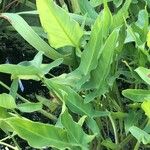
Peltandra virginica
Green arrow arum · Arrow Arum · Poison Arum · Tuckahoe · Virginia Peltandra
Description
Source: leafsnapPeltandra virginica, commonly known as arrow arum or tuckahoe, is a perennial aquatic plant belonging to the Araceae family. Native to North America, it thrives in wetlands, swamps, and marshes across the eastern United States. This plant features distinctive arrow-shaped leaves that can grow up to 12 inches long and 6 inches wide. The dark green leaves have prominent veins running through them. The flowers of Peltandra virginica are small and inconspicuous, growing on a spadix that is surrounded by a white or yellowish-green spathe. Peltandra virginica plays a crucial role in wetland ecosystems. It provides habitat for various aquatic animals such as fish and amphibians and helps improve water quality by filtering pollutants. Historically, Native Americans used Peltandra virginica for medicinal purposes. It was used to treat various ailments, including skin irritations, headaches, fever, and digestive issues. Overall, Peltandra virginica is an important aquatic plant that offers significant ecological benefits and holds cultural importance due to its medicinal uses throughout history.
💡 Carl Linnaeus first described this plant in 1753, naming it Arum virginicum. Over time, it has been reclassified into several different genera, including Alocasia, Caladium, Calla, and Lecontia, before finally being settled in the genus Peltandra. Like all other members of the Araceae family, Peltandra virginica is a toxic plant.
🌳 Green arrow arum provides distinct benefits to local wildlife, particularly acting as a food source for wetland animals like ducks. Its bright green spathe and nutrient-rich, starchy corm are appealing, yet its potential for human use has largely remained unexplored. Despite not being widely utilized for products such as pigments or spices, the plant functions as a quiet cornerstone in its ecosystem, essential to the diet of certain waterfowl.
🎭 Belief and innocence.
Care Guide
💧 Water Every 7 days
The green arrow arum thrives in swampy areas and requires consistently moist soil, as it does not tolerate drought. To ensure optimal growth, it should be watered every two weeks. Being a perennial herb, the green arrow arum flourishes outdoors, especially when its natural wetland conditions are replicated during its active growing season.
How should I water my Green arrow arum plant?
To water your Green arrow arum plant, there are several options you can consider. If you have a small potted arum indoors, you can easily bring it to your kitchen sink and use the faucet to add water. Hold the pot and wait until you see water coming out of the drainage holes to know when to stop watering. It's important to avoid doing this during winter or in cold climates as the cold temperature can harm the root system. Generally, using the faucet is fine for watering your Green arrow arum, unless the local tap water has a high level of fluorine, chlorine, or salts. In that case, you can use rainwater or lake water instead. Additionally, the Green arrow arum responds well to overhead watering or watering directly into the soil, so you can use a watering can, hose, or any other tool that suits your preference.
What should I do if I give my Green arrow arum too much or too little water?
If you realize that your Green arrow arum isn't getting enough water, start by giving it a thorough watering. Make sure to water until excess water drains out of the container or until the soil is completely moist if you grow it outside. On the other hand, if you notice that your Green arrow arum is getting too much water, reduce your watering schedule. It's also important to consider the soil and container that the plant is in. If water isn't draining well, the plant may become overwatered again. To fix this, transfer it to looser soil and a container with better drainage or a more porous material. Additionally, check the plant's location. If it's in a cramped spot, consider moving it to a window or near a door for better ventilation. Having well-ventilated plants can help prevent overwatering to some extent.
How frequently do I need to water my Green arrow arum?
The Green arrow arum does not need constant soil moisture. It is actually better to let the soil dry out between waterings. If you are growing this plant in a container, you can determine when to water by checking how dry the soil is. For example, if about half of the soil in the container is dry, it's time to water. You can check by feeling the soil with your fingers or using a soil moisture meter. If you're growing the Green arrow arum outdoors, you can water it about once every two weeks, unless it has recently rained.
How much water does my Green arrow arum require?
To water your Green arrow arum, wait until the top half of the soil has become dry. Then, add enough water to make the soil moist again. The amount of water needed depends on the size of your plant and container. For a small plant in a small to medium-sized container, one to two cups of water should be enough. Increase the volume of water for larger plants. To check if the soil is properly moist, stick your finger or a trowel into it. Alternatively, look for excess water draining from the bottom of the container.
How do I know if I am giving enough water to my Green arrow arum plant?
Both overwatering and underwatering can have negative effects on the health of your Green arrow arum plant. However, they manifest in slightly different ways. If your plant is not getting enough water, you may notice yellow leaves and brown, brittle leaf margins. On the other hand, if your plant is being overwatered, you may see both yellow and brown marks on the leaves. Overwatering can also lead to diseases like root rot, which may be visible on the plant. Fortunately, if you can recognize the signs of overwatering and underwatering, you can take the necessary steps to fix these issues.
☀️ Light Full sun
Green arrow arum does best with ample sunlight, which supports strong growth and vigor. Although it can tolerate moderate shade, reduced sun exposure may impede its development. Its adaptability is linked to originating in habitats that commonly receive abundant sunlight. Both excessive shade and overexposure can negatively affect its health.
What are the sunlight requirements for Green Arrow Arum?
Green Arrow Arum (Peltandra virginica) requires generous sun exposure to thrive, showing robust growth and vitality under full sun conditions. While it can tolerate moderate levels of shade, too little sun may impede its growth. As a plant adapted to habitats with abundant sunlight, its health may decline under excessive shade or overexposure. Watch the sunlight movement through your garden to find spots that ensure the perfect balance for your Green Arrow Arum, making them happy and healthy.
How does artificial lighting support indoor cultivation of Green Arrow Arum?
Artificial lighting plays a vital role for indoor Green Arrow Arum, especially when natural sunlight is insufficient, such as during winter or in less sunny spaces. Adequate lighting ensures optimal growth, with faster and healthier development. LED lights are recommended due to their ability to provide specific light wavelengths needed by the plants. For full sun plants, 30-50W/sq ft of artificial light is needed, partial sun plants require 20-30W/sq ft, and full shade plants need 10-20W/sq ft. The light source should be placed 12-36 inches above the plant, mimicking natural sunlight as closely as possible, and the plants should receive 8-12 hours of light per day.
What are the symptoms of incorrect lighting for Green Arrow Arum?
Symptoms of incorrect lighting for Green Arrow Arum include smaller new leaves compared to older ones, leggy or sparse growth due to increased stem or leaf spacing, early dropping of older leaves, decreased or halted new growth, pale new leaves indicating insufficient chlorophyll, chlorosis signifying chlorophyll breakdown and reduced photosynthesis from excessive sunlight, sunscald characterized by pale, bleached areas on plant tissues, leaf curling as a defense against extreme sunlight, wilting due to increased water loss from overexposure, and leaf scorching from too much sunlight.
How can you address inadequate sunlight for Green Arrow Arum?
To address inadequate sunlight for Green Arrow Arum, you can gradually increase light exposure by moving plants to sunnier spots, ensuring at least 6 hours of direct sunlight daily, especially near south-facing windows. If moving the plant is not feasible, consider supplemental artificial light, keeping a lamp on for at least 8 hours daily or using professional grow lights for sufficient illumination. For outdoor plants, avoid sudden changes in light to prevent sunburn. If parts of the plant have been affected by low light, they may not recover, but new growth should be healthy once light conditions improve.
What should you do to optimize sunlight for Green Arrow Arum planted in the ground?
To optimize sunlight for Green Arrow Arum planted in the ground, start by identifying and reducing obstructions, such as pruning branches that block sunlight. If dealing with smaller plants, consider transplanting during their dormant period, usually in late winter or early spring, to a location that offers ample sunlight and good drainage. This ensures the plant receives enough light for healthy growth.
🌡️ Temperature 5–35°C
The ideal temperature range for green arrow arum growth is 41℉ (5℃) to 95℉ (35℃). Native to wetlands and marshes, it prefers conditions that remain consistently cool and moist. In winter it can tolerate temperatures down to 23℉ (-5℃) as long as the ground is not frozen.
What is the optimal temperature range for Green Arrow Arum growth?
The optimal temperature range for the growth of Green Arrow Arum, also known as Peltandra virginica, is between 41°F (5°C) and 95°F (35°C). This plant is native to wetlands and marshes, environments that offer cool and moist conditions which it thrives in. It is important to maintain these temperature conditions for optimal growth.
Can Green Arrow Arum survive winter conditions?
Yes, Green Arrow Arum has strong cold resistance and can withstand winter temperatures as low as 23°F (-5°C), provided the ground is not frozen. Special frost protection measures are usually not necessary. However, in anticipation of temperatures dropping below the plant's tolerance limit, it's advisable to cover the plant with soil or straw for extra protection. Additionally, watering the plant abundantly before the first freeze in autumn helps the soil remain moist and prevents drought and water scarcity during the winter and early spring.
How does low temperature affect Green Arrow Arum, and what are the solutions?
Green Arrow Arum is cold-tolerant and performs best when the temperature is consistently cool. It should be kept above certain minimum thresholds during winter to avoid negative effects. If temperatures fall below its cold tolerance limit, there may not be immediate noticeable changes, but the plant might experience decreased sprouting or fail to sprout at all come springtime. The solution in spring for any affected parts that fail to sprout is to remove them to promote healthy growth of the plant.
What happens when Green Arrow Arum is exposed to high temperatures, and what can be done?
Exposure to high temperatures during summer can have detrimental effects on Green Arrow Arum. When the temperature goes beyond its tolerance, the plant's leaves may lighten in color, begin to curl, become prone to sunburn, and, in severe cases, the plant may wilt and dry out. To address this, sunburned and dried parts should be trimmed away. It's beneficial to relocate the plant to a shaded area or use a shade cloth to protect it from the midday and afternoon sun. Ensuring the soil remains moist by watering in the morning and evening will also help mitigate the effects of high temperatures.
💨 Humidity
🪴 Soil
🌱 Fertilizer
🪴 Pot & Repot Every 12 months
✂️ Pruning
The Green Arrow Arum, known for its arrow-shaped leaves, thrives in wetland areas. To maintain its health, prune the plant from early to late spring. This helps manage the foliage, remove dead leaves, and encourages healthy growth. Pruning also improves air circulation and prevents overcrowding, which is essential for the long-term vitality of the Green Arrow Arum.
🌿 Propagating
🐛 Diseases & pets
☠️ Toxicity
Characteristics
- Plant Type
- Herb
- Life Cycle
- Perennial
- Genus
- Peltandra
- Family
- Araceae
- Hardiness Zone
- 5-9
- Mature Height
- 91 cm
- Mature Spread
- 46 cm to 61 cm
- Leaf Color
- Green, Gray
- Leaf Type
- Deciduous
- Flower Color
- Green, White, Yellow
- Flower Size
- 6.35 cm to 25.40 cm
- Bloom Time
- Late spring, Early summer, Mid summer
- Planting Time
- Spring
- Harvest Time
- Mid summer
- Native Area
- Cuba