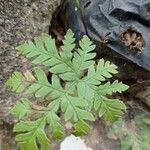
Pentagramma triangularis
Goldback fern · Western Gold Fern · Western goldfern · Goldenback fern · Gold fern
Description
Source: leafsnapPentagramma triangularis, commonly known as the gold fern or the goldback fern, is a species of fern in the family Pteridaceae, native to Western North America, with highest abundance in the state of California. Its common name "goldback" refers to the light yellow color of the fern's protective coating which inhibits moisture loss. The gold texture appears as a dry powder that is excreted on the underside of the fern. The Latin specific epithet Pentagramma derives from "five lines" or "stripes" while triangularis derives from "three sided", describing the shape of the fern's broad triangular fronds.
🎭 Captivation, Genuineness, Enchantment
Care Guide
💧 Water
The Silverback fern, which has its origins in woodlands, thrives in dappled light and moist soil. It generally prefers to be watered once a week to maintain the right moisture level, though it can tolerate short periods of dryness. When grown indoors as an understory plant, it is important to manage watering carefully in containers to avoid root rot.
☀️ Light Partial sun
Silverback fern is native to habitats like forest understories and rocky areas, where it grows in natural shade. It prefers partial sun but can adjust to full sun or full shade, showing its versatility and hardiness.
What are the sunlight requirements for Silverback Fern (Pentagramma triangularis)?
Silverback Fern, also known by its botanic name Pentagramma triangularis, thrives best in partial sun conditions, requiring about 3-6 hours of sunlight daily. It's essential to monitor the way sunlight moves through your garden to pick locations offering a mix of light and shade. Though it prefers partial sun, it can also grow in full shade, thanks to its native environments like forest understories or rocky areas. Remember, the right balance of light ensures the plant's growth and happiness.
How do you provide artificial lighting for indoor Silverback Fern plants?
When natural sunlight is insufficient for your Silverback Fern, particularly during winter or in less sunny spaces, artificial lighting can be a vital solution. LED lights are recommended as they can be tailored to emit specific light wavelengths needed by plants. For different plants: full sun plants require 30-50W/sq ft, partial sun plants 20-30W/sq ft, and full shade plants 10-20W/sq ft of artificial light. Position the light source 12-36 inches above the plant and ensure it receives 8-12 hours of light per day to mimic natural daylight conditions.
What are the symptoms of insufficient light in Silverback Ferns?
Silverback Ferns exhibit several symptoms when exposed to inadequate light: new leaves may grow smaller, the plant may develop leggy or sparse growth patterns, and there might be a faster drop of older leaves. Additionally, these ferns may experience slowed or ceased growth, lighter-colored new leaves indicating a lack of chlorophyll, chlorosis (yellowing of leaves), sunscald, leaf curling, wilting from overexposure to sunlight, and leaf scorching. These symptoms highlight the importance of providing optimal lighting conditions.
What solutions are available for Silverback Ferns experiencing light-related issues?
To address light deficiencies in Silverback Ferns, gradually accustom them to more sunlight by shifting them to sunnier spots each week until they attain 3-6 hours of direct sunlight daily. If the plant is large or not easily movable, supplement with artificial light, using a desk or ceiling lamp for at least 8 hours daily, or professional plant grow lights. For outdoor plants, avoid sudden light intensity changes to prevent sunburn. If necessary, prune nearby trees to reduce obstructions or consider transplanting smaller plants to sunnier locations during their dormant period, ensuring they have ample sunlight and good drainage.
🌡️ Temperature 10–35°C
The Silverback fern naturally grows in areas where the temperature ranges from 50 to 95 °F (10 to 35 °C). It flourishes optimally in these conditions. If the temperature drops or rises beyond these figures, it may be necessary to modify the environment using heating or air conditioning systems.
What is the native environment temperature range for Silverback fern?
Silverback fern, also known by its botanical name Pentagramma triangularis, is native to environments where the temperatures range between 50 to 95 °F (10 to 35 °C). It thrives best within these temperature parameters. Adjustments to the plant's environment with heating or cooling systems may be necessary if the temperature falls outside this range.
Does Silverback fern require special frost protection measures during winter?
Silverback fern possesses strong cold resistance and usually does not require special frost protection measures during winter. However, if temperatures are expected to drop below -25°C, it is crucial to offer some form of cold protection. This can include covering the plant with soil or straw and ensuring that the soil is abundantly watered before the first freeze of autumn, to keep it moist and prevent drought and water scarcity during winter and early spring.
How does low temperature affect Silverback fern, and what are the solutions?
Silverback fern is cold-tolerant and fares best when the temperature remains above 10°C. It should be kept above -15°C during winter. If temperatures fall below -25°C, there might be no noticeable changes during winter, but there could be a decrease in sprouting or even an absence of sprouting during spring. The solution for any parts of the plant that fail to sprout in spring is to remove them.
How does high temperature affect Silverback fern, and what are the solutions?
During summer, it is essential to keep Silverback fern below 35°C. If the temperature surpasses 38°C, the plant's leaves may become lighter in color, prone to curling, susceptible to sunburn, and, in severe cases, the entire plant may wilt and dry up. To combat these issues, trim away the sunburned and dried-up parts of the plant. Move the plant to a location that provides shade during the midday and afternoon sun or use a shade cloth. Additionally, water the plant in the morning and evening to keep the soil moist.
💨 Humidity
🪴 Soil 6-7
🌱 Fertilizer
Typically, a one-time application of fertilizer during spring is ample for the Silverback fern, though several feedings can optimize its development. Apply the feed roughly every one to one and a half months. Fertilizing not only enhances the appearance and performance of the leaves, fostering uniform color and a healthy texture, but also boosts root expansion and nutrient uptake, contributing to the overall wellbeing of the plant in the long run.
🪴 Pot & Repot
✂️ Pruning
The Silverback Fern is known for its graceful fronds, which are divided into three lobes and have shimmering silvery undersides. To encourage new growth and enhance air circulation, it is best to prune this plant from early to late spring. During pruning, remove any dead or damaged fronds. Be sure to use clean, sharp tools to promote quick healing and keep a neat appearance, particularly when used as ground cover.
🌿 Propagating
🐛 Diseases & pets
☠️ Toxicity
Characteristics
- Plant Type
- Herb
- Life Cycle
- Perennial
- Genus
- Pentagramma
- Family
- Pteridaceae
- Hardiness Zone
- 6-9
- Mature Height
- 30 cm
- Mature Spread
- 15 cm to 30 cm
- Leaf Color
- Green, Dark Green
- Leaf Type
- Evergreen
- Planting Time
- Spring, Autumn