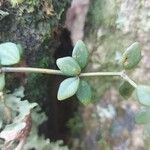
Peperomia tetraphylla
Acorn Peperomia
Description
Source: leafsnapPeperomia tetraphylla, known as the acorn peperomia or four-leaved peperomia, is a small plant in the Peperomia genus and the Piperaceae family that grows natively in tropical and subtropical regions around the world. Additionally in can found on the Easter Islands and Hawaii as introduced species.P. tetraphylla is an low-growing herb, with creeping stems, sometimes forming mats. The leaves are elliptic or round, growing in whorls of 3 to 4, typically green but might also be reddish on the underside. It grows in wet highland and evergreen forests, often as an epiphyte on top of trees or falles logs, but can also be found on rocky knolls or among grass by river banks.The specific epithet tetraphylla is from the Ancient Greek language, meaning "four leaves". It was first described in 1832 by W.J. Hooker and G.A. Walker-Arnott after a coastal survey of South America under the command of Captain F.W. Beechey.Three varieties are known: P. tetraphylla, Peperomia tetraphylla var. piedadeana, and Peperomia tetraphylla var. tenera.
💡 Acorn Peperomia plants have lush, succulent leaves that bring a vibrant green touch to any space. They make excellent tabletop displays and are perfect for brightening up the workplace. The presence of these green plants not only adds color but also lifts spirits and helps reduce stress.
🌳 The Acorn Peperomia is a succulent herb often seen in dish gardens. Its deep green leaves are highly valued, and its spreading habit makes it an excellent choice for ground cover. This plant is well-suited for coastal gardens and is frequently used in hanging baskets. For a striking color contrast, consider pairing Acorn Peperomia with petunias.
🎭 Impartial justice, belief, gentleman
Care Guide
💧 Water
The Acorn Peperomia flourishes in tropical climates that provide consistent moisture and high humidity. It prefers to be watered weekly, ensuring the soil remains moist but not waterlogged. This plant is well-suited for indoor growth, where conditions can mimic its natural environment. During its growing season, it's important to maintain proper watering to support its lush, evergreen foliage.
☀️ Light Partial sun
Acorn Peperomia generally thrives when given gentle sunlight for part of the day and can tolerate periods of shade. Its native habitat reflects this need for moderate light. Excessive light can burn its leaves, while insufficient light can impair photosynthesis and lead to stalled growth.
What are the sunlight requirements for Acorn Peperomia?
Acorn Peperomia, or Peperomia tetraphylla, thrives when exposed to mild sun rays for a portion of the day, typically requiring about 3-6 hours of sunlight to satisfy the partial sun requirement, and can survive in full shade with less than 3 hours of sunlight. It's vital to observe the movement of sunlight through your garden to locate areas that provide a good balance of light and shade, ensuring optimal growth and health of your plants.
How does insufficient or excessive sunlight affect Acorn Peperomia?
When Acorn Peperomia receives inadequate light, it may exhibit symptoms such as small leaves, leggy or sparse growth, faster leaf drop, slower or no new growth, lighter-colored new leaves, chlorosis (leaves losing green color), sunscald, leaf curling, wilting, and leaf scorching. These symptoms indicate either an excessive exposure to sunlight or a lack of adequate sunlight, affecting the plant's ability to photosynthesize efficiently, its structure, and overall health.
What can I do if my Acorn Peperomia is not getting enough light or is exposed to too much light?
To manage light conditions for your Acorn Peperomia, consider shifting the plant to sunnier spots gradually if it lacks light, aiming for 3-6 hours of direct sunlight daily. For indoor plants that are large or immobile, supplement with artificial light such as desk, ceiling, or professional plant grow lights for at least 8 hours daily. If the plant suffers from excessive light exposure, transition it carefully to an optimal lighting condition to avoid sunburn. For plants grounded outdoors, reducing obstructions or transplanting during the plant’s dormant period to a sunnier location with good drainage can also help improve light access.
How should I use artificial lighting for Acorn Peperomia?
If natural sunlight is insufficient for your Acorn Peperomia, especially during winter or in less sunny spaces, consider using artificial lights to provide the necessary illumination for optimal growth. LED lights are recommended due to their ability to be customized to different wavelengths beneficial for plant growth. For full sun plants, aim for 30-50W/sq ft; for partial sun plants, 20-30W/sq ft; and for full shade plants, 10-20W/sq ft of artificial light. The light source should be placed 12-36 inches above the plant, mimicking natural sunlight duration of 8-12 hours per day depending on the plant species’ needs.
🌡️ Temperature 20–37.8°C
The acorn Peperomia is native to habitats with temperatures between 20 and 38 ℃ (68 and 100 ℉). It prefers warm tropical conditions of 24 to 28 ℃ (75 to 82 ℉). In colder seasons, adjusting the temperature by 3 to 5 ℃ (5 to 9 ℉) is recommended to promote healthy growth and prevent stress.
What are the ideal growing conditions for Acorn Peperomia?
Acorn Peperomia, or Peperomia tetraphylla, thrives best in environments with temperatures ranging from 20 to 38°C (68 to 100°F), but it particularly prefers warm tropical temperatures within the range of 24 to 28°C (75 to 82°F). It has some tolerance to cold, generally remaining unaffected by temperatures above 0°C. However, if temperatures are expected to drop below freezing, protective measures like wrapping the plant with plastic film, fabric, or other materials are recommended. These measures should be removed once the temperature rises again to ensure the plant continues to grow healthily.
How does Acorn Peperomia react to low temperatures, and what should I do?
Acorn Peperomia has a moderate tolerance to low temperatures, preferring conditions above 20°C. It can survive the winter if kept above 0°C, but if temperatures fall below -5°C, the leaves might droop and, in severe cases, wilt and fall off. To mitigate frost damage, trim off the affected parts and, before facing low temperatures again, wrap the plant with non-woven fabric or cloth and set up a wind barrier for additional protection.
What are the effects of high temperatures on Acorn Peperomia, and how can I protect it?
During summer, it's crucial to keep Acorn Peperomia below 38°C. Exposing the plant to temperatures above 43°C can cause leaf discoloration, dry and withered leaf tips, curled leaves, and increased susceptibility to sunburn. To protect your plant, trim away sunburned and dried-up parts. Relocating the plant to a shadier spot or using shade cloth can protect it from the midday and afternoon sun. Ensuring the soil remains moist through watering in the morning and evening also helps mitigate the effects of high temperatures.
💨 Humidity normal (40-60%)
This plant will thrive in moderate humidity, which is probably the level in your home. However, misting it a few times a week can be very beneficial. Make sure the room has good ventilation.
🪴 Soil 6-7
🌱 Fertilizer
Acorn Peperomia responds well to regular, weak applications of fertilizer to encourage healthy leaf development. Apply fertilizer to Acorn Peperomia about once a month during the summer. Nitrogen is important for foliage, and providing nitrogen-rich fertilizers helps Acorn Peperomia do well.
🪴 Pot & Repot
When repotting Acorn Peperomia, choose a pot that is 1-2 inches (2.5–5.1 cm) larger in diameter and has good drainage. Use a well-draining potting mix, and consider adding perlite to improve drainage. Repot in spring or early summer, water thoroughly afterward, and keep it in a shady spot at first.
✂️ Pruning
The Acorn Peperomia is known for its trailing stems and round, succulent leaves. To encourage bushier growth, it's best to prune the plant from early to late spring. This involves trimming back leggy stems and removing any dead or yellowing leaves, which also helps improve air circulation and light penetration. For the best results, use clean, sharp scissors when pruning.
🌿 Propagating
🐛 Diseases & pets
☠️ Toxicity
Characteristics
- Plant Type
- Herb
- Life Cycle
- Annual
- Genus
- Peperomia
- Family
- Piperaceae
- Hardiness Zone
- 9-12
- Mature Height
- 10 cm to 30 cm
- Mature Spread
- 61 cm
- Leaf Color
- Green
- Leaf Type
- Deciduous, Evergreen
- Flower Color
- Yellow, Green
- Flower Size
- 0.10 cm
- Bloom Time
- All year round
- Planting Time
- Spring, Autumn
- Harvest Time
- All year round
- Native Area
- Sri Lanka, Lesotho, Belize, India, Mexico, Guatemala, Madagascar, Rwanda, Nigeria, Kenya, Uganda, Tanzania, Zimbabwe, Cuba, Sierra Leone, Indonesia, Cameroon, Liberia, Mozambique, Venezuela, Burundi, Brazil, Ethiopia, Nepal, Malawi, Honduras, Peru, South Africa, Zambia, Sudan, Philippines, Guinea, Panama, New Zealand, China, Colombia, Bolivia, Vietnam, Myanmar, El Salvador, Nicaragua, Eswatini, Bhutan, Ecuador, Costa Rica, Congo (DRC), Thailand