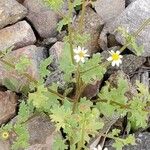
Perityle emoryi
Emory's rock daisy · Emory's rockdaisy · Emory's rocklily
Description
Source: leafsnapPerityle emoryi is a species of flowering plant in the aster family known by the common name Emory's rockdaisy. It is native to the Southwestern United States, northwest Mexico, and the Baja California Peninsula. It is a common wildflower of the deserts, and can also be found in California coastal regions. It grows in many types of habitat, it tolerates disturbance, and it can become somewhat weedy. The plant is also known from Chile and Peru and it is an introduced species in parts of Hawaii. Its distribution is apparently expanding.
🎭 Faithful affection, Tenderness, Purity
Care Guide
💧 Water
Emory's rockdaisy, which originates from arid regions, thrives with minimal moisture and is highly drought-tolerant. It requires watering only once a week, and planting it in well-draining soil helps prevent root rot, mirroring the conditions of its natural habitat.
How should I water my Emory's rockdaisy plant?
To water Emory's rockdaisy, you have various options such as a garden hose with a spray nozzle or a watering can. Emory's rockdaisy is not too particular about the type of water it receives and can thrive with rainwater, tap water, or filtered water. However, it's best to avoid watering this plant from above as it can harm the leaves and flowers and potentially cause disease. Instead, a drip irrigation system is recommended for watering Emory's rockdaisy as it provides even and direct watering to the soil. When it comes to container-grown Emory's rockdaisy, you can use a cup, watering can, or tap to water it directly into the soil.
What should I do if I give my Emory's rockdaisy too much water or not enough water?
The solution for an underwatered Emory's rockdaisy is simple: start watering it more regularly when you notice it lacks moisture. However, overwatering can be a more serious problem if not caught early. This can lead to diseases and the eventual decline and death of the plant. To prevent this, choose a suitable growing spot with ample sunlight to dry out the soil and good drainage that allows excess water to drain away instead of pooling. If your potted Emory's rockdaisy is overwatered, consider changing to a new pot with better drainage. When repotting, use loose soil and an efficiently draining pot.
How often do I need to water my Emory's rockdaisy?
Emory's rockdaisy requires regular watering throughout the growing season. In spring, water it once a week but as the season gets warmer, you may need to increase watering to two or three times a week. However, be careful not to overwater as it can harm the plant. Regardless of how often you water, make sure the soil remains moist but not wet. Watering Emory's rockdaisy in a pot is different. Generally, you'll need to increase watering frequency because pot soil can dry out faster. For container-grown rockdaisies, water them a few times per week compared to once a week for those planted in the ground.
How much water does my Emory's rockdaisy require?
Determining how much water to give to your Emory's rockdaisy can be done in a few ways. Some gardeners prefer to assess the soil moisture by feeling it, and they suggest watering until the top six inches of soil feel moist. Another approach is to use a specific measurement, like giving about two gallons of water per week, depending on the temperature and drying rate of the soil. However, sticking strictly to these guidelines may overwater the plant if it needs less water. When growing Emory's rockdaisy in a container, the watering method is different. You should ensure that all layers of dry soil are moistened, which can be checked by feeling the soil with your finger or observing a slight trickle of excess water from the drainage holes.
How do I know if I am giving enough water to my Emory's rockdaisy?
Avoiding overwatering your Emory's rockdaisy can be challenging. Although the plants have deep roots that need weekly moisture, they are highly prone to root rot. Overwatering can also cause browning in the plant. Underwatering is less of a concern since Emory's rockdaisy can survive for a while without supplemental watering. However, if you neglect to water the plant for too long, it will wilt and develop dry leaves.
☀️ Light Full sun
Emory's rockdaisy performs best when exposed to abundant light each day. Such strong exposure is a crucial factor for its healthy propagation. Originating from bright habitats, it is well adapted to those lighting conditions. If kept too shaded, its growth can be stunted, whereas excessive exposure can cause it to show signs of scorching.
What are the sunlight requirements for Emory's rockdaisy?
Emory's rockdaisy thrives best under full sun conditions, needing more than 6 hours of sunlight daily to flourish. Originating from environments rich in light, this plant adapts well to bright conditions and may suffer from stunted growth if overly shaded. However, excessive exposure without the proper balance can lead to signs of scorching. It's important to observe the movement of sunlight through your garden to find spots that offer an ideal mix of light and shade, ensuring the plant's happiness and health.
How does artificial lighting benefit indoor plants like Emory's rockdaisy?
Indoor plants, including Emory's rockdaisy, can greatly benefit from artificial lighting, especially when natural sunlight is insufficient, such as in winter or less sunny spaces. Artificial lights can promote faster, healthier growth by supplementing the light needed. For plants requiring full sun, 30-50W/sq ft of artificial light is suggested, while partial sun plants need 20-30W/sq ft, and full shade plants require 10-20W/sq ft. LED lights are especially beneficial as they can be customized to provide specific light wavelengths. The light source should be positioned 12-36 inches above the plant to mimic natural sunlight, and the lighting should last for 8-12 hours daily to simulate the length of natural daylight.
What symptoms indicate that Emory's rockdaisy is receiving insufficient light?
When Emory's rockdaisy doesn't get enough light, several signs may appear. These include smaller new leaves, leggy or sparse growth, faster leaf drop, and a cessation or slowing of new growth due to the plant entering a survival mode. Reduced light can also cause new leaves to appear lighter in color or pale, indicating a lack of chlorophyll and essential nutrients. Insufficient lighting leads to weaker plants that are more prone to damage and a reduced ability to photosynthesize effectively.
What are the consequences of overexposure to sunlight for Emory's rockdaisy?
Overexposure to sunlight can cause several issues for Emory's rockdaisy, including chlorosis (leaves turning yellow due to chlorophyll breakdown), sunscald (pale, bleached areas on plant tissue), leaf curling (as a defense mechanism to minimize water loss), wilting (due to increased water loss through transpiration), and leaf scorching (brown, dry edges on leaves). These symptoms reflect the stress and damage caused by too much sunlight, which can hinder the plant's ability to perform photosynthesis and maintain overall health.
How can you remedy light-related issues for Emory's rockdaisy?
To address light-related issues in Emory's rockdaisy, implementing solutions based on the plant's needs is crucial. For indoor plants, gradually moving them to sunnier locations or utilizing artificial light to ensure at least 6 hours of direct sunlight daily can be beneficial. Outdoors, gradually adapting the plants to increased sunlight while avoiding sudden changes in light intensity helps prevent sunburn. Reducing obstructions and possibly transplanting the plants can improve sunlight exposure. It’s important to note that parts of the plant affected by poor light may not recover, but new growth should be healthy with improved light conditions.
🌡️ Temperature 20–37.8°C
Emory's rockdaisy comes from a temperate habitat and performs best in temperatures of 68 to 100 °F (20 to 38 °C). It is important to keep conditions within this range and to adjust them with the seasons to prevent temperature stress.
What is the ideal temperature range for Emory's rockdaisy?
Emory's rockdaisy, known botanically as Perityle emoryi, thrives in temperate climates, with an ideal temperature range between 68 to 100 °F (20 to 38 °C). It's crucial to adjust the surrounding temperature according to seasonal variations to prevent temperature stress. Particularly fond of heat, Emory's rockdaisy can be negatively affected by cold temperatures. In the autumn, if grown outdoors, it is advised to bring the plant indoors, placing it near a bright window but at a safe distance from heaters to avoid overheating. During winter, maintaining temperatures above 20°C is beneficial for the plant's growth, as temperatures nearing or dropping to 0°C can be harmful.
How should I care for Emory's rockdaisy if it's exposed to low temperatures?
Emory's rockdaisy prefers warm environments and does not tolerate low temperatures well, thriving best when the temperature remains above 20°C. During winter, it is important to ensure that the temperature where the plant is kept does not fall below 0°C. Exposure to temperatures below -5°C can cause the leaves to lighten in color, and after frost damage, leaves may turn brown or black. This is often accompanied by wilting and drooping. To care for a frost-damaged Emory's rockdaisy, you should trim off the affected parts and move the plant indoors to a warm environment for protection against the cold. Place the plant near a south-facing window for ample sunlight while avoiding placing it near heaters or air conditioning vents, which could cause excessive dryness in the air.
What should I do if Emory's rockdaisy experiences high temperatures?
During the summer, care should be taken to ensure that Emory's rockdaisy is kept in conditions below 38°C to avoid heat stress. If the temperature exceeds 43°C, the plant's leaves may lighten, increasing susceptibility to sunburn. To manage this, trim away the sunburned and dried-up parts of the plant. Relocate the plant to a shaded area, particularly one that is shielded from the midday and afternoon sun. Additionally, it's beneficial to water the plant in the morning and evening to maintain soil moisture, which helps the plant cope with high temperatures.
💨 Humidity
🪴 Soil 5-7
🌱 Fertilizer
Emory's rockdaisy does well with regular, low-strength applications of fertilizer to encourage healthy leaf growth. Fertilize Emory's rockdaisy about once a month during the summer. Nitrogen is important for foliage, and providing nitrogen-rich fertilizer helps Emory's rockdaisy thrive.
🪴 Pot & Repot
✂️ Pruning
Emory's rockdaisy is a hardy perennial well-suited for desert climates. To encourage healthy growth, it benefits from light pruning in the early to late spring. During pruning, remove any spent flowers and damaged stems. Be sure to use clean tools to prevent the spread of disease and avoid over-pruning, as this can reduce stress on the plant and enhance its blooms and overall vitality.
🌿 Propagating
🐛 Diseases & pets
☠️ Toxicity
Characteristics
- Plant Type
- Herb
- Life Cycle
- Annual
- Genus
- Perityle
- Family
- Asteraceae
- Hardiness Zone
- 9-11
- Mature Height
- 2 cm to 61 cm
- Mature Spread
- 40 cm
- Leaf Color
- Green, Dark Green
- Leaf Type
- Evergreen
- Flower Color
- White, Yellow
- Flower Size
- 1.02 cm
- Bloom Time
- Late winter, Spring
- Planting Time
- Spring
- Harvest Time
- Mid spring, Late spring, Early summer, Mid summer
- Native Area
- Mexico, Peru