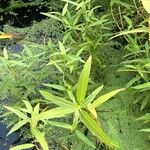
Persicaria amphibia
Water smartweed · Amphibious bistort · Water persicaria · Willow-grass · Water knotweed
Description
Source: leafsnapPersicaria amphibia, commonly known as water smartweed or amphibious bistort, is a perennial herbaceous plant that belongs to the family Polygonaceae. Native to Europe and Asia, this plant typically grows in shallow water bodies such as ponds, lakes, ditches, and slow-moving streams. Water smartweed has a prostrate or floating habit, with stems that can reach up to 1 meter in length. The lance-shaped leaves have pointed tips and are arranged alternately along the stem. The plant produces small, pinkish-white flowers that are organized into long spikes rising above the water surface. This plant serves as an important food source for aquatic animals, including ducks, geese, and fish. Additionally, it has medicinal properties; traditionally, its leaves have been used to treat skin conditions such as eczema. Water smartweed can be easily propagated from seed or by dividing mature plants during spring when new growth appears. It thrives in full sun but can tolerate partial shade. Overall, Persicaria amphibia is an intriguing aquatic perennial that adds beauty to any pond or lake while providing significant ecological benefits to surrounding wildlife habitats.
🌳 Often overlooked, water smartweed plays an interesting role in the diets of both people and animals. People eat its leaves as a leafy vegetable, and in some cultures they are valued for their nutritional content. Additionally, waterfowl—especially ducks—feed on water smartweed as a food source during migration. This dual role in providing sustenance highlights the plant’s cross-species importance beyond being just pond vegetation.
Care Guide
💧 Water Every 3 days
☀️ Light Full sun
Water smartweed grows best in a spot that gets abundant sunlight for most of the day. It can, however, tolerate locations with less sun. Too much or too little sun can affect the plant's health and vigour, and its native habitat is key to understanding its sunlight needs.
What are the sunlight requirements for Water Smartweed (Persicaria amphibia)?
Water Smartweed thrives in full sun, which means it needs above 6 hours of sunlight daily, but it can also cope with partial sun, requiring about 3-6 hours of sunlight. Observing how sunlight moves through your garden and choosing spots that provide the ideal balance of light and shade is crucial for the plant's health, ensuring its happiness.
What essentials should be considered for the healthy growth of Water Smartweed?
For healthy growth, Water Smartweed requires exposure to a sun-soaked position for most of the day but can tolerate areas with less sunlight. The amount of sun exposure directly influences the plant's health and vigor, with its originating habitat playing a key role in understanding its sun needs. If natural sunlight is insufficient, particularly in winter or less sunny spaces, artificial lighting can be a vital solution. Indoor plants benefit from LED lights, which can be customized to provide specific wavelengths needed by the plants. Full sun plants require 30-50W/sq ft of artificial light, partial sun plants need 20-30W/sq ft, and full shade plants need 10-20W/sq ft. The light source should be placed 12-36 inches above the plant to mimic natural sunlight, and the duration should mimic natural daylight hours, typically 8-12 hours per day.
What are the symptoms of insufficient or excessive light exposure in Water Smartweed?
Symptoms of insufficient light in Water Smartweed include smaller new leaves, leggy or sparse growth, faster leaf drop, slower or no new growth, lighter-colored new leaves, and symptoms of excessive light exposure comprise chlorosis (leaves losing their green color), sunscald (damage from intense sunlight), leaf curling (as a defense against excessive sunlight), wilting (due to high water loss from transpiration), and leaf scorching (brown, dry edges on leaves). These symptoms help identify whether the plant is receiving too much or too little sunlight.
What solutions are recommended for Water Smartweed experiencing light-related issues?
For indoor plants, gradually move them to sunnier locations each week till they receive at least 6 hours of direct sunlight daily. Utilize south-facing windows and keep curtains open during the day. If the plant is large or not easily movable, consider using artificial light, keeping a lamp on for at least 8 hours daily or investing in professional grow lights. Outdoors, gradually adapt plants to sunnier spots to avoid sunburn. It's crucial to avoid sudden changes in light intensity. If parts of the plant affected by insufficient sunlight may not recover, but new, healthy growth should appear with increased light exposure. Also, for ground plants, reduce obstructions like tree branches that block sunlight and, if necessary, transplant smaller plants during their dormant period to a location with ample sunlight and good drainage.
🌡️ Temperature 5–32.2°C
Water smartweed grows best in mild conditions, preferring temperatures from 41 to 89.6 °F (5 to 32 ℃). To ensure its growth through changing seasons, the temperature should be closely monitored and adjusted as needed.
What are the ideal growing conditions for Water Smartweed?
Water smartweed thrives best in mild conditions, with its ideal temperature range being between 41 to 89.6 °F (5 to 32 °C). To ensure its growth across variable seasons, it's important to maintain and adjust temperatures within this range. The plant has strong cold resistance, implying that special frost protection measures are typically unnecessary. However, in areas where winter temperatures might drop below -30°C, it's crucial to provide some cold protection by covering the plant with materials like soil or straw. Additionally, before the first autumn freeze, it's recommended to water the plant abundantly, ensuring the soil remains moist and is ready to enter a frozen state, which helps prevent drought and water scarcity during winter and early spring.
How does Water Smartweed react to low temperatures, and what should be done?
Water smartweed is cold-tolerant and fares best when temperatures stay above 5°C. During winter, it should remain above -25°C. If temperatures drop below -30°C, there might not be immediate visible changes, but there could be a decrease in sprouting or a failure to sprout in spring. The solution in spring for any parts of the plant that failed to sprout is to remove these parts to potentially foster new growth.
What are the effects of high temperatures on Water Smartweed, and how can they be mitigated?
During summer, it's crucial to keep Water smartweed's temperature below 32°C. Exceeding 35°C can cause the plant's leaves to lighten in color, become prone to curling, and susceptible to sunburn. In severe cases, the plant might wilt and dry out entirely. To mitigate these effects, trim away the parts of the plant that are sunburned and dried-up. Additionally, moving the plant to a shaded location or using a shade cloth to protect it from the midday and afternoon sun can be beneficial. Watering the plant in the morning and evening will help keep the soil moist and support the plant's health.
💨 Humidity
🪴 Soil
🌱 Fertilizer
🪴 Pot & Repot
✂️ Pruning
🌿 Propagating
🐛 Diseases & pets
☠️ Toxicity
Characteristics
- Plant Type
- Herb
- Life Cycle
- Perennial
- Genus
- Persicaria
- Family
- Polygonaceae
- Hardiness Zone
- 4-8
- Mature Height
- 0.2 m to 3.05 m
- Mature Spread
- 2.13 m
- Leaf Color
- Green
- Leaf Type
- Deciduous
- Flower Color
- Pink
- Flower Size
- 0.76 cm to 2.03 cm
- Bloom Time
- Early summer, Mid summer
- Planting Time
- Spring, Autumn
- Harvest Time
- Mid summer, Late summer
- Native Area
- Turkey, Sweden, India, Mexico, Slovakia, Montenegro, Pakistan, Slovenia, Morocco, Croatia, Belarus, Germany, Ethiopia, Romania, Latvia, Belgium, Portugal, Netherlands, Saudi Arabia, Tunisia, Bulgaria, Ukraine, Lebanon, China, Afghanistan, Syria, Kyrgyzstan, Kazakhstan, Italy, Japan, Mongolia, Finland, Iran, Azerbaijan, Lesotho, Austria, Yemen, Kenya, Uzbekistan, Russia, Iraq, Iceland, Estonia, South Korea, France, Nepal, Tajikistan, Czech Republic, South Africa, Armenia, Poland, Greece, Serbia, Lithuania, Norway, Spain, Switzerland, Denmark, Bhutan, Albania, Ireland, United Kingdom, Hungary, Algeria, Turkmenistan