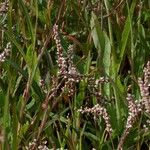
Persicaria decipiens
Slender knotweed · Willow-weed · Willow-leaved knotweed · Willow-leaved Persicaria
Description
Source: leafsnapPersicaria decipiens, commonly known as slender knotweed, is a species of flowering plant native to Australia and Asia.Persicaria decipiens is a trailing plant whose stems grow horizontally at first but become more vertical with time, reaching 30 cm (1 ft) high. Its narrow elliptic to lanceolate (spear-shaped) leaves are 5–12 cm (2–4.5 in) long and 0.5–1.3 cm (0.20–0.51 in) across. The slender pink flower spikes appear from November to June, with a peak in February. Cylindrical in shape, they are not stiff and tend to bend over. The plant tends to die back in winter and regenerate after water.Persicaria decipiens was among the plants collected by Joseph Banks and Daniel Solander on 5 May 1770 at Botany Bay during the first voyage of Captain James Cook. Prolific Scottish botanist Robert Brown described the species as Polygonum decipiens in his 1810 work Prodromus Florae Novae Hollandiae et Insulae Van Diemen. It was given its current name by Karen Wilson in 1988 as the broadly defined genus Polygonum was split into smaller genera. Common names include slender knotweed, willow weed and snake root. P. decipiens is found in water and wet soil. It is found across Africa and the Mediterranean, through southwestern Asia, Malesia and all states of Australia, as well as Norfolk Island, New Zealand and New Caledonia. It has become naturalised in Madagascar.Likely pollinators of its flowers are insects, including honeybees, native bees, flies, wasps and small butterflies.Persicaria decipiens is not cultivated but is eaten locally in times of famine in Africa.
Care Guide
💧 Water
Slender knotweed flourishes in moist environments and requires steady moisture levels to thrive. It benefits from weekly watering to maintain its vigor, taking advantage of seasonal rains when grown outdoors. This aligns its growth cycle with the natural availability of water.
☀️ Light Full sun
Native to areas with abundant sunlight, slender knotweed performs best with plenty of light. It can adjust to lower-light conditions and still grow and prosper. However, both insufficient and excessive light can restrict its growth, resulting in a weaker, less healthy plant.
What are the sunlight requirements for Slender knotweed?
Slender knotweed requires full sun, which is above 6 hours of sunlight daily, to thrive optimally. However, it can also grow under partial sun conditions, with about 3-6 hours of sunlight. It's important to watch how sunlight moves through your garden, choosing spots that offer a good balance of light and shade to ensure the plant's happiness.
How does artificial lighting benefit indoor Slender knotweed plants?
Indoor Slender knotweed plants benefit significantly from artificial lighting, especially when natural sunlight is insufficient, like in winter or less sunny spaces. Artificial lights, like LED lights, can be customized to provide specific wavelengths needed by the plant. The right artificial light setup involves selecting the correct wattage (30-50W/sq ft for full sun plants, 20-30W/sq ft for partial sun plants, and 10-20W/sq ft for full shade plants), positioning the light source 12-36 inches above the plant, and ensuring it receives 8-12 hours of light per day to mimic natural sunlight conditions and promote healthier growth.
What are the symptoms of light deficiency in Slender knotweed?
Symptoms of light deficiency in Slender knotweed include smaller new leaves, leggy or sparse growth, faster leaf drop, slower or no new growth, lighter-colored new leaves, chlorosis (leaves turning yellow), sunscald on leaves, leaf curling, wilting, and leaf scorching. These symptoms indicate that the plant is not receiving adequate sunlight, affecting its growth and overall health.
How can I address insufficient light for my Slender knotweed?
To address insufficient light for Slender knotweed, gradually move the plant to a location with at least 6 hours of direct sunlight daily, if indoors, consider using a south-facing window or artificial lighting such as a desk or ceiling lamp for at least 8 hours daily or invest in professional plant grow lights. Outdoors, move the plant to a sunnier spot gradually each week to avoid shock. Reducing obstructions like pruning trees or transplanting to a better-lit location can also help improve sunlight exposure. Note that parts of the plant affected by insufficient light may not recover fully, but new growth should be healthy with increased light exposure.
🌡️ Temperature 20–41.1°C
Slender knotweed is native to areas that experience a pronounced temperature range of 68 to 105.8 °F (20 to 41 ℃). It grows best under those conditions. Seasonal changes may require adjustments to maintain these temperatures.
What is the ideal temperature range for Slender knotweed?
Slender knotweed, or Persicaria decipiens, thrives in a notable temperature range of 68 to 105.8 °F (20 to 41 °C). It's essential to maintain these temperatures for optimal growth. In environments that seasonally deviate from this range, adjustments may be necessary, including moving the plant indoors during autumn to avoid cold temperatures. Keeping the plant above 20°C during winter is beneficial, as temperatures approaching 0°C can be detrimental.
How does low temperature affect Slender knotweed, and what are the solutions?
Slender knotweed prefers warm temperatures and does not tolerate low temperatures well, thriving best when the temperature is above 20°C. Exposure to temperatures below -5°C may cause the leaves to lighten in color. Frost damage can lead the color to turn brown or black, with symptoms such as wilting and drooping. To address this, trim off frost-damaged parts and move the plant to a warm environment indoors, ideally near a south-facing window for sunlight. It's also important to avoid placing it near heaters or air conditioning vents to prevent air dryness.
How does high temperature affect Slender knotweed, and what are the solutions?
During summer, it's crucial to keep Slender knotweed's temperature below 41°C. When temperatures exceed 45°C, the leaves may become lighter, indicating stress and increased susceptibility to sunburn. Solutions include trimming away sunburned and dried-up parts and moving the plant to a shaded location, especially from the midday and afternoon sun. Additionally, watering the plant in the morning and evening helps keep the soil moist, aiding in temperature management.
💨 Humidity
🪴 Soil 6-7
🌱 Fertilizer
Slender knotweed requires the most fertilizer during its active growth phase, which occurs mainly in spring, summer, and early fall. Fertilizing supplies essential nutrients the soil may lack, encouraging healthy root and stem development and the attractive foliage that is a key characteristic of this plant.
🪴 Pot & Repot
✂️ Pruning
To help slender knotweed thrive, it's important to prune it regularly from early to late spring. This care promotes the growth of its graceful stems and lovely pinkish flowers. Key pruning techniques include removing dead stems and thinning out crowded areas to improve airflow. This results in improved growth, increased flower production, and overall enhanced vitality for the plant.
🌿 Propagating
🐛 Diseases & pets
☠️ Toxicity
Characteristics
- Plant Type
- Herb
- Life Cycle
- Perennial
- Genus
- Persicaria
- Family
- Polygonaceae
- Hardiness Zone
- 9-13
- Mature Height
- 30 cm
- Mature Spread
- 15 cm
- Leaf Color
- Green, Dark Green
- Leaf Type
- Deciduous
- Flower Color
- Pink, White
- Flower Size
- 0.25 cm to 0.51 cm
- Bloom Time
- Summer, Fall
- Planting Time
- Spring, Summer, Autumn, Winter
- Harvest Time
- Late summer, Fall, Early winter
- Native Area
- Sri Lanka, Libya, Somalia, Lesotho, Turkey, India, Egypt, Angola, Namibia, Rwanda, Nigeria, Morocco, Yemen, Kenya, Uganda, Tanzania, Zimbabwe, Niger, Mali, Benin, Iraq, Sierra Leone, Cameroon, Liberia, Mozambique, Burundi, Ghana, Ethiopia, Botswana, Portugal, France, Malawi, Congo, Central African Republic, Tunisia, South Africa, Zambia, Sudan, Philippines, Cyprus, Bulgaria, Greece, Bangladesh, Guinea, New Zealand, Chad, China, Italy, Spain, Myanmar, Israel, Togo, Senegal, Iran, Côte d'Ivoire, Albania, Algeria, Gambia, Gabon