Persicaria lapathifolia
Pale knotweed · Smartweed · Pale persicaria · Pale smartweed · Pink knotweed
Description
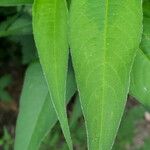
Source: leafsnapPersicaria lapathifolia, commonly known as pale smartweed or nodding smartweed, is an herbaceous plant belonging to the family Polygonaceae. Native to North America, you can typically find it in wetlands, marshes, and along the edges of streams and ponds. The plant features a slender stem that can grow up to 1 meter in height. Its leaves are alternately arranged, lance-shaped or oval with pointed tips, and green on top with a pale underside. Prominent veins run through each leaf. The flowers of Persicaria lapathifolia are small and pinkish-white, arranged in long spikes at the ends of the stems. They bloom from July through September. Native Americans have historically used this plant for medicinal purposes to treat various ailments such as diarrhea, fever, and sore throat, among others. In addition, Persicaria lapathifolia serves as an important food source for waterfowl like ducks, while its seeds provide nourishment for small mammals such as rodents. Overall, this plant plays a significant role in maintaining ecological balance by providing habitat for wildlife and serving medicinal purposes, making it a valuable addition to any ecosystem it inhabits.
💡 Curlytop Knotweed quietly stands on the dark green grassland slope, its pink flowers peeking through the greenery. When the wind blows, it sways among the leaves like a group of elves dancing. At night, it resembles stars twinkling in the sky, decorating the lush green grass with their delicate glow.
🌳 Historically, folk healers brewed an infusion from curlytop Knotweed roots to treat diarrhea and hemorrhage. Although those medicinal applications are now largely forgotten, curlytop Knotweed has drawn interest for its capacity to remove soil pollutants such as cadmium and lead, functioning much like a natural purifier. Beekeepers frequently grow curlytop Knotweed to attract bees. While it is technically edible, it is not celebrated for its flavor. A little-known use of curlytop Knotweed is in producing natural green dyes.
🎭 Energetic
Care Guide
💧 Water Every 7 days
Curlytop Knotweed thrives in its natural environment when it receives regular watering, ideally once a week, without becoming waterlogged. Its adaptability means it can grow well outdoors in various climates, requiring less irrigation in areas with frequent rainfall.
How should I water my Curlytop Knotweed?
Watering Curlytop Knotweed can be done using various common watering tools such as a garden hose with a spray nozzle or a watering can. This plant is not too particular about the type of water it receives since it can thrive with rainwater, tap water, or filtered water. It is advisable to avoid watering from overhead as this can harm the leaves and flowers and potentially lead to disease. Setting up a drip irrigation system is often the best method for watering Curlytop Knotweed, as it ensures even and direct application of water to the soil. When watering a container-grown Curlytop Knotweed, the same principles apply but you can use a cup, watering can, or tap water to directly supply water to the soil.
What should I do if I give my Curlytop Knotweed too much or too little water?
To prevent underwatering, simply water your Curlytop Knotweed more regularly when you notice it lacks moisture. Overwatering is a more serious issue that can lead to diseases and the plant's decline and death. To avoid overwatering, choose a sunny location with good drainage to allow excess water to drain away. If you overwater a potted Curlytop Knotweed, consider changing it to a new pot with better drainage and loose soil.
How frequently should I water my Curlytop Knotweed?
Curlytop Knotweed requires regular watering throughout its growing season. In the spring, you should aim to water it once every week. As the season progresses and it gets warmer, you may need to increase the frequency to two or three times a week. However, be cautious not to overwater, as it can harm the plant. It is important to keep the soil moist, but not wet, regardless of how often you water. Watering Curlytop Knotweed in a pot differs slightly. Potted plants require more frequent watering, as the soil in the pot heats up and dries out faster than ground soil. Typically, you would water a potted Curlytop Knotweed a few times per week, compared to once per week for a plant in the ground.
How much water does my Curlytop Knotweed require?
To determine how much water to give your Curlytop Knotweed, there are a few options. Some gardeners prefer to check the soil moisture by feeling it and water until the top six inches feel moist. Another approach is using a set measurement, like two gallons per week, taking into account the temperature and rate of soil drying. However, be cautious to avoid overwatering if your plant needs less. When growing in a container, you'll need a different method. Moistening all dry soil layers is generally recommended. Test this by checking for moisture with your finger, or observe a slight trickle of excess water from the drainage holes.
How can I know if I'm giving enough water to my Curlytop Knotweed plant?
Avoiding overwatering your Curlytop Knotweed can be challenging because these plants have deep roots and need weekly watering. However, they are also prone to root rot and may turn brown if overwatered. Underwatering is less of a concern as these plants can survive without extra water for a while, but if you wait too long, they may wilt and develop dry leaves.
☀️ Light Full sun
Curlytop Knotweed does best where it gets abundant sunlight. It can, however, tolerate moderate sun fairly well. Too much shade can hinder its growth, and an excess of light may also cause damage. Its original habitat consisted of open, well-exposed areas.
What are the sunlight requirements for Curlytop Knotweed?
Curlytop Knotweed requires an environment well-saturated with sun exposure but can also manage in moderate sun exposure. The plant thrives best in full sun, which is defined as above 6 hours of sunlight daily, and can tolerate partial sun, about 3-6 hours of sunlight. It's important to monitor the sunlight patterns in your garden to ensure spots provide the ideal balance of light and shade, accommodating the plant's needs for optimal growth.
What should I know about artificial lighting for Curlytop Knotweed?
When natural sunlight is insufficient, especially indoors or during less sunny seasons, artificial lighting can be crucial for Curlytop Knotweed's growth. Indoor plants benefit significantly from LED lights, which can be customized to emulate the specific light spectra needed. Full sun plants require 30-50W per square foot, partial sun plants need 20-30W per square foot, and full shade plants should have 10-20W per square foot. Position the light source 12-36 inches above the plant, and simulate natural daylight hours by keeping the lights on for 8-12 hours per day.
What are the symptoms of light deficiency or overexposure in Curlytop Knotweed?
Curlytop Knotweed may exhibit various symptoms under inadequate light or excessive sunlight. Light deficiency can lead to smaller leaves, leggy growth, faster leaf drop, slower or no new growth, and lighter-colored new leaves. Conversely, too much sunlight can cause chlorosis (yellowing of leaves), sunscald, leaf curling, wilting, and leaf scorching. These symptoms reflect the plant's struggle either to absorb sufficient light or to protect itself from light damage.
What proactive steps can I take to address light exposure issues with Curlytop Knotweed?
For indoor plants, gradually relocate the plant to achieve at least 6 hours of direct sunlight daily. Utilize south-facing windows and keep obstructions like curtains away during daylight. If the plant is large, consider supplementing with artificial light for about 8 hours a day. Outdoors, acclimate your plant to brighter conditions by progressively moving it to sunnier spots. If sunlight is blocked by physical structures or trees, you may need to prune or relocate the plant to a more suitable location to ensure it receives adequate sunlight. Remember, damaged parts might not recuperate, but proper light exposure will promote healthy new growth.
🌡️ Temperature 15–35°C
Curlytop Knotweed originates from temperate regions and does best in temperatures between 68 and 95°F (20 to 35℃). Making seasonal adjustments to replicate natural temperature fluctuations is beneficial.
What are the essential care tips for Curlytop Knotweed?
Curlytop Knotweed, botanically known as Persicaria lapathifolia, is indigenous to temperate regions and prefers temperatures between 68 to 95°F (20 to 35°C). It adapts well to seasonal temperature variations that mimic its natural habitat. The plant is notably resilient to cold; hence, special frost protection measures are typically unnecessary. Nevertheless, in areas where winter temperatures might plunge below -15°C, it's crucial to shield the plant using soil or straw for insulation. It's also advisable to water the plant abundantly before the first freeze in autumn to ensure the soil is moist and enters a frozen state, which helps to prevent drought and water scarcity during the winter and early spring.
How does Curlytop Knotweed react to low temperatures?
Curlytop Knotweed shows remarkable tolerance to cold, thriving optimally at temperatures above 20°C. However, during the winter season, it's essential to maintain temperatures above 0°C to ensure the plant's well-being. In instances where temperatures drop below -15°C, the plant may not exhibit noticeable changes immediately but could experience reduced or absent sprouting in the spring. To manage this, it is recommended to remove any parts of the plant that have failed to sprout in spring.
What should be done if Curlytop Knotweed is exposed to high temperatures?
During the summer months, it is crucial to prevent Curlytop Knotweed from being exposed to temperatures exceeding 35°C. Exposure to temperatures above 41°C can result in the leaves turning lighter in color, becoming prone to curling, suffering from sunburn, and in severe cases, leading to the wilting and drying out of the plant. To mitigate these effects, trim away sunburned and dried parts of the plant. It is also advisable to relocate the plant to a spot with shade during the midday and afternoon sun, or alternatively, use a shade cloth. Ensuring the soil remains moist by watering the plant in the morning and evening can also help in reducing stress on the plant due to high temperatures.
💨 Humidity normal (40-60%)
This plant will thrive in moderate humidity, which is probably the level in your home. However, misting it a few times a week can be very beneficial. Make sure the room has good ventilation.
🪴 Soil 6-7
🌱 Fertilizer
Curlytop Knotweed responds well to regular, dilute fertilizer applications to encourage healthy leaf development. Fertilize Curlytop Knotweed about once a month during the summer. Nitrogen is important for foliage, so supplying nitrogen-rich sources helps the plant thrive.
🪴 Pot & Repot Every 12 months
When repotting Curlytop Knotweed, pick a pot that's 1–2 inches (2.5–5.1 cm) larger in diameter and has good drainage. Use a well-draining potting mix, and consider adding perlite for extra drainage. Repot in spring or early summer, water thoroughly afterward, and keep it in a shady spot at first.
✂️ Pruning
🌿 Propagating
🐛 Diseases & pets
☠️ Toxicity
Characteristics
- Plant Type
- Herb
- Life Cycle
- Annual
- Genus
- Persicaria
- Family
- Polygonaceae
- Hardiness Zone
- 7-10
- Mature Height
- 40 cm to 91 cm
- Mature Spread
- 91 cm
- Leaf Color
- Green
- Leaf Type
- Deciduous
- Flower Color
- Pink, White
- Flower Size
- 0.51 cm to 1.27 cm
- Bloom Time
- Early summer, Mid summer
- Planting Time
- Spring, Summer, Autumn
- Harvest Time
- Mid summer, Late summer
- Native Area
- Egypt, Turkey, Sweden, India, Austria, Mexico, Pakistan, Morocco, Yemen, Belarus, Uzbekistan, Russia, Iraq, Germany, Indonesia, Ethiopia, Romania, Belgium, Portugal, Nepal, Netherlands, France, Tunisia, Georgia, Philippines, Cyprus, Bulgaria, Poland, Turkmenistan, Greece, Bangladesh, Ukraine, China, Norway, Afghanistan, Italy, Kazakhstan, Spain, Switzerland, Vietnam, Myanmar, Mongolia, Israel, Finland, Denmark, Iran, Albania, Ireland, United Kingdom, Hungary, Algeria, Thailand