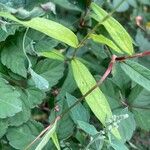
Persicaria longiseta
Bristly lady's-thumb · Oriental Lady's Thumb · Oriental Smartweed · Long-bristled Smartweed · Low Smartweed
Description
Source: leafsnapPersicaria longiseta is a species of flowering plant in the knotweed family known by the common names Oriental lady's thumb, bristly lady's thumb, Asiatic smartweed, long-bristled smartweed, low smartweed, Asiatic waterpepper, bristled knotweed, bunchy knotweed, and tufted knotweed. It is native to Asia (China, India, Russia, Japan, Malaysia, etc.), and it is present in North America and Europe as an introduced species and often a weed.Persicaria longiseta is an annual herb with stems 30 to 80 centimeters (12–32 inches) long, sometimes reaching one meter (40 inches). The hairless, branching stems may root at lower nodes that come in contact with the substrate. The leaves are lance-shaped and up to 8 centimeters (3.2 inches) long by 3 cm (1.2 inches) wide. They have bristly ochrea. The inflorescence is an elongate cluster up to 8 centimeters (3.2 inches) long and contains many pink flowers. The fruit is a small, smooth achene.In its native region this plant is a common weed of rice paddies. It was introduced to North America near Philadelphia around 1910 and probably spread via the railroads. It is present in much of the eastern United States and much of Canada. It grows in moist habitat types such as wetlands, as well as dry and upland habitat. It can be found in meadows, marshes, mudflats, riverbanks, floodplains, levees, and lowland and upland forests. It is invasive in some areas.
💡 This plant was discovered in Philadelphia around 1910. It is a type of rice field weed that is difficult to remove due to its strong ability to thrive in wetlands, riverbanks, grasslands, moors, and mudflats.
🌳 Oriental lady's thumb is a versatile plant that can be a great addition to outdoor gardens due to its ability to thrive in various sun, soil, and water conditions. It produces attractive pink flowers that bloom from summer to early fall, making it a colorful enhancement to backyard gardens.
🎭 Dependence
Care Guide
💧 Water
The oriental lady's thumb plant thrives in consistently moist environments and requires weekly watering to maintain optimal health. Although it is adaptable and can survive short periods of dryness, this plant grows best in outdoor settings near water bodies. Its growth is closely tied to water availability, flourishing when it is properly hydrated.
☀️ Light Full sun
Oriental lady's thumb grows best when exposed to a generous amount of sunlight during the day. It can also tolerate partial shade, which allows the plant to adjust and persist in less bright conditions. Both too much and too little sun can reduce its growth and vigor. Native to sunny habitats, oriental lady's thumb is adapted to those light conditions.
What are the sun requirements for Oriental lady's thumb?
Oriental lady's thumb requires a generous amount of sunlight to thrive, ideally benefiting from full sun exposure of more than 6 hours daily. However, it can also grow under partial sun conditions, with about 3-6 hours of sunlight. Observing the movement of sunlight through your garden can help you find the ideal spot that provides a well-balanced environment of light and shade, essential for the plant's health and happiness.
How can artificial lighting benefit indoor plants and what are some tips?
Artificial lighting is crucial for the growth of indoor plants, especially when natural sunlight is not sufficient, such as during winter or in less sunny spaces. It promotes faster and healthier growth by providing the necessary wavelengths of light. For optimal growth, full sun plants require 30-50W/sq ft of artificial light, partial sun plants need 20-30W/sq ft, and full shade plants need 10-20W/sq ft. The artificial light source should be placed 12-36 inches above the plant, mimicking natural sunlight conditions, and plants generally need 8-12 hours of light per day.
What are the signs of light deficiency in Oriental lady's thumb when grown indoors?
When Oriental lady's thumb is cultivated indoors with insufficient light, several symptoms can manifest. These include smaller new leaves, leggy or sparse growth, faster leaf drop, the halting of new growth or its complete cessation, lighter-colored new leaves, chlorosis, sunscald, leaf curling, wilting, and leaf scorching. These symptoms highlight the plant's struggle to adapt to less than ideal light conditions, affecting its health and vitality.
What solutions are recommended for improving light conditions for Oriental lady's thumb?
To improve light exposure for Oriental lady's thumb, it's recommended to gradually move the plant to a sunnier location, aiming for at least 6 hours of direct sunlight daily. For indoor plants that are large or difficult to move, artificial lighting, such as desk lamps or professional grow lights, can be used for at least 8 hours a day. Outdoor plants should be relocated to sunnier spots gradually to prevent sunburn. If trees block sunlight, pruning might be necessary. For smaller plants, consider transplanting during their dormant period to a location with better sunlight and drainage. It's important to note that while affected parts may not recover, new growth, post improved lighting conditions, should be healthy.
🌡️ Temperature 5–35°C
Oriental lady's thumb is naturally suited to moderate climates and prefers temperatures between 68 and 95 °F (20 to 35 ℃). When seasons change, providing a cooler environment can help recreate its natural habitat.
What climates does Oriental lady's thumb prefer?
Oriental lady's thumb, scientifically known as Persicaria longiseta, thrives in moderate climates, with a preference for temperatures ranging from 68 to 95 °F (20 to 35 °C). To replicate its natural habitat as seasons change, providing a cooler environment can be beneficial. Despite its strong cold resistance, where winter temperatures are expected to plummet below -30°C, it is crucial to take steps to protect the plant. This includes covering it with soil or straw and ensuring the soil is moist before the first freeze of autumn to prevent drought and water scarcity during the colder months.
How does Oriental lady's thumb react to low temperatures?
Oriental lady's thumb is notably cold-tolerant, flourishing when temperatures remain above 20°C. Throughout the winter, it's essential to keep the temperature above 0°C to ensure the plant's well-being. In cases where temperatures dip below -30°C, the plant may not exhibit visible changes during the winter, but this could lead to a decrease in sprouting, or in some cases, a failure to sprout at all come springtime. The recommended solution for any parts of the plant that fail to sprout in the spring is to remove them.
How should Oriental lady's thumb be cared for during high temperatures?
During the summer months, it is important to ensure that the temperature around Oriental lady's thumb does not exceed 35°C. Temperatures above 38°C could cause the plant's leaves to lighten in color, curl, become susceptible to sunburn, and in severe cases, lead to the wilting and drying of the entire plant. To mitigate these effects, trim away any sunburned or dried parts of the plant, relocate the plant to a shaded area during the midday and afternoon sun, or use a shade cloth to provide protection. Additionally, watering the plant in the morning and evening will help keep the soil adequately moist.
💨 Humidity
🪴 Soil 5-7
🌱 Fertilizer
Oriental lady's thumb responds well to regular, dilute fertilizer applications to encourage healthy leaf development. You should fertilize Oriental lady's thumb about once a month during the summer. Nitrogen is essential for foliage, and supplying nitrogen-rich fertilizers helps Oriental lady's thumb thrive.
🪴 Pot & Repot
✂️ Pruning
🌿 Propagating
🐛 Diseases & pets
☠️ Toxicity
Characteristics
- Plant Type
- Herb
- Life Cycle
- Annual, Perennial
- Genus
- Persicaria
- Family
- Polygonaceae
- Hardiness Zone
- 4-9
- Mature Height
- 0.3 m to 1.07 m
- Mature Spread
- 30 cm to 91 cm
- Leaf Color
- Green, Blue
- Leaf Type
- Deciduous
- Flower Color
- Pink, White, Purple, Red
- Flower Size
- 0.25 cm to 0.76 cm
- Bloom Time
- Early summer, Mid summer
- Planting Time
- Spring
- Harvest Time
- Mid summer, Late summer
- Native Area
- Russia, Nepal, India, Malaysia, Indonesia, Myanmar, Mongolia, Japan, Philippines, Koppen, Pakistan, South Korea, China