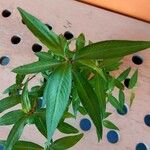
Persicaria odorata
ယျယျိင်၊ တၞံ · Vietnamese-coriander · Vietnamese cilantro · Cambodian mint · Hot mint
Description
Source: leafsnapPersicaria odorata, with common names Vietnamese coriander, rau răm, laksa leaf, Vietnamese cilantro, phak phai, praew leaf, hot mint and Cambodian mint, is a herb whose leaves are used in Southeast Asian and Northeast Indian cooking. Vietnamese coriander is not related to the mints, nor is it in the mint family Lamiaceae, but its general appearance and fragrance are reminiscent of them. Persicaria is in the family Polygonaceae, collectively known as "smartweeds" or "pinkweeds".
Care Guide
💧 Water
Vietnamese coriander thrives in humid environments and requires weekly watering to maintain adequate moisture levels. It is not drought-tolerant. As an herbaceous perennial, it benefits from consistent moisture both indoors and outdoors, with its growth cycle closely tied to water availability.
☀️ Light Full sun
Vietnamese coriander is native to habitats with plentiful sunlight, for example open fields and sunlit meadows. It favors full sun, though it will tolerate partial sun.
🌡️ Temperature 20–37.8°C
Vietnamese coriander prefers tropical conditions and grows best when temperatures range from 68 to 100 °F (20 to 38 °C). In colder seasons, it is advisable to grow it indoors or in a greenhouse to ensure it receives sufficient warmth.
💨 Humidity high (>60%)
This plant needs special care because it loves high humidity levels of 60-80% or more. The best way to achieve this is by placing a humidifier near the plant. Daily misting is also essential! Make sure the room has good ventilation.
🪴 Soil 5-7
🌱 Fertilizer
To achieve maximum yield, Vietnamese coriander benefits from regular applications of a balanced fertilizer, especially one high in nitrogen. Apply fertilizer before planting, at planting, and again when seedlings are 2 inches (5.1 cm) tall. Adding compost or manure also supplies nutrients continuously. Insufficient soil nutrients cause underdeveloped leaves and stems, inferior flavors, thin stems, and potentially a bitter taste.
🪴 Pot & Repot 2-3 years
Repot Vietnamese coriander every 2-3 years in the spring, using a medium-sized pot with good drainage. After repotting, keep the plant warm and moist, but be careful to avoid sogginess. Place the herb in a well-lit area, away from direct sunlight, to encourage healthy growth.
✂️ Pruning
Vietnamese coriander is a flavorful herb that thrives when pruned from early to late spring. Start by removing any dead or overcrowded stems to encourage healthy, bushy growth. Regular trimming not only promotes denser foliage but also helps maintain the plant's shape and improve air circulation. This, in turn, reduces the risk of fungal diseases.
🌿 Propagating
🐛 Diseases & pets
☠️ Toxicity
Characteristics
- Plant Type
- Herb
- Life Cycle
- Perennial
- Genus
- Persicaria
- Family
- Polygonaceae
- Hardiness Zone
- 10-12
- Mature Height
- 91 cm
- Mature Spread
- 30 cm
- Leaf Color
- Purple, Green, Brown
- Leaf Type
- Evergreen
- Flower Color
- Pink, White
- Flower Size
- 0.25 cm to 0.51 cm
- Bloom Time
- Summer, Early fall, Mid fall
- Planting Time
- Spring, Summer, Autumn
- Harvest Time
- Late summer, Fall, Early winter
- Native Area
- Cambodia, Vietnam, Myanmar, Japan, Laos, Thailand, China