Persicaria perfoliata
Asian Tearthumb · Asiatic Tearthumb · Devil's-tail Tearthumb · Giant Climbing Tearthumb · Mile-a-minute-vine
Description
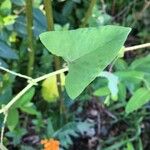
Source: leafsnapPersicaria perfoliata, commonly known as mile-a-minute weed, is a fast-growing annual vine native to Asia. It has become an invasive species in many regions, including North America and Europe. The plant features triangular leaves with small barbs along the edges, and its stems are covered in tiny prickles. It produces small white or pink flowers from late summer to early fall, followed by blue-black berries. The vine can grow up to 6 meters long, quickly covering other plants or structures and causing damage or shading out other vegetation. Mile-a-minute weed spreads rapidly through seed dispersal by birds and animals, as well as through vegetative reproduction from stem fragments that root at nodes where they touch the ground. Control measures include manually removing plants before they produce seeds, applying herbicides, and implementing biological control using insects that feed on the plant's leaves or stem tips.
🌳 Mile-A-Minute's thick growth habit and quick groundcover are frequently seen in a negative light because of its invasive behavior. Still, this trait can also have beneficial effects, particularly for controlling soil erosion. The dense mats of vegetation it creates can hold soil in place in locations where erosion is common, thereby serving an important, though unintended, purpose in protecting the environment and supporting agricultural activities.
🎭 Mandatory, Health
Care Guide
💧 Water Every 7 days
Mile-A-Minute, a plant native to humid environments, thrives in consistently moist conditions and prefers regular watering without becoming waterlogged. Watering once a week is ideal. When grown outdoors, it benefits from rainwater, which supports its natural growth cycles throughout the seasons.
☀️ Light Full sun
Mile-A-Minute needs abundant sunlight to grow optimally; it can tolerate lower light conditions but may not prosper vigorously. In its native environment it does best in places with unblocked sun. Insufficient light can weaken the plant, while excessive sun can scorch its leaves.
What are the sun requirements for Mile-A-Minute?
Mile-A-Minute demands high exposure to sunlight for optimum growth. It can withstand modest light scenarios but thrives best in full sun, requiring over 6 hours of sunlight to flourish abundantly. In its natural habitat, it enjoys unobstructed sunlight. However, inadequate sunlight can hamper its strength, and too much direct exposure may lead to leaf scorching. It is essential to observe how sunlight moves through your garden and choose planting spots that provide a perfect balance of light and shade.
Can artificial lighting be used for Mile-A-Minute, and how?
Yes, artificial lighting can be used for Mile-A-Minute, especially when natural sunlight is insufficient, such as in winter or less sunny spaces. Artificial lights, like LED lights, can offer a vital solution by providing the specific wavelengths of light needed. Full sun plants require 30-50W/sq ft, partial sun plants 20-30W/sq ft, and full shade plants 10-20W/sq ft of artificial light. The light source should be placed 12-36 inches above the plant to mimic natural sunlight, and most plants need 8-12 hours of light per day for optimal growth.
What are the signs of inadequate light for Mile-A-Minute when grown indoors?
When Mile-A-Minute is grown indoors and receives inadequate light, it may exhibit several symptoms, including smaller new leaves compared to older ones, leggy or sparse growth, faster leaf drop, slower or no new growth, and lighter-colored new leaves due to insufficient chlorophyll. In addition, excessive sunlight exposure can cause chlorosis, sunscald, leaf curling, wilting, and leaf scorching, all of which adversely affect the plant's health and growth.
What are the solutions to address light deficiency for Mile-A-Minute?
To address light deficiency for Mile-A-Minute, gradually increase sunlight exposure to at least 6 hours daily by moving the plant to a sunnier location. Utilize a south-facing window and keep curtains open during the day for maximum sunlight. If the plant is large or not easily movable, consider using artificial light, keeping lamps on for at least 8 hours daily. For outdoor plants, avoid sudden changes in light exposure to prevent sunburn. If light obstruction is an issue, prune trees or relocate the plant to a sunnier spot, especially during its dormant period for minimal stress.
🌡️ Temperature 10–25°C
Mile-A-Minute originates from temperate regions and favors a warmer climate, doing best at temperatures of 68 to 95 °F (20 to 35 ℃). As seasons change, temperatures should be adjusted carefully to match its natural habitat.
What is the native climate of Mile-A-Minute?
Mile-A-Minute, botanically known as Persicaria perfoliata, is native to temperate regions and flourishes in warmer climates. It thrives optimally in temperatures ranging from 68 to 95 °F (20 to 35 °C). As the seasons change, it's important to adjust the temperature settings to match its natural habitat conditions closely.
Does Mile-A-Minute require frost protection measures during winter?
Mile-A-Minute is highly tolerant to cold temperatures and does not require additional frost protection measures during the winter months. However, to prepare for the first freeze of autumn, it's advised to water the plant generously. This ensures that the soil remains moist and freezes, which helps to prevent drought and water scarcity for the plant during the winter and into early spring.
How should Mile-A-Minute be cared for in low temperatures?
Despite its high cold tolerance, it's crucial to ensure that the winter temperature for Mile-A-Minute never dips below -25°C. If temperatures fall beyond this threshold, the plant may not show immediate signs of distress during the winter, but it could lead to reduced or even absent sprouting in the spring. In such cases, removing the parts that fail to sprout in spring is recommended.
What should be done if Mile-A-Minute experiences high temperatures?
Mile-A-Minute doesn't fare well in temperatures exceeding 35°C, leading to halted growth and increased susceptibility to rot. To mitigate damage from high temperatures, it's advisable to trim any sunburned and dried-up parts of the plant. Moving the plant to a naturally shaded area or using a shade cloth during the midday and afternoon sun can protect it. Also, maintaining soil moisture is crucial, so water the plant in the morning and evening.
💨 Humidity
🪴 Soil 5-7
🌱 Fertilizer
Mile-A-Minute responds well to regular, weak applications of fertilizer to encourage healthy leaf development. Fertilize Mile-A-Minute roughly once a month during the summer. Nitrogen is important for foliage, and providing nitrogen-rich sources aids Mile-A-Minute in thriving.
🪴 Pot & Repot
✂️ Pruning
🌿 Propagating
🐛 Diseases & pets
☠️ Toxicity
Characteristics
- Plant Type
- Herb
- Life Cycle
- Annual, Perennial
- Genus
- Persicaria
- Family
- Polygonaceae
- Hardiness Zone
- 6
- Mature Height
- 3.05 m to 3.66 m
- Mature Spread
- 6.1 m
- Leaf Color
- Green
- Leaf Type
- Deciduous
- Flower Color
- White
- Flower Size
- 2.54 cm
- Bloom Time
- Late spring, Early summer, Mid summer
- Planting Time
- Spring, Summer, Autumn
- Harvest Time
- Mid summer, Late summer
- Native Area
- Nepal, Russia, India, Turkey, Malaysia, Indonesia, Vietnam, Myanmar, Japan, Philippines, Koppen, Bhutan, Bangladesh, Laos, South Korea, Thailand, China