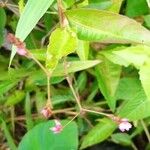
Persicaria sagittata
American Tearthumb · Arrow-leaf Smartweed · Arrowleaf Tearthumb · Arrowvine · Arrow-leaved Smartweed
Description
Source: leafsnapPersicaria sagittata, common names American tearthumb, arrowleaf tearthumb, or arrowvine, is a plant species widespread in the eastern half of North America as well as in eastern Asia. It has been found in every state and province from Texas to Manitoba to Newfoundland to Florida, plus Colorado and Oregon. It also grows in China, the Russian Far East, Siberia, Korea, Japan, northern India and Mongolia. It grows in moist areas along lake shores, stream banks, etc.Persicaria sagittata is an annual herb up to 200 cm (80 inches) tall, with prickles along the stem. Leaves are up to 10 cm (4 inches) long, heart-shaped or arrowhead-shaped (unusual for the genus). Flowers are white to pink, borne in spherical to elongated clusters up to 15 mm (0.6 inches) long.
Care Guide
💧 Water
Arrowvine thrives with moderate moisture, needing weekly watering to maintain proper hydration and drainage. As an evergreen, it keeps its lush appearance throughout the year, even in drier conditions, demonstrating its adaptation to wetland habitats.
☀️ Light Full sun
Arrowvine thrives in bright light and tolerates moderate exposure, though it is not entirely dependent on it. In its native habitats, it has adapted to make use of intense sunlight. However, both excessive and insufficient light can negatively affect the plant's health and growth.
What are the sunlight requirements for Arrowvine?
Arrowvine requires full sun to thrive, which means it needs above 6 hours of sunlight daily. However, it can also tolerate partial sun, roughly about 3-6 hours of sunlight. Observing how sunlight moves through your garden helps in choosing spots that provide a perfect balance of light and shade, ensuring the plants' happiness. Arrowvine, in its native habitats, utilizes the piercing sun to its advantage, although excessive or scarce light can harm its health and growth.
How does artificial lighting affect Arrowvine indoors, and what are the recommendations?
Indoor Arrowvine plants require adequate lighting for optimal growth. When natural sunlight is insufficient, particularly in winter or less sunny spaces, artificial lights such as LED lights, which can be customized to provide specific wavelengths of light, offer a vital solution. For full sun plants, 30-50W/sq ft of artificial light is needed, partial sun plants require 20-30W/sq ft, and full shade plants need 10-20W/sq ft. The light source should be placed 12-36 inches above the plant, and most plants need 8-12 hours of light per day to mimic natural daylight hours.
What are the common symptoms of light deficiency in Arrowvine when grown indoors?
Arrowvine may show several symptoms if it doesn't receive adequate light, including small leaves, leggy or sparse growth, faster leaf drop, slower or no new growth, lighter-colored new leaves, chlorosis, sunscald, leaf curling, wilting, and leaf scorching. These symptoms indicate a range of issues from insufficient sunlight causing a lack of chlorophyll and essential nutrients, to damages from excessive sunlight exposure.
What solutions can be applied to Arrowvine experiencing light-related issues?
To address light-related issues in Arrowvine, gradually introducing the plant to more sunlight is key. For indoor plants, this may involve moving the plant to a sunnier location each week until it receives at least 6 hours of direct sunlight daily or using artificial light like desk lamps or professional grow lights for at least 8 hours a day. For outdoor plants, moving them to the best spot for sunlight gradually helps to prevent sunburn. Reducing obstructions, such as pruning branches that block sunlight or transplanting smaller plants to sunnier locations, can also benefit the plant's exposure to adequate light. However, parts of the plant that have been negatively affected by past insufficient sunlight may not recover, but new growth can be healthy after adjusting light exposure.
🌡️ Temperature 5–25°C
Arrowvine is native to areas with moderate temperatures between 68 and 95 °F (20 to 35 ℃). Fluctuations outside this range may require seasonal adjustments to maintain the plant's optimal health.
What is the ideal temperature range for growing Arrowvine?
Arrowvine thrives in moderate temperature regions, with an ideal range between 68 to 95°F (20 to 35°C). It's essential to make seasonal adjustments if the temperature varies significantly from this range to ensure the plant's optimal health. Arrowvine is notably cold-tolerant and does not require special frost protection measures in winter. However, it is advisable to water the plant generously before the first freeze of autumn to keep the soil moist. This preparation helps to prevent drought and water scarcity for the plant during the colder months and early spring.
How does Arrowvine react to low temperatures?
Arrowvine exhibits remarkable tolerance to cold temperatures, withstand falling temperatures down to -25°C (-13°F) without significant immediate visible damage. Despite this tolerance, extended exposure to temperatures below this threshold can lead to issues such as reduced or absent sprouting in the following spring. To combat this, it is recommended to remove any plant parts that have failed to sprout as spring arrives.
What should be done if Arrowvine is exposed to high temperatures?
Arrowvine struggles with high temperatures, particularly those exceeding 35°C (95°F). Under such conditions, the plant's growth halts, and it becomes significantly more prone to rot. The best response to high temperature exposure includes trimming away any parts of the plant that are sunburned or dry. Additionally, relocating the plant to a site with shade during the midday and afternoon sun or using a shade cloth can be beneficial. Ensuring the soil remains moist by watering in the morning and evening is also crucial under these conditions.
💨 Humidity
🪴 Soil 6-7
🌱 Fertilizer
Arrowvine benefits from regular, light applications of fertilizer to encourage healthy leaf development. Apply fertilizer to Arrowvine about once a month during the summer. Nitrogen is important for foliage, and providing nitrogen-rich sources supports Arrowvine's growth.
🪴 Pot & Repot
✂️ Pruning
Arrowvine is characterized by its arrow-shaped leaves and benefits from pruning between early and late spring. Regularly trimming damaged stems and controlling growth will help promote density and improve air circulation, which minimizes the risk of disease. To keep the plant healthy and visually appealing, avoid heavy pruning outside of the recommended seasons to prevent stress.
🌿 Propagating
🐛 Diseases & pets
☠️ Toxicity
Characteristics
- Plant Type
- Herb
- Life Cycle
- Annual, Perennial
- Genus
- Persicaria
- Family
- Polygonaceae
- Hardiness Zone
- 5
- Mature Height
- 46 cm to 61 cm
- Mature Spread
- 30 cm to 61 cm
- Leaf Color
- Green
- Leaf Type
- Deciduous
- Flower Color
- White, Pink
- Flower Size
- 0.25 cm
- Bloom Time
- Summer
- Planting Time
- Spring, Summer, Autumn
- Harvest Time
- Late summer, Early fall, Mid fall
- Native Area
- Russia, Nepal, India, Georgia, Japan, Mongolia, Venezuela, Koppen, Bhutan, Dominican Republic, South Korea, China