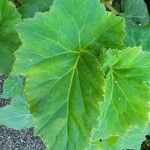
Petasites japonicus
Japanese Butterbur · Great butterbur · Butterbur · Giant butterbur · Sweet-coltsfoot
Description
Source: leafsnapPetasites japonicus, also known as butterbur, giant butterbur, great butterbur and sweet-coltsfoot, is an herbaceous perennial plant in the family Asteraceae. It is native to China, Japan, Korea and Sakhalin and introduced in Europe and North America. It was introduced to southern British Columbia in Canada by Japanese migrants.It is dioecious, with male and female flowers produced on separate individuals. Occasionally, morphologically hermaphroditic (but functionally sterile) flowers exist.
💡 Japanese butterbur is a dioecious plant, which means each individual plant is either male or female. Interestingly, all the Japanese butterbur found in Finland are male, so they cannot reproduce sexually. Despite this limitation, they are quite capable of spreading through their rootstock. Once established, Japanese butterbur can dominate an area and suppress the growth of other plants.
Care Guide
💧 Water
☀️ Light Partial sun
🌡️ Temperature 5–35°C
💨 Humidity
🪴 Soil 6-7
🌱 Fertilizer
🪴 Pot & Repot
✂️ Pruning
🌿 Propagating
🐛 Diseases & pets
☠️ Toxicity
Characteristics
- Plant Type
- Herb
- Life Cycle
- Perennial
- Genus
- Petasites
- Family
- Asteraceae
- Hardiness Zone
- 5-9
- Mature Height
- 61 cm to 91 cm
- Mature Spread
- 0.91 m to 1.52 m
- Leaf Color
- Green, Yellow, White
- Leaf Type
- Deciduous
- Flower Color
- White
- Flower Size
- 30.48 cm
- Bloom Time
- Early spring, Mid spring
- Planting Time
- Spring
- Harvest Time
- Late spring, Early summer