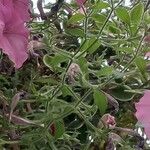
Petunia hybrida
اطلسی · Garden petunia · Chitravarna · Common garden petunia · చిత్రవర్ణ
Description
Source: leafsnapPetunia hybrida is a popular flowering plant in the Solanaceae family, created by hybridizing various species of petunias. This plant is admired for its vibrant and beautiful flowers, which come in a spectrum of colors including pink, purple, red, white, and yellow. Typically grown as annuals in gardens or as potted indoor plants, Petunia hybrida thrives in full sun to partial shade and prefers well-drained soil with regular watering. The plants can grow up to 12 inches tall and spread about 24 inches wide. The trumpet-shaped flowers of Petunia hybrida feature five petals forming a funnel-like shape. They bloom from spring to fall in most climates, and can even bloom year-round in warmer regions. The popularity of Petunia hybrida is largely due to its ease of cultivation and stunning blooms. It has also been widely used in breeding new varieties with improved traits such as disease resistance and larger flowers. In summary, Petunia hybrida is an excellent choice for gardeners seeking an easy-to-grow plant with beautiful, colorful flowers that can enhance any garden throughout the growing season.
🌳 More than just a garden ornamental, the garden petunia has made notable contributions to science, particularly in plant molecular biology. Many people are unaware of its role in gravity research — NASA has studied petunias aboard the International Space Station. Moreover, these flowers have played a key part in gene gun technology and were among the pioneers in genetic engineering.
🎭 Serenity: you provide warmth and a feeling of security.
Care Guide
💧 Water Every 7 days
Petunia hybrida is mildly drought-tolerant, but regular watering helps keeping the flowers in constant bloom. Petunias prefer full sunlight, so be aware, container plants may dry out more quickly during hot weather periods. During such periods the plants require two daily waterings. Watering the plants early in the morning can help sustain the plants through the early afternoon, typically the warmest and sunniest part of the day. During the winter, Petunias go dormant and will need less water.
☀️ Light Full sun
The garden petunia thrives with ample sunlight for robust growth, though it can tolerate reduced sun exposure. It comes from habitats with abundant sun, which explains its preference for those conditions. Excessive or insufficient sunlight can impact its health, affecting the size and frequency of its blooms.
🌡️ Temperature 20–37.8°C
The native growing temperature range for garden petunia is 20 to 38℃ (68 to 100 ℉). It prefers conditions within that range but can tolerate temperatures as low as 10℃ (50℉) and as high as 40℃ (104℉). In cooler temperatures, it is suggested to adjust watering schedules to prevent cold damage. In warmer temperatures, it is suggested to provide shade during the hottest part of the day to prevent scorching.
💨 Humidity
🪴 Soil 6-7
🌱 Fertilizer
When most of the Garden petunia's flowers have fully opened, resume fertilizing. At about the time blooms are at their peak, fertilize again every three to four weeks, weather permitting. Then, once the Garden petunia begins producing fewer new blooms, discontinue fertilizing; there's no need to feed it when it can no longer make more flowers.
🪴 Pot & Repot
When repotting Garden petunia, choose a pot that is 1-2 inches (2.5–5.1 cm) larger in diameter and has good drainage. Use a well-draining potting mix and consider adding perlite for improved drainage. Repot in spring or early summer, water thoroughly afterward, and keep it in a shady spot at first.
✂️ Pruning
🌿 Propagating
🐛 Diseases & pets
☠️ Toxicity
Petunias do not produce any native toxins or allergens that cause problems when petunias are grown in gardens and not intentionally consumed.
Characteristics
- Plant Type
- Herb
- Life Cycle
- Annual, Perennial
- Genus
- Petunia
- Family
- Solanaceae
- Hardiness Zone
- 9-11
- Mature Height
- 10 cm to 49 cm
- Mature Spread
- 10 cm to 49 cm
- Leaf Color
- Green, White
- Leaf Type
- Deciduous, Evergreen
- Flower Color
- Violet, Purple, Pink, White, Red
- Flower Size
- 4.06 cm to 10.16 cm
- Bloom Time
- Mid spring, Late spring, Summer
- Planting Time
- Spring, Summer
- Harvest Time
- Mid spring, Late spring, Summer, Fall, Early winter, Mid winter