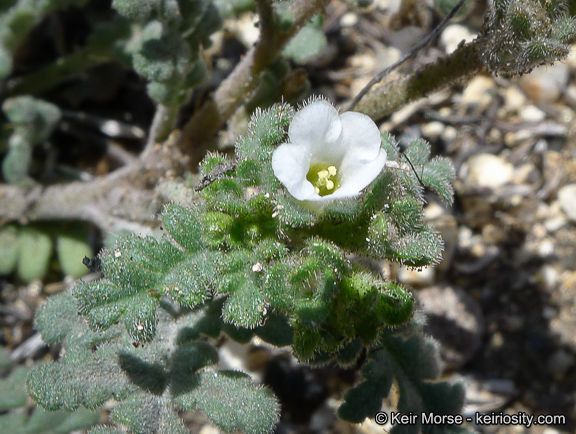
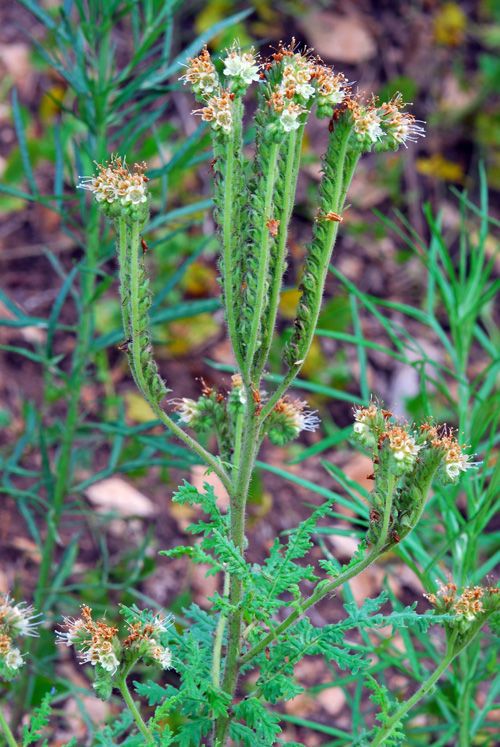
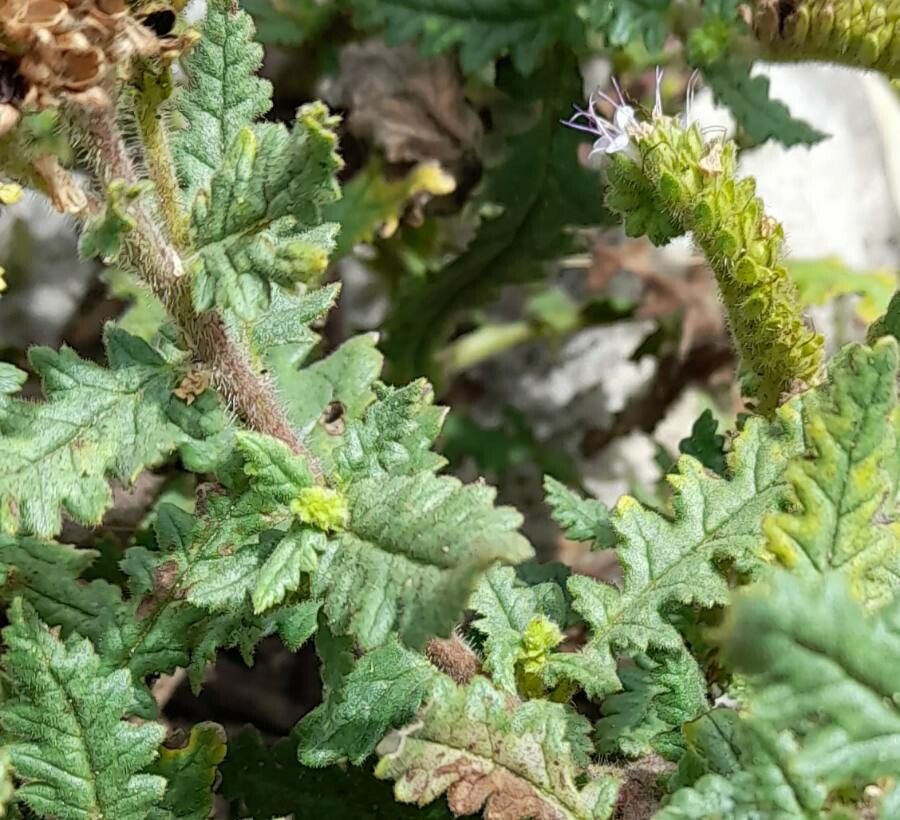
Phacelia vallis-mortae is a species of flowering plant in the borage family, Boraginaceae, known by the common name Death Valley phacelia. It is native to the southwestern United States, where it grows in deserts such as Death Valley, and mountain, plateau, and valley scrub habitat. It is an annual herb growing up to 60 centimeters tall with a branching or unbranched stem. It is coated in soft and stiff hairs. The leaves are up to 8 centimeters long and most are compound, divided into smaller leaflets lined with teeth or lobes. The hairy inflorescence is a one-sided curving or coiling cyme of bell-shaped flowers. Each flower 1 to 1.5 centimeters long and a shade of lavender or purple, surrounded by a calyx of narrow sepals coated in long hairs.
Death valley phacelia shows strong resistance to disease and is generally not likely to suffer from them. Still, it can be vulnerable to pests and diseases present in its surroundings. These infections are typically minor. As for care, the plant needs a moderate amount of upkeep. It should be pruned regularly to keep a good appearance and support healthy growth. Fertilizing can also encourage flowering. Death valley phacelia is well suited for anyone with outdoor space, such as a garden or patio, and does not demand extensive care experience. It may need increased attention if grown indoors.
How to keep Phacelia Vallis Mortae.
Light
Death valley phacelia comes from bright, open habitats and flourishes in full sun. It can tolerate some partial sun but favors direct sunlight for optimal growth. This annual and biennial plant is known for its sun-loving nature.
Water
The Death Valley phacelia thrives in arid conditions and requires minimal water. It benefits from deep watering twice a week, which should be infrequent to prevent over-saturation. This drought-tolerant species enters dormancy during prolonged dry spells, conserving resources until conditions improve.
Temperature
Death valley phacelia can adjust to a broad range of temperature conditions, but its distribution may still be constrained by different combinations of moisture and heat. It does best in warm summer climates with adequate rainfall or watering. Long stretches of cloudy, rainy weather and extended high temperatures can increase the likelihood of Death valley phacelia dying. In winter, giving the plant proper protection from cold can improve its survival rate.
Fertilizer
When most of Death valley phacelia's blooms have opened to full size, resume fertilizing. During the period of peak flowering, apply fertilizer every three to four weeks, weather permitting. Once the plant begins producing fewer new blooms, stop fertilizing; there is no need to feed it when it can no longer produce more flowers.
Pruning
The Death Valley phacelia is known for its vibrant purple flowers and its ability to tolerate drought. To promote healthy growth, improve airflow, and reduce the risk of disease, it's important to prune any dead or damaged stems from early to late spring. Regular trimming encourages denser growth and helps maintain the plant's shape. For specific pruning advice, consult reliable sources.
Botanical profile.
- Plant Type
- Herb
- Life Cycle
- Annual
- Genus
- Phacelia
- Family
- Boraginaceae
- Hardiness Zone
- 7-10
- Mature Height
- 10 cm to 40 cm
- Mature Spread
- 15 cm to 30 cm
- Leaf Color
- Green
- Leaf Type
- Semi-evergreen
- Flower Color
- Lavender
- Flower Size
- 1.02 cm to 1.52 cm
- Bloom Time
- Early spring, Mid spring
- Planting Time
- Spring, Summer, Autumn
- Harvest Time
- Late spring, Early summer