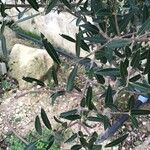
Phillyrea latifolia
Broad-leaved phillyrea · Mock privet · Jasmine box · Phillyrea · Green Olive Tree
Description
Source: leafsnapPhillyrea latifolia, commonly known as the green olive tree or mock privet, is a small evergreen tree or shrub that belongs to the Oleaceae family. Native to the Mediterranean region, it thrives in various habitats, including rocky hillsides, woodlands, and coastal areas. The plant has a dense, bushy growth habit with dark green, glossy leaves that are leathery in texture. The lance-shaped leaves have entire margins and can grow up to 10 cm long. In the spring, the plant produces small white flowers that are followed by blackish-purple berries. Phillyrea latifolia is hardy and requires minimal care once established. It prefers well-drained soil and full sun exposure but can also tolerate partial shade. While it is drought-tolerant, it benefits from occasional watering during prolonged dry spells. The plant has various uses, including ornamental purposes due to its attractive foliage, hedge planting due to its dense growth habit, and traditional medicinal uses for ailments such as rheumatism. Overall, Phillyrea latifolia is an attractive evergreen shrub that requires minimal care, making it an ideal choice for gardeners seeking low-maintenance plants with ornamental value.
🌳 Mock privet can indicate heavy metal content in soil. Although not widely recognized, its absorption capabilities point to a potential role in phytoremediation, helping to identify areas with elevated levels of certain metals and thereby indirectly supporting environmental monitoring and possible soil remediation efforts.
Care Guide
💧 Water Every 7 days
Native to the Mediterranean, mock privet thrives with regular watering but can withstand short periods of drought. Ideally, it should be watered every 1-2 weeks in well-drained soil. Being an evergreen, this plant is well-suited for temperate climates and adapts well to changes in seasonal rainfall.
How should I water my Mock privet?
Your Mock privet is not picky about how you water it, so you can use any common watering tool. This includes watering cans, hoses, and cups. It's important to water the plant by applying the water directly to the soil. Make sure to moisten all areas of the soil equally to provide water to all parts of the root system. Using filtered water is helpful because tap water may contain harmful particles. Additionally, it's best to use water that is at or slightly above room temperature to prevent shocking the Mock privet. However, the plant usually responds well to any kind of water you give it.
What should I do if I give my Mock privet plant too much or too little water?
Outdoor plants, especially newly planted ones or seedlings, are prone to lack of watering. It is important to consistently water them for the first few months, even when the tree is small or recently planted. Once the roots are established, Mock privet can usually rely on rainwater. When Mock privet is planted in pots, overwatering is a common issue. If you accidentally overwater your Mock privet, you should take action immediately to fix it. First, stop watering the plant to minimize the impact of overwatering. Next, inspect the roots by removing the plant from its pot. If there are no signs of root rot, you can return the plant to its container. In case of root rot, trim any affected roots and consider using a fungicide to prevent further damage. Finally, repot the Mock privet in well-draining soil. On the other hand, if your Mock privet is underwatered, it can be easily addressed by watering it more frequently. Signs of underwatering include drooping, drying, and falling leaves. The leaves will recover quickly and become full again after sufficient watering. It is important to adjust your watering frequency promptly when underwatering occurs.
How frequently should I give water to my Mock privet?
If your area doesn't get much rain, you'll need to water your outdoor plants regularly. In the spring and fall, watering every 2 weeks should be enough. But in the summer, plants need more frequent watering. In the winter, you can water less often, and sometimes not at all. If your Mock privet is young or newly planted, it needs more water to help it grow. For potted plants, there are two ways to determine how often to water your Mock privet. One way is to have a set schedule, like watering once a week or once every other week. But this might not always work because it doesn't consider the specific conditions for your plant. The other way is to check the soil moisture. Wait until the top few inches of soil have dried out before watering again.
How much water does my Mock privet require?
When watering your Mock privet, you may be surprised to learn that it doesn't always need a lot of water. If only a few inches of soil have dried since the last watering, giving it about five to ten ounces of water each time can support healthy growth. You can also determine the amount of water based on the dryness of the soil. Take note of how many inches of soil have dried out between waterings. To ensure proper moisture levels, water enough to moisten all the dry soil layers since the last watering. If over half of the soil has dried out, consider giving more water, making sure to stop when you see excess water draining from the pot's holes. If your Mock privet is planted in a rainy outdoor area, it may not need additional watering. When the plant is young or establishing, provide 1-2 inches of rain per week. As it grows and establishes, it can rely solely on rainwater, unless there is a long period of hot weather with no rainfall for 2-3 weeks. In such cases, give the plant a thorough watering to prevent stress.
How do I know if I am giving enough water to my Mock privet?
The Mock privet is more commonly affected by overwatering, and there are a few signs to watch out for. When overwatered, the Mock privet's leaves turn yellow and may fall off. Additionally, overwatering can cause the plant's overall structure to shrink and lead to root rot. On the other hand, an underwatered Mock privet will start wilting and its leaves may turn brown or become brittle. Regardless of whether you notice signs of overwatering or underwatering, it's important to take action and restore the health of your Mock privet.
☀️ Light Full sun
Mock privet strongly prefers abundant light to thrive. Nevertheless, it can continue to grow with only moderate light. Originating from sunny habitats, both excessive and insufficient light can hinder its vigorous growth. Its sun requirement does not change significantly at different growth stages.
What are the sunlight requirements for Mock Privet?
Mock Privet, or Phillyrea latifolia, thrives with ample exposure to light, requiring above 6 hours of sunlight for full sun conditions and about 3-6 hours for partial sun. Observing the movement of sunlight through your garden is crucial for choosing spots that offer the right balance of light and shade, ensuring the plant's health. This species originates from environments with abundant sunshine, and deviations from its light requirements can hinder its growth. The essential sun requirements remain consistent across different growth stages, highlighting the plant's strong affinity for light.
Can Mock Privet grow under artificial lighting?
Yes, Mock Privet can grow under artificial lighting when natural sunlight is insufficient, such as during winter or in less sunny spaces. Indoor plants require adequate lighting for optimal growth, making artificial lights an essential solution. LED lights are recommended due to their ability to provide specific wavelengths needed by the plant. Full sun plants should have 30-50 watts per square foot, partial sun plants 20-30 watts per square foot, and full shade plants 10-20 watts per square foot. The light source should be placed 12-36 inches above the plant to mimic natural sunlight, and most plants need 8-12 hours of light per day.
What are the signs of insufficient light for Mock Privet?
Mock Privet shows several symptoms when exposed to insufficient light, including smaller new leaves, leggy or sparse growth, faster leaf drop, slower or halted growth, and lighter-colored new leaves. Additionally, excessive sunlight can cause chlorosis (leaves turning yellow), sunscald (damage from intense sunlight), leaf curling (a defense mechanism against too much sunlight), wilting (due to water loss), and leaf scorching (brown, dry patches on leaves). These symptoms indicate the plant's struggle with either too much or too little sunlight.
How can I address sunlight-related issues for Mock Privet?
To address sunlight deficiencies for Mock Privet, consider gradually moving the plant to a location with at least 6 hours of direct sunlight daily. For indoor plants, using a south-facing window or providing additional light through desk or ceiling lamps for at least 8 hours a day is beneficial. When relocating the plant outdoors, make sure to adapt it gradually to prevent sunburn. If the plant is blocked from sunlight, pruning obstructing branches or transplanting it to a sunnier location with good drainage might be necessary. Unfortunately, parts of the plant that have suffered due to insufficient light may not recover, but new growth should be healthy with improved light conditions.
🌡️ Temperature 10–35°C
Mock privet is native to areas with temperatures ranging from 50 to 95 °F (10 to 35 ℃). It favors milder climates. To promote optimal growth, during colder seasons make sure the temperature does not fall below 50 °F (10 ℃).
What is the ideal temperature range for Mock Privet?
Mock privet, known botanically as Phillyrea latifolia, thrives in environments where temperatures range from 50 to 95 °F (10 to 35 °C). It is indigenous to regions that prefer milder climates and possesses strong cold resistance, making it quite adaptable to varying temperatures. While it generally does not require special frost protection measures, it is crucial to ensure that during the colder seasons, the temperature does not fall below 50 °F (10 °C). However, if winter temperatures are expected to plummet below -25°C, protections such as wrapping the trunk and branches with non-woven fabric or cloth are recommended. Additionally, watering the plant abundantly before the first freeze of autumn to maintain soil moisture can help prevent drought and water scarcity during winter and early spring.
How does Mock Privet respond to low temperatures, and what are the solutions to cold damage?
Mock privet can tolerate low temperatures well, thriving best when kept above 10°C. During winter, it is advised to keep it above -15°C to avoid damage. However, if temperatures fall below -25°C, there may not be immediate noticeable changes, but come spring, the branches could become brittle and dry, with no new shoots emerging. The solution to cold damage involves pruning away any dead branches that have failed to produce new leaves during spring, helping the plant to recover and maintain healthy growth.
How does Mock Privet cope with high temperatures, and what are the solutions to heat stress?
During the summer, Mock privet should ideally be kept below 35°C. If the temperature exceeds 38°C, the plant may exhibit signs of heat stress, such as leaves becoming lighter in color, tips drying and withering, and an increased susceptibility to sunburn. The solutions to mitigate heat stress include trimming away the sunburned and dried-up parts to prevent further damage. It's also beneficial to move the plant to a location where it can receive shade during the midday and afternoon sun, or to use a shade cloth to protect it. Additionally, watering the plant in the morning and evening helps keep the soil moist and supports the plant in coping with high temperatures.
💨 Humidity normal (40-60%)
This plant will thrive in moderate humidity, which is probably the level in your home. However, misting it a few times a week can be very beneficial. Make sure the room has good ventilation.
🪴 Soil 6-7
🌱 Fertilizer
The timing of fertilizing mock privet is important. Apply fertilizer in early spring and continue monthly until early summer. Fertilizer encourages attractive blooms and supplies energy during both dormant and active growth periods.
Why is it necessary to fertilize my Mock privet?
No matter what type of Mock privet you have, regular fertilization will ensure that your plant remains healthy. Providing the right nutrients will result in stronger growth and increased resilience to difficult conditions, as well as better defense against diseases and pests. The foliage of your Mock privet is a standout feature, so it's important to maintain it. To achieve this, you should establish a consistent fertilization routine tailored to your specific Mock privet. This will encourage the development of vibrant, lush leaves with deep color.
When should I fertilize my Mock privet?
To ensure healthy growth of your Mock privet, it is recommended to fertilize it during the late winter or early spring. This provides the necessary nutrients for the plant to thrive when the weather warms up. In warm climate regions, an additional fertilizer feeding during early fall can be beneficial. This not only boosts the soil's nutrient content for the following growing season, but also strengthens the plant, making it more resilient to winter cold and less prone to foliage damage. Fertilizing earlier will also allow enough time for new branches to grow and withstand the harsh winter conditions.
When shouldn't I add fertilizer to my Mock privet?
There are a few times during the year when you should avoid fertilizing your Mock privet. First, do not fertilize during the early and mid-winter months when the plant is dormant. It does not need nutrients during this time. Additionally, it is not recommended to fertilize in late spring and summer when the weather is hotter and drier. These conditions can negatively affect the plant's response to fertilization. To prevent any problems, stick to a fertilization schedule that only includes feeding in early spring and early fall.
What kind of fertilizer does my Mock privet need?
A Mock privet primarily requires nitrogen as its most important nutrient, but that doesn't mean phosphorus and potassium are insignificant. In fact, your Mock privet needs an adequate amount of all three nutrients for optimal growth. Therefore, a balanced fertilizer like a 10-10-10 can be effective. However, a more precise nutrient ratio, particularly with higher nitrogen content, often promotes better growth. For instance, a ratio of 10-6-4 can be beneficial. When fertilizing, you have the option of using either granular or liquid-based fertilizer.
How can I give nutrients to my Mock privet plant?
To fertilize your Mock privet, you have two options: using granular fertilizer or liquid fertilizer. If you choose to use granular fertilizer, simply sprinkle it on the soil at the right time. This type of fertilizer releases nutrients slowly into the soil over time. It's advisable to lightly water your Mock privet before applying the fertilizer. Alternatively, you can use liquid fertilizer, although this method is less common. To do this, mix the fertilizer with water and pour it onto the soil around the base of your Mock privet. Before fertilizing, it can be helpful to perform a soil test to determine if any adjustments to the pH are necessary.
🪴 Pot & Repot 2-3 years
Repot your mock privet every 2 to 3 years during the spring to encourage moderate growth. Choose a pot that is slightly larger to allow for root expansion. Use well-draining soil and resume regular watering once you see new growth. Mock privet is a resilient plant, which helps minimize stress after repotting.
✂️ Pruning
🌿 Propagating
🐛 Diseases & pets
☠️ Toxicity
Characteristics
- Plant Type
- Shrub
- Life Cycle
- Perennial
- Genus
- Phillyrea
- Family
- Oleaceae
- Hardiness Zone
- 6-9
- Mature Height
- 7.92 m
- Mature Spread
- 7.92 m
- Leaf Color
- Green, Gray
- Leaf Type
- Evergreen, Semi-evergreen
- Flower Color
- White
- Flower Size
- 0.25 cm to 0.51 cm
- Bloom Time
- Early spring, Mid summer, Late summer, Fall, Winter
- Planting Time
- Spring, Autumn
- Harvest Time
- Mid summer, Late summer
- Native Area
- Libya, Turkey, Tunisia, Montenegro, Cyprus, Bulgaria, Greece, Croatia, Slovenia, Morocco, Lebanon, Russia, Serbia, Syria, Italy, Spain, France, Albania, Algeria, Portugal