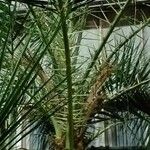
Phoenix reclinata
Senegal date palm · Wild date palm · Isundu · Reclining Date Palm · Senegal date
Description
Source: leafsnapPhoenix reclinata, commonly known as the Senegal date palm, is a species of palm tree native to Africa. This tall, slender tree can reach heights of up to 15 meters. The trunk of the Senegal date palm is covered in rough, fibrous bark, which can be utilized for making ropes and baskets. The leaves of Phoenix reclinata are pinnate, meaning they consist of multiple leaflets arranged on either side of a central stem. These long, narrow leaflets with pointed tips contribute to the tree's elegant appearance. The Senegal date palm produces small yellow flowers that grow in clusters at the base of its leaves. These flowers develop into small black or red fruits that resemble dates but are not edible by humans. Phoenix reclinata is commonly used as an ornamental plant due to its attractive appearance and its ability to tolerate drought conditions. Additionally, it holds cultural significance in many African countries, where it has been used for medicinal purposes or as a source of food for both humans and animals. Overall, Phoenix reclinata is an impressive plant with numerous practical and aesthetic uses, making it popular among gardeners worldwide.
🌳 Although the senegal date palm is primarily admired for its ornamental qualities, its uses reach into more inventive areas. The plant's fibers are used to weave baskets, and its sap functions as a fermenting agent in traditional brewing. In addition, research suggests its byproducts may be usable as a natural pesticide, underscoring its varied usefulness.
Care Guide
💧 Water Every 7 days
The Senegal date palm, native to arid regions, is known for its exceptional drought resistance. It grows well in areas with moderate humidity and needs watering every 1-2 weeks. As an evergreen plant, the Senegal date palm keeps its leaves throughout the year, so it's important to water it consistently in all seasons.
How should I water my Senegal date palm tree?
Your Senegal date palm is not very particular about how you water it. You can use any common watering tool, such as watering cans, hoses, or even cups, to moisten the soil. Regardless of the tool you choose, make sure to water the soil directly and evenly across all areas to provide enough water to the entire root system. Using filtered water is recommended as tap water may contain harmful particles. Also, it's a good idea to use water that is at or slightly above room temperature as extreme hot or cold water can be a bit of a shock for the Senegal date palm. However, overall, the Senegal date palm is quite adaptable and responsive to any type of water you give it.
What do I do if I give my Senegal date palm too much or too little water?
For outdoor plants, especially newly planted ones or seedlings, it's important to avoid under-watering. Remember to water them consistently for the first few months when they are small or just planted. Once the roots are established, Senegal date palms can rely on rain most of the time. When Senegal date palms are planted in pots, be careful not to overwater them. If you accidentally overwater your plant, take immediate action to fix the situation. First, stop watering the plant to mitigate the effects of overwatering. Then, remove the plant from its pot and check the roots for any sign of root rot. If there is no root rot, you can place the plant back in its container. However, if root rot is present, trim away the affected roots and consider using a fungicide to prevent further damage. Finally, replant the Senegal date palm in well-draining soil. In the case of under-watering, simply water the plant more frequently. This is often an easy fix. If you notice the leaves drooping, drying out, or falling off, it's a sign of under-watering. Once you water the plant sufficiently, the leaves should quickly regain their fullness. Remember to adjust your watering frequency as soon as you notice under-watering.
How often do I need to water my Senegal date palm?
Most outdoor plants can grow normally with rainwater. However, if your area doesn't receive much rainfall, you need to water your plants regularly. In the spring and fall, watering every two weeks should be enough, but during the summer, you'll need to water more frequently. In the winter, when plants grow slower and require less water, you can water them sparingly or not at all. If you have a young or newly planted Senegal date palm, you should water it more often to help it establish and become more adaptable to drought. For potted plants, there are two main ways to determine how often to water your Senegal date palm. One way is to follow a fixed watering schedule, either once a week or once every other week. However, this method may not consider the unique growing conditions for your palm. The other approach is to check the soil moisture. Wait until the top two to four inches of soil (about ⅓ to ½ depth of the pot) have completely dried out before watering again. This method allows you to adjust the watering frequency based on the season, as the plant's water needs are highest during summer.
How much water does my Senegal date palm require?
Watering your Senegal date palm may be different than expected. It doesn't always require a large amount of water. Instead, if only a few inches of soil have dried since the last watering, providing five to ten ounces of water each time will support healthy growth. You can also determine the water volume based on soil moisture. Take note of how many inches of soil have dried between waterings. To ensure your Senegal date palm receives adequate moisture, water enough to dampen all the dry layers of soil since the last watering. If more than half of the soil is dry, consider giving more water than usual. In such cases, continue adding water until you see excess water draining from the pot's holes. If your Senegal date palm is planted in a rainy outdoor area, it may not need additional watering. While young or getting established, it requires 1-2 inches of rain per week. As it matures, it can rely solely on rainfall, except during hot weather with no rain for 2-3 weeks. In such situations, provide a full watering to prevent stress for the palm.
How do I know if I'm giving enough water to my Senegal date palm plant?
The Senegal date palm commonly experiences issues with overwatering. To identify overwatering, look for yellowing leaves and leaf drop. Additionally, overwatering can lead to shriveled plant structure and root rot. On the other hand, an underwatered Senegal date palm will start to wilt and may have brown or brittle leaves. If you notice signs of either overwatering or underwatering, it is important to take action to restore the health of your Senegal date palm.
☀️ Light Full sun
The Senegal date palm requires abundant sunlight to encourage healthy growth. It performs best in places with plenty of sun, yet can also survive where sunlight is only moderate. Excessive sun can scorch the plant, while inadequate light can impede its growth. Native to sun-rich habitats, these light conditions are appropriate at every stage of the plant’s life cycle.
What are the sunlight requirements for Senegal date palm?
The Senegal date palm thrives in locations that receive ample sunlight, necessitating above 6 hours of sunlight for 'full sun' conditions and about 3-6 hours for 'partial sun' conditions. It's essential to observe how sunlight moves through your garden throughout the day to find the perfect spot for your plant, ensuring a healthy balance of light and shade suitable for its growth. Originally from regions abundant in sunlight, these conditions are crucial at every stage of its life cycle for optimal health.
How does artificial lighting benefit indoor Senegal date palms when natural sunlight is insufficient?
Indoor Senegal date palms require adequate lighting for optimal growth, especially when natural sunlight is scarce, such as during winter or in less sunny spaces. Artificial lighting serves as an effective substitute, promoting healthier and faster growth. LED lights are recommended for their ability to be customized to the specific light wavelengths needed by plants. Full sun plants need 30-50W/sq ft of artificial light, partial sun plants require 20-30W/sq ft, and full shade plants should have 10-20W/sq ft. The light source should be placed 12-36 inches above the plant, mimicking natural sunlight, and be kept on for 8-12 hours per day to simulate the natural daylight hours.
What are the symptoms of insufficient or excessive sunlight exposure in Senegal date palm?
Senegal date palms show various symptoms when they don't receive adequate sunlight or are exposed to too much sun. Insufficient light can cause smaller leaves, leggy growth, faster leaf drop, slower or halted growth, and pale new leaves indicating a lack of chlorophyll. Excessive sunlight can lead to chlorosis, where leaves turn yellow due to chlorophyll breakdown, sunscald which appears as pale or necrotic spots on leaves or stems, leaf curling as a defense against water loss, wilting from increased water loss, and leaf scorching characterized by brown, dry edges on leaves. These symptoms affect the plant's photosynthesis and overall health.
What strategies can be utilized to ensure optimal sunlight for indoor and outdoor Senegal date palms?
To optimize sunlight for Senegal date palms, gradually introduce them to sunnier locations, ideally moving them closer to a south-facing window or a spot with direct sunlight for at least 6 hours daily. For plants that are large or difficult to move, consider using artificial lighting for at least 8 hours a day to supplement light intake. When dealing with outdoor palms, it's vital to move them gradually to avoid sunburn from sudden changes in light intensity. Pruning nearby trees to reduce shade or transplanting smaller plants during their dormant period can also help increase sunlight exposure. It's important to note that parts of the plant already affected by poor light may not recover, but new growth should be healthy with improved light conditions.
🌡️ Temperature 20–37.8°C
The Senegal date palm comes from tropical areas, where the climate is generally warm and humid. As a result, it is adapted to high temperatures and humidity. It is sensitive to sudden temperature changes and prefers a consistent thermal environment, so avoiding indoor temperature fluctuations is important. It generally does not tolerate cold and requires warmer conditions for growth. If temperatures fall too low, the plant may stop growing or even die.
💨 Humidity dry (<40%)
This plant prefers dry conditions, so don't mist it. However, watering it less often can also thrive in higher humidity.
🪴 Soil 6-7
🌱 Fertilizer
Early spring, as a Senegal date palm comes out of dormancy, is the best time to apply fertilizer. This encourages overall growth and supports flower formation. Fertilizing improves the leaves, stems, and branches, and helps produce flowers that are large, vivid, and long-lasting. It assists in moving nutrients from the roots to the flowers and strengthens the plant’s health and resistance to disease.
🪴 Pot & Repot 1-2 years
Repot the Senegal date palm every 1–2 years in the spring to support its upright growth. Use a large and sturdy container, and make sure to water it generously after repotting. Place the plant in bright, indirect light to help it recover. Regular pruning will encourage a healthy shape and promote vigor.
✂️ Pruning
The Senegal date palm is characterized by its graceful, feathery leaves and clumping growth habit. To maintain its health and appearance, prune the plant in early spring. This is the optimal time to remove any damaged fronds and to shape the plant. Make sure your tools are clean and sharp before you begin. Proper pruning improves airflow, reduces pest problems, and encourages vigorous growth, all of which align with the palm's natural growth cycle.
🌿 Propagating
🐛 Diseases & pets
☠️ Toxicity
Characteristics
- Plant Type
- Tree
- Life Cycle
- Perennial
- Genus
- Phoenix
- Family
- Arecaceae
- Hardiness Zone
- 9-11
- Mature Height
- 7.62 m to 10.67 m
- Mature Spread
- 3.66 m to 6.1 m
- Leaf Color
- Green
- Leaf Type
- Evergreen
- Flower Color
- Yellow, Cream
- Flower Size
- 1.02 cm to 2.03 cm
- Bloom Time
- Mid summer
- Planting Time
- Spring, Summer
- Harvest Time
- Mid summer, Late summer, Early fall
- Native Area
- Burkina Faso, Somalia, Angola, Namibia, Madagascar, Rwanda, Eritrea, Nigeria, Yemen, Kenya, Uganda, Tanzania, Zimbabwe, Guinea-Bissau, Benin, Sierra Leone, Equatorial Guinea, Cameroon, Liberia, Mozambique, Burundi, Ghana, Ethiopia, Botswana, Congo, Central African Republic, Saudi Arabia, Malawi, South Africa, Zambia, Sudan, Guinea, Togo, Senegal, Eswatini, Côte d'Ivoire, Gambia, Congo (DRC), Gabon