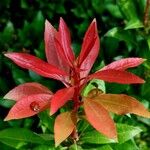
Photinia glabra
Description
Source: leafsnapPhotinia glabra, commonly known as Japanese photinia or Japanese Christmas berry, is an evergreen shrub that belongs to the Rosaceae family. Native to Japan and Taiwan, it has been widely cultivated around the world for its ornamental value. The plant can grow up to 10 meters tall and features glossy, dark green leaves that are oval-shaped with serrated edges. New leaves emerge as a bright red color, making the plant particularly attractive in the spring. Photinia glabra produces small white flowers in clusters during late spring or early summer, followed by red berries that ripen in autumn and persist through winter. Though inedible, these berries add a vibrant touch of color to the garden. The plant prefers well-drained soil and full sun exposure, though it can tolerate partial shade. It is relatively easy to grow and maintain, requiring minimal pruning except for shaping purposes. In addition to its ornamental use, Photinia glabra has medicinal properties. Traditionally, its leaves have been used to treat various ailments such as fever, coughs, and sore throats. Overall, this evergreen shrub is an excellent choice for gardeners seeking a low-maintenance yet visually appealing plant. Its year-round interest is due to its colorful foliage and berries.
🌳 Japanese photinia is mainly recognized for its decorative value in landscaping and gardens, but its potential goes beyond its appearance. Although often overlooked, Japanese photinia can be used as an attractive subject for bonsai creation, linking to the Japanese art of cultivating small, ornamental trees. Its capacity to tolerate heavy pruning makes Japanese photinia a feasible choice for this delicate craft, possibly translating its elegance into miniature forms for indoor and outdoor spaces.
Care Guide
💧 Water Every 7 days
Japanese photinia, native to moderate climates, is drought-tolerant but prefers soil that stays consistently moist, allowing it to dry out between waterings. It's best to water this plant every 2-3 weeks. To help retain moisture, especially since Japanese photinia is typically grown outdoors due to its size and growth habits, consider using mulch.
☀️ Light
What are the sunlight requirements for Japanese photinia?
Japanese photinia thrives best in environments with ample sunlight throughout the day, though it can also tolerate slightly filtered or partially obstructed light. Full sun, categorized as above 6 hours of sunlight per day, is ideal, with partial sun, about 3-6 hours of sunlight daily, being acceptable. Insufficient light may lead to health decline, whereas too much direct exposure can also be harmful. Observing the movement of sunlight in your garden and placing the plants in spots that offer a good balance of light and shade will enhance their growth and health.
How can artificial lighting be used for indoor Japanese photinia plants?
For indoor Japanese photinia plants, when natural sunlight is insufficient, especially during winter or in less sunny locations, artificial lights provide an essential alternative. Using LED lights, which can be customized to offer specific wavelengths needed by your plants, helps promote healthier, faster growth. It's recommended to provide full sun plants with 30-50W/sq ft of light, partial sun plants with 20-30W/sq ft, and full shade plants with 10-20W/sq ft. Place the light source 12-36 inches above the plant, mimicking natural sunlight as closely as possible, and ensure it receives 8-12 hours of light daily.
What are the signs of insufficient light or overexposure in Japanese photinia?
Signs of light deficiency in Japanese photinia include small, newer leaves, leggy or sparse growth, early leaf drop, halted new growth, and lighter-colored new leaves. Overexposure to sunlight can lead to chlorosis, where leaves turn yellow due to chlorophyll breakdown, sunscald with necrotic plant tissue, leaf curling as a defense mechanism against water loss, wilting from excessive transpiration, and leaf scorching characterized by brown, dry leaf edges.
What solutions can help Japanese photinia experiencing improper light conditions?
For Japanese photinia struggling with light conditions, indoor solutions include gradually moving the plant to sunnier spots to achieve at least 6 hours of sunlight daily, utilizing south-facing windows, and considering artificial lights if relocation isn't feasible, ensuring 8 hours of exposure. Outdoors, similarly, plants should be gradually introduced to sunnier locations to prevent shock. If sunlight is obstructed, consider pruning or transplanting during dormant phases to more sunlit areas, minimizing sunblocks like trees or buildings and enhancing growth and health.
🌡️ Temperature 0–32°C
Japanese photinia is native to areas where temperatures typically range from 32 to 90 °F (0 to 32 ℃). The plant favors moderate climates. If temperatures become extreme, be sure to protect it or move it indoors.
💨 Humidity
🪴 Soil
🌱 Fertilizer
Timing is important when fertilizing Japanese photinia. Apply fertilizer in early spring and continue monthly until early summer. Fertilizer encourages attractive blooms and supplies energy during both dormant periods and active growth.
🪴 Pot & Repot Every 12 months
✂️ Pruning
Japanese photinia is known for its glossy leaves and vibrant red new growth. To keep the plant healthy and looking its best, it's important to prune it annually in late spring, right after it finishes blooming. Focus on trimming away any dead branches and thinning out crowded areas to improve air circulation. Additionally, removing faded flowers can help increase the plant's vigor, enhance its appearance, and promote healthier growth overall.
🌿 Propagating
🐛 Diseases & pets
☠️ Toxicity
Characteristics
- Plant Type
- Shrub
- Life Cycle
- Perennial
- Genus
- Photinia
- Family
- Rosaceae
- Hardiness Zone
- 3-8
- Mature Height
- 3.05 m to 7.01 m
- Mature Spread
- 3.05 m to 4.57 m
- Leaf Color
- Green, Red
- Leaf Type
- Evergreen
- Flower Color
- White
- Flower Size
- 0.76 cm to 0.76 cm
- Bloom Time
- Late spring, Early summer
- Planting Time
- Spring, Autumn
- Harvest Time
- Mid summer, Late summer
- Native Area
- Vietnam, Myanmar, Japan, Thailand, China