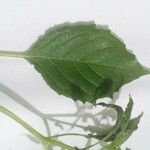
Physalis minima
Wild gooseberry · Annual ground-cherry · Sunberry · Green-gooseberry · Pygmy Groundcherry
Description
Source: leafsnapPhysalis minima is a species of perennial herbs belonging to the family Solanaceae. Native gooseberry, wild cape gooseberry and pygmy groundcherry are some of the popular common names in English. It is a pantropical annual herb 20–50 cm high at its maturity. It can be found near the marshes of Java. Leaves are soft and smooth (not furry), with entire or jagged margins, 2.5–12 cm long. Cream to yellowish flowers are followed by edible yellowish fruit encapsulated in papery cover which turns straw brown and drops to the ground when the fruit is fully ripe. The plant tends to have a weedy character, often found growing in disturbed sites.
🌳 Physalis lagascae can signal the presence of certain soil metals, including copper and zinc. Its occurrence in a location can inform farmers and botanists that the soil contains these essential elements, a fact that is important for understanding plant nutrition and planning agricultural practices. Using Physalis lagascae as a bioindicator can contribute to more sustainable farming by reducing the need for artificial soil testing.
🎭 Love, luck. Employed in love spells, its symbolism consists of love, temptation, passion, and rewarded effort.
Care Guide
💧 Water
☀️ Light Full sun
Physalis lagascae requires maximum exposure to sunlight throughout the day to grow vigorously. Native to areas with abundant sun, it does best in those conditions. However, both insufficient and excessive sunlight can harm its health, potentially stunting growth or damaging leaves.
🌡️ Temperature 20–37.8°C
Physalis lagascae thrives at temperatures between 68 and 100 ℉ (20 and 38 ℃). Native to warm areas, the plant tolerates hot summers well. In colder months, it is advisable to keep temperatures above 50 ℉ (10 ℃) to lessen the chance of damage.
💨 Humidity
🪴 Soil 6-7
🌱 Fertilizer
Physalis lagascae benefits from regular, dilute fertilizer applications to encourage healthy leaf growth. Fertilize Physalis lagascae about once a month during the summer. Nitrogen is essential for foliage, and providing nitrogen-rich sources helps Physalis lagascae thrive.
🪴 Pot & Repot
✂️ Pruning
🌿 Propagating
🐛 Diseases & pets
☠️ Toxicity
Characteristics
- Plant Type
- Herb
- Life Cycle
- Annual
- Genus
- Physalis
- Family
- Solanaceae
- Hardiness Zone
- 9-11
- Mature Height
- 49 cm to 76 cm
- Mature Spread
- 30 cm to 46 cm
- Leaf Color
- Green
- Leaf Type
- Deciduous
- Flower Color
- Yellow
- Flower Size
- 2.03 cm
- Bloom Time
- Late spring, Early summer, Mid summer
- Planting Time
- Spring
- Harvest Time
- Mid summer
- Native Area
- Colombia, Belize, Cuba, Honduras, Mexico, Guatemala, Venezuela, Peru, El Salvador, Nicaragua, Ecuador, Costa Rica, Panama