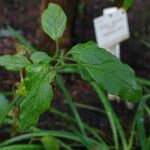
Physalis viscosa
Grape ground-cherry · Perennial ground-cherry · Stellate ground-cherry · Sticky Cape-gooseberry · Sticky ground-cherry
Description
Source: leafsnapPhysalis viscosa is a species of flowering plant in the nightshade family known by many common names, including starhair groundcherry, stellate ground-cherry and grape groundcherry in English, and arrebenta-cavalo, balãozinho, and camambú in Portuguese and Spanish (from Guaraní akamambu, «blister»). It is native to South America, and it is known on other continents as an introduced species and sometimes a weed. It can grow in many types of habitat, including disturbed areas. This is a rhizomatous perennial herb producing hairy stem up to about 40 centimeters in maximum height. The oval leaves are 3 to 5 centimeters long and have smooth or toothed edges. The flowers blooming from the leaf axils are bell-shaped and about 1.5 centimeters wide. They are yellow with darker centers, and have five stamens tipped with yellow anthers. The calyx of sepals at the base of the flower enlarges as the fruit develops, becoming an inflated, ribbed, lanternlike structure 2 to 3 centimeters long which contains the berry.
🌳 An interesting ecological role of the husk tomato is its function as a bioindicator. This plant has demonstrated the ability to signal the presence and concentration of certain metal elements in the soil. Researchers focused on phytoremediation use husk tomato to track soil health and detect contamination levels, supporting environmental assessments.
Care Guide
💧 Water Every 7 days
The starhair groundcherry thrives in moist environments and requires soil that stays consistently damp. It has a moderate tolerance for drought but generally needs to be watered once a week. This plant is primarily grown outdoors, and its growth cycle is greatly influenced by rainfall patterns. As a result, you may need to adjust your watering schedule according to the changes in seasons.
How should I water my Starhair groundcherry plant?
To properly water the Starhair groundcherry, it is recommended to use filtered water at room temperature. Tap water may contain harmful particles, so filtered water is preferable. The water should not be cold, as the plant is accustomed to a warmer environment and cold water can be stressful. It is best to avoid overhead watering, as it can cause problems with the foliage. Instead, pour the filtered room temperature water directly onto the soil until it is completely soaked. This helps to moisturize the roots and support their growth and nutrient absorption in the soil.
What should I do if I give too much or too little water to my Starhair groundcherry plant?
When caring for your Starhair groundcherry, both overwatering and underwatering can harm its health. Overwatering is more common and can cause wilting, yellowing, and diseases like root rot, mold, and mildew. Underwatering is less likely, but it can make the leaves brittle and brown. To prevent damage from overwatering, watch for early signs, reduce watering if needed, and improve soil drainage. For underwatering, simply water more regularly until the signs improve.
How often do I need to water my Starhair groundcherry plant?
If your Starhair groundcherry is in a pot, you can check if it needs water by sticking your finger in the soil. If the top few inches of soil are dry, it's time to water it. The same method can be used if you grow it in the ground outdoors. Usually, during spring and early fall, watering once a week is enough. But in extremely hot weather, you might need to water it twice or more per week. However, mature Starhair groundcherries are quite resilient and can survive dry periods.
How much water does my Starhair groundcherry plant need?
To properly water your Starhair groundcherry, don't be afraid to give it a good amount of water. When the top two to three inches of soil are dry, it's time for a thorough watering. Make sure to wet the soil completely, allowing excess water to drain through the pot's holes. If you don't see any water draining out, you may have not watered enough. However, be careful not to let water collect in the soil, as this can harm the plant. If there is no drainage, it could mean that the soil is not draining well, which is not good for the plant's health. If the plant is outside, around 1 inch of rainfall per week should be adequate.
How do I water my Starhair groundcherry at different times when it is growing?
The watering requirements of the Starhair groundcherry can vary depending on its growth stages. In the first few years of its life or when it is transplanted to a new location, you should provide more water than usual. During these stages, the plant focuses on developing new roots that support future growth, and these roots benefit from slightly increased moisture. As the plant matures, it will require less water. Another growth stage when the plant may need more water is during the bloom period. Flower development requires a significant amount of moisture, so additional watering may be necessary during this time.
☀️ Light Full sun
Husk tomato grows best with constant sunlight; without it, its development can be stunted. It can, however, adjust to situations with somewhat less light than usual. Still, too much sun may scorch the leaves, while too little can reduce fruit production.
What are the sunlight requirements for Starhair groundcherry?
Starhair groundcherry requires full sun, meaning it needs above 6 hours of sunlight daily to thrive best. It can also adjust to partial sun conditions, where it gets about 3-6 hours of sunlight. This plant originates from bright, tropical environments, favoring direct sunlight but capable of adapting well to slightly shaded areas as well. Remember to watch how sunlight moves through your garden to find spots that offer the perfect balance of light and shade to ensure the happiness and health of your plants.
How can artificial lighting be used for indoor Starhair groundcherry plants?
For indoor Starhair groundcherry plants, when natural sunlight is insufficient, particularly during winter or in less sunny spaces, artificial lighting becomes essential. LED lights are preferred because they can be customized to provide specific wavelengths your plants need. Full sun plants require 30-50W/sq ft, partial sun plants 20-30W/sq ft, and full shade plants 10-20W/sq ft of artificial light. The light source should be placed 12-36 inches above the plant, mimicking natural sunlight, and most plants need 8-12 hours of light per day.
What are the symptoms of inadequate light for Starhair groundcherry?
Symptoms of inadequate light in Starhair groundcherry include smaller new leaves, leggy or sparse growth, faster leaf drop, slower or no new growth, lighter-colored new leaves, chlorosis (leaves turning yellow), sunscald (damaged leaves from intense sunlight), leaf curling, wilting, and leaf scorching. These symptoms indicate the plant may be struggling with the light conditions it's placed in, potentially leading to reduced health and growth.
What are the solutions for Starhair groundcherry plants experiencing light-related issues?
For light-related issues in Starhair groundcherry plants, solutions vary based on the plant's location. Indoors, gradually move the plant to a sunnier spot or use artificial light, ensuring it receives at least 6 hours of direct sunlight daily or 8 hours of artificial light if not easily movable. Outdoors, gradually adapt your plant to brighter conditions to avoid sunburn. For plants in the ground, reduce obstructions like pruning branches that block sunlight, or consider transplanting to a sunnier location during the plant's dormant period for better sunlight exposure. Note that parts of the plant affected by insufficient light may not fully recover, but new growth should be healthier with improved light conditions.
🌡️ Temperature 20–37.8°C
Husk tomato does best in its native growing environment at temperatures of 68 to 100.4 °F (20 to 38 ℃). It is heat-tolerant but may require seasonal adjustments under extreme conditions.
What is the ideal temperature range for Starhair groundcherry?
Starhair groundcherry, known botanically as Physalis viscosa, thrives in environments with temperatures that typically range from 68 to 95 °F (20 to 35 °C). It naturally adjusts to seasonal changes within these balmy temperatures. While it possesses some level of cold tolerance, it generally does not require special care when temperatures are above 0°C. However, if temperatures are expected to fall below freezing, it's necessary to implement temporary cold protection measures, like wrapping the plant with plastic film, fabric, or other materials, which should be removed once temperatures rise again.
How does Starhair groundcherry react to low temperatures, and what are the solutions?
Starhair groundcherry has a moderate tolerance to low temperatures but thrives best when the temperature remains above 20°C. During winter, ensuring the temperature stays above 0°C is essential. If temperatures drop to below -5°C, the leaves might start to droop, and while mild cases can see recovery, severe cases will result in the leaves wilting and eventually falling off. To combat frost damage, trim off the frost-affected parts and, to prevent future damage, wrap the plant with non-woven fabric or cloth and construct a wind barrier to protect it from cold winds.
What should I do if Starhair groundcherry experiences high temperatures?
In the summer, it's crucial to ensure that the Starhair groundcherry is not exposed to temperatures above 35°C. When temperatures exceed 38°C, you might notice the leaves changing color to a lighter shade, leaf tips drying and withering, leaves curling, and an increased risk of sunburn. To address this, trim away sunburned and dried-up parts of the plant. Relocate the plant to an area with shade during the midday and afternoon sun or use a shade cloth. Additionally, water the plant in the morning and evening to maintain soil moisture.
💨 Humidity
🪴 Soil 5-7
🌱 Fertilizer
Feed Husk tomato with organic or commercial fertilizer high in nitrogen for leaf growth, phosphorus for root development and blossoms, and potassium for photosynthesis and maximum fruit production. Plant in spring, amend the soil with compost or manure, and fertilize seedlings when they reach a height of 2-4 inches (5.1–10.2 cm). A lack of macronutrients causes slow growth, wilting, and problems with fruit quality.
🪴 Pot & Repot
✂️ Pruning
Starhair groundcherry is a low-growing perennial plant with hairy stems and bright yellow flowers. To promote bushiness and healthy growth, prune it from early to late spring before new growth begins. Make sure to remove any dead stems during this process. However, be cautious not to over-prune, as this can cause stress to the plant. For more detailed pruning instructions, refer to reliable horticultural sources on starhair groundcherry.
🌿 Propagating
🐛 Diseases & pets
☠️ Toxicity
Characteristics
- Plant Type
- Herb
- Life Cycle
- Annual
- Genus
- Physalis
- Family
- Solanaceae
- Hardiness Zone
- 10-12
- Mature Height
- 46 cm
- Mature Spread
- 46 cm to 61 cm
- Leaf Color
- Green, Dark Green
- Leaf Type
- Deciduous
- Flower Color
- Yellow
- Flower Size
- 0.76 cm to 1.27 cm
- Bloom Time
- Late spring, Early summer, Mid summer
- Planting Time
- Spring
- Harvest Time
- Mid summer
- Native Area
- Colombia, Bahamas, Belize, Cuba, Honduras, Mexico, Guatemala, Bolivia, Venezuela, Peru, Guyana, Nicaragua, Ecuador, Costa Rica, Panama, Jamaica