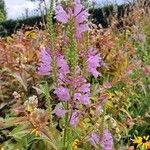
Physostegia correllii
Correll's False Dragonhead
Description
Source: leafsnapPhysostegia correllii is a species of flowering plant in the mint family known by the common name Correll's false dragonhead. It is native to northern Mexico, as well as Texas and Louisiana in the United States. Most occurrences are historical and have not been seen recently. Today it is known from one location in Travis County, Texas, and two or three locations in Louisiana, and its current distribution in Mexico is unknown.This rhizomatous perennial herb may reach heights over 2 meters. It produces spikes of flowers in June through September. The flowers are purple with darker streaks. The flowers are pollinated by bumblebees.This plant is a wetland species that can be found today in wet, disturbed areas such as drainage ditches.
Care Guide
💧 Water
☀️ Light Full sun
Correll's false dragonhead is a sun-loving, perennial herbaceous plant native to open habitats, frequently thriving in meadows and grasslands. It prefers full sun but can also tolerate partial sun.
🌡️ Temperature 5–35°C
Correll's false dragonhead can tolerate a wide range of temperatures, but its distribution may still be restricted by different combinations of moisture and heat. It performs best in warm summer climates with sufficient rainfall or watering. Extended periods of cloudy, rainy weather or prolonged high temperatures can increase the likelihood of Correll's false dragonhead dying. In winter, shielding the plant from cold can improve its chances of survival.
💨 Humidity
🪴 Soil 6-7
🌱 Fertilizer
Early spring, when Correll's false dragonhead is coming out of dormancy and starting active growth, is the best time to apply fertilizer. Fertilizing supplies essential nutrients needed for healthy development. Although Correll's false dragonhead has fairly low fertilizer requirements, feeding it annually can improve its survival and encourage stronger, longer-lasting blooms.
🪴 Pot & Repot
✂️ Pruning
Correll's false dragonhead is a perennial herb that produces spiky flowers in late summer. To promote healthy growth and abundant blooms, prune the plant in early spring. Additionally, remove spent flowers to encourage continuous flowering. Keep an eye on its spreading habit and trim as needed to control its size, which will enhance both its vitality and appearance.
🌿 Propagating
🐛 Diseases & pets
☠️ Toxicity
Characteristics
- Plant Type
- Herb
- Life Cycle
- Perennial
- Genus
- Physostegia
- Family
- Lamiaceae
- Hardiness Zone
- 5-9
- Mature Height
- 0.61 m to 1.22 m
- Mature Spread
- 30 cm to 61 cm
- Leaf Color
- Green, Dark Green
- Leaf Type
- Deciduous
- Flower Color
- Pink
- Flower Size
- 2.03 cm to 3.05 cm
- Bloom Time
- Early summer, Mid summer
- Planting Time
- Spring, Summer, Autumn
- Harvest Time
- Late summer, Early fall
- Native Area
- Mexico