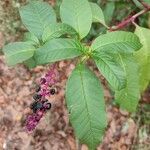
Phytolacca bogotensis
Southern pokeweed · Pokeweed · Text · Papa Cimarrona (ES) · Uva de Cão
Description
Source: leafsnapPhytolacca bogotensis, commonly known as the Colombian pokeberry, is a perennial herbaceous plant belonging to the Phytolaccaceae family. Native to South America, it can be found in countries such as Colombia, Ecuador, Peru, and Venezuela. The plant can grow up to 2 meters in height and features a thick stem with large, oval-shaped leaves that have pointed tips. Its small flowers are either white or greenish-yellow, and it produces dark purple berries containing numerous seeds. Traditionally, indigenous communities have used Phytolacca bogotensis for its anti-inflammatory properties. Additionally, its deep purple color has made it a popular natural dye for textiles. However, it is important to note that all parts of this plant contain toxic substances like saponins and oxalates, which can cause severe gastrointestinal distress if improperly ingested. Overall, Phytolacca bogotensis is a fascinating plant with both medicinal properties and potential dangers if not handled correctly.
🌳 One interesting aspect of tropical Pokeweed is its possible role as a bioindicator. This means tropical Pokeweed may exhibit visible responses to certain environmental contaminants or soil conditions, potentially acting as an early warning system for ecosystem health. While there are few widely known applications, researchers could explore this potential further by examining tropical Pokeweed's response to different levels of soil nutrients or contaminants to assess overall environmental quality.
Care Guide
💧 Water Every 7 days
Southern pokeweed, a plant native to moist habitats, thrives when it receives consistent hydration. To keep its soil evenly moist, it should be watered weekly. This outdoor species, accustomed to temperate regions, benefits from seasonal rainfall, which encourages lush growth during its active growing season.
☀️ Light Full sun
Tropical pokeweed grows best when it receives plenty of light. Generally, full sun promotes its optimal development, though it can still do reasonably well with some shade. Too much or too little light may affect the plant's vitality, mirroring the light conditions of its original habitat.
🌡️ Temperature 20–37.8°C
Tropical Pokeweed is native to regions with mild temperatures between 68 and 100.4 °F (20 and 38 ℃). It prospers in warm climates and, in colder areas, may need seasonal adjustments to replicate its native conditions.
💨 Humidity
🪴 Soil 6-7
🌱 Fertilizer
Tropical Pokeweed needs the most fertilizer during its active growth period, which occurs mainly in spring, summer, and early fall. Fertilization is required to supply essential nutrients the soil may lack, encouraging healthy root and stem growth and producing attractive foliage, a notable characteristic of this plant.
🪴 Pot & Repot
✂️ Pruning
Southern pokeweed is a hardy perennial plant characterized by its large, dark-green leaves and small white flowers. To maintain its health and appearance, prune the plant in early spring. This will help remove dead branches and encourage healthy new growth. Pruning also manages the plant's size, prevents overcrowding, and promotes robust, multi-stemmed growth. For the best results, always use clean and sharp tools.
🌿 Propagating
🐛 Diseases & pets
☠️ Toxicity
Characteristics
- Plant Type
- Herb
- Life Cycle
- Perennial
- Genus
- Phytolacca
- Family
- Phytolaccaceae
- Hardiness Zone
- 9-11
- Mature Height
- 3.05 m
- Mature Spread
- 1.22 m to 2.44 m
- Leaf Color
- Green, Dark Green
- Leaf Type
- Deciduous
- Flower Color
- Pink, Purple, Red
- Flower Size
- 0.51 cm to 1.02 cm
- Bloom Time
- Late spring, Early summer, Mid summer
- Planting Time
- Spring
- Harvest Time
- Mid summer, Late summer, Early fall
- Native Area
- Colombia, Belize, Cuba, Honduras, Mexico, Bolivia, Venezuela, Peru, Nicaragua, Ecuador, Costa Rica, Panama, Jamaica