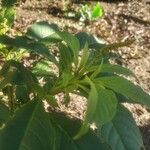
Phytolacca icosandra
Red inkplant · Tropical pokeweed · Button pokeweed
Description
Source: leafsnapPhytolacca icosandra, commonly known as the inkberry or ombú, is a large evergreen tree native to South America. It can grow up to 60 feet tall with a broad canopy that can extend up to 50 feet in diameter. The tree features a thick trunk and branches covered in rough bark. The leaves of the inkberry are simple, alternate, and ovate-shaped with smooth margins. They are dark green on top and lighter green on the underside. The plant's small, white flowers, which have five petals, grow in clusters at the ends of branches. The fruit of Phytolacca icosandra is a small, berry-like drupe that is initially green but turns black when ripe. It contains several seeds that can be used for propagation. Inkberry trees thrive in full sun or partial shade with well-draining soil, although they can tolerate poor soil conditions and drought once established. Due to their unique appearance, they have been used for ornamental purposes. Moreover, they possess medicinal properties and have been used to treat skin conditions such as eczema and psoriasis. Overall, Phytolacca icosandra is a fascinating plant species notable for its large size, evergreen nature, unique appearance, and medicinal properties, making it an important part of South American flora and biodiversity conservation efforts today.
🌳 One interesting aspect of tropical Pokeweed is its possible role as a bioindicator. This means tropical Pokeweed may exhibit visible responses to certain environmental contaminants or soil conditions, potentially acting as an early warning system for ecosystem health. While there are few widely known applications, researchers could explore this potential further by examining tropical Pokeweed's response to different levels of soil nutrients or contaminants to assess overall environmental quality.
Care Guide
💧 Water Every 7 days
Tropical Pokeweed flourishes in moist environments, needing a steady supply of water and consistently damp soil. To maintain ideal moisture levels, water the plant weekly. When grown outdoors, applying mulch can help retain moisture and regulate soil temperature, improving water efficiency and supporting the plant's overall health.
How should I water my Tropical Pokeweed?
To ensure the health of the Tropical Pokeweed, it is best to use filtered water at room temperature for watering. Tap water may contain harmful particles, so filtered water is preferred. It is important to use room temperature or slightly warm water because the plant is accustomed to warm environments and cold water can be a shock. Additionally, avoid watering from above, as this can cause problems with the leaves. Instead, water the plant by applying filtered room temperature water directly to the soil until it is fully soaked. This helps the roots stay moist and allows them to spread and collect nutrients effectively.
What can I do if I give my Tropical Pokeweed too much water or too little water?
Overwatering is a common issue for Tropical Pokeweed and can lead to wilting, yellowing leaves, and various diseases like root rot. Underwatering is less likely but can cause brittle, brown leaves. It's crucial to notice signs of overwatering promptly, as some diseases may become irreversible. If you notice early signs, reduce your watering and improve soil drainage. If you suspect underwatering, increase watering until the signs improve.
How often should I water my Tropical Pokeweed plant?
If your Tropical Pokeweed is in a pot, you can check if it needs water by sticking your finger in the soil. If the top layer of soil, about two to three inches, feels dry, then it's time to water it. The same method can be used if you have the plant growing outdoors in the ground. In spring and early fall, watering once a week is usually sufficient. However, during very hot weather, you may need to water it twice a week or even more. It's worth noting that mature and well-established Tropical Pokeweed plants are quite resilient and can tolerate dry conditions.
How much water does my Tropical Pokeweed require?
To properly care for your Tropical Pokeweed, make sure to give it enough water. When the top two to three inches of soil are dry, it's time to water. Give it a thorough watering that completely soaks the soil. The water should be enough to cause excess water to drain out from the bottom of the pot. If you don't see any excess water draining, you may not have given enough water. However, be careful not to let the water accumulate inside the soil, as this can harm the plant. If water is not draining well, it may indicate poorly draining soil, which is not good for the plant's health. If the plant is outside, about one inch of rain per week should be sufficient.
How do I water my Tropical Pokeweed when it's growing at different stages?
The water requirements of the Tropical Pokeweed vary depending on its growth stages. When the plant is in its early years or has just been transplanted, it requires more water. During these stages, the focus is on growing new roots to support future growth, and these roots benefit from slightly higher moisture levels. As the Tropical Pokeweed matures, it will need less water. Another stage that requires increased watering is during the bloom period, as flower development requires a significant amount of moisture.
☀️ Light Full sun
Tropical pokeweed grows best when it receives plenty of light. Generally, full sun promotes its optimal development, though it can still do reasonably well with some shade. Too much or too little light may affect the plant's vitality, mirroring the light conditions of its original habitat.
What are the sunlight requirements for tropical Pokeweed?
Tropical Pokeweed requires an abundance of light exposure to thrive, ideally full sun exposure, which means above 6 hours of direct sunlight daily. However, it can still survive fairly well with partial sun, about 3-6 hours of sunlight. Its vitality could be altered with either an excess or shortage of light, hinting at the light conditions of its original habitat. It's essential to watch how sunlight moves through your garden and choose spots that provide a balance of light and shade, ensuring the plants' happiness.
How does artificial lighting support indoor tropical Pokeweed growth?
Indoor tropical Pokeweed requires adequate lighting for optimal growth, especially when natural sunlight is insufficient, such as in winter or less sunny spaces. Artificial lights are a vital solution, with LED lights being a popular choice because they can provide the specific wavelengths needed by the plants. For artificial lighting, full sun plants need 30-50W/sq ft, partial sun plants need 20-30W/sq ft, and full shade plants need 10-20W/sq ft. The light source should be placed 12-36 inches above the plant, mimicking natural sunlight, and plants typically need 8-12 hours of light per day.
What are the symptoms of inadequate lighting in tropical Pokeweed?
Symptoms of inadequate lighting in tropical Pokeweed include smaller new leaves, leggy or sparse growth, faster leaf drop, slower or no new growth, lighter-colored new leaves, chlorosis, sunscald, leaf curling, wilting, and leaf scorching. These symptoms indicate that the plant is not receiving enough light, leading to a range of issues from reduced growth to potential damage caused by overexposure to sunlight.
What solutions can help tropical Pokeweed with inadequate lighting?
For indoor tropical Pokeweed, gradually moving the plants to a sunnier location each week until they receive at least 6 hours of direct sunlight daily is recommended. Using a south-facing window and keeping curtains open during the day maximizes sunlight exposure. Artificial light, like desk lamps or professional plant grow lights, can also supplement light exposure for at least 8 hours daily. For outdoor plants, move them gradually to the best spot for sunlight, avoiding sudden changes in light intensity. If sunlight is obstructed, consider pruning obstructive branches or transplanting smaller plants to a location with ample sunlight and good drainage to minimize obstructions and ensure healthy growth.
🌡️ Temperature 20–37.8°C
Tropical Pokeweed is native to regions with mild temperatures between 68 and 100.4 °F (20 and 38 ℃). It prospers in warm climates and, in colder areas, may need seasonal adjustments to replicate its native conditions.
What is the native environment of Tropical Pokeweed?
Tropical Pokeweed is native to environments that enjoy mild temperatures, typically ranging from 68 to 100.4 °F (20 to 38 °C). It thrives in warm climates and may need adjustments in colder climates to mimic its natural habitat. This plant loves heat, and exposure to cold can harm it. In colder months, it's advised to bring the plant indoors, placing it near a bright window but away from direct heat sources, to maintain temperatures above 20°C, ensuring its continuous growth. Exposing the plant to temperatures near or below 0°C can be detrimental.
How does low temperature affect Tropical Pokeweed, and what are the solutions?
Tropical Pokeweed prefers warm environments and struggles with low temperatures. It flourishes when the temperature is above 20°C and requires a minimum temperature above 0°C during the winter months. Exposure to temperatures below -5°C can cause the leaves to lighten in color, and following frost damage, they may turn brown or black. The plant may also show signs of wilting and drooping under such conditions. To address this, the frost-damaged parts should be trimmed, and the plant should be moved indoors to a warmer spot, ideally near a south-facing window, while avoiding placement near heaters or air conditioning vents to prevent air dryness.
How should you care for Tropical Pokeweed in high temperatures?
During the hotter months, it is crucial to ensure that the temperature around Tropical Pokeweed stays below 38°C to prevent heat stress. When temperatures exceed 43°C, the plant's leaves can lighten, making it more prone to sunburn. To mitigate this, sunburned or dried parts of the plant should be trimmed away, and the plant should be moved to a location with afternoon shade. Watering the plant early in the morning and later in the evening helps maintain soil moisture, offering relief from the heat.
💨 Humidity
🪴 Soil 6-7
🌱 Fertilizer
Tropical Pokeweed needs the most fertilizer during its active growth period, which occurs mainly in spring, summer, and early fall. Fertilization is required to supply essential nutrients the soil may lack, encouraging healthy root and stem growth and producing attractive foliage, a notable characteristic of this plant.
🪴 Pot & Repot
✂️ Pruning
Tropical Pokeweed is a tall plant known for its vibrant berries. To maintain its size and encourage healthy growth, it's best to prune it from early to late spring. Remove any dead or overcrowded branches to improve airflow and light penetration. Regular pruning helps keep the plant healthy and well-shaped, which supports disease prevention and stimulates new growth.
🌿 Propagating
🐛 Diseases & pets
☠️ Toxicity
Characteristics
- Plant Type
- Herb
- Life Cycle
- Perennial
- Genus
- Phytolacca
- Family
- Phytolaccaceae
- Hardiness Zone
- 9-11
- Mature Height
- 3.05 m
- Mature Spread
- 1.22 m to 2.44 m
- Leaf Color
- Green, Dark Green
- Leaf Type
- Deciduous
- Flower Color
- Pink, Purple, Red
- Flower Size
- 0.51 cm to 1.02 cm
- Bloom Time
- Late spring, Early summer, Mid summer
- Planting Time
- Spring
- Harvest Time
- Mid summer, Late summer, Early fall
- Native Area
- Colombia, Belize, Cuba, Honduras, Mexico, Bolivia, Venezuela, Peru, Nicaragua, Ecuador, Costa Rica, Panama, Jamaica