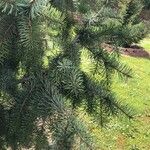
Picea breweriana
Brewer Spruce · Weeping spruce · Brewer's Spruce
Description
Source: leafsnapPicea breweriana, commonly known as Brewer's spruce, is a species of coniferous tree native to the western United States. Named after the botanist William Henry Brewer, who first discovered it in 1863, this tree can reach heights of up to 60 meters and features a narrow conical shape with dense foliage ranging from blue-green to dark green. The bark of Picea breweriana is thin and scaly, with a reddish-brown coloration. This tree thrives in cool, moist climates with well-drained soils and is typically found in mountainous regions at elevations between 1,500 and 2,700 meters above sea level. Brewer's spruce is highly valued for both its ornamental and practical uses. Its attractive appearance and rapid growth make it a popular choice for landscaping, while its strong and durable wood is often used in construction, including furniture making and building homes. Despite its relative abundance in some parts of the western United States, Picea breweriana is classified as an endangered species, primarily due to habitat loss from logging activities and wildfires that have devastated large areas of its natural habitat. Conservation efforts are underway to protect this important species from further decline, ensuring that future generations can continue to enjoy its beauty and benefit from its various uses.
Care Guide
💧 Water Every 7 days
Brewer's spruce, native to mountainous regions, flourishes in environments with intermittent moisture. It thrives in consistent humidity, so it should be watered every 1-2 weeks to mimic its natural wet cycles. As an evergreen, brewer's spruce benefits from being outdoors where it can naturally receive rainfall. This reduces the need for artificial watering during the growing season.
☀️ Light Full sun
Brewer's spruce is found in open habitats, such as sunny meadows and forest margins, which provide abundant light. It performs best in full sun but can tolerate partial sun, adapting well to a range of light conditions.
What are the sunlight requirements for Brewer's Spruce?
Brewer's Spruce, also known by its botanical name Picea breweriana, thrives best under specific sunlight conditions. For optimal growth, it requires 'Full sun,' which is above 6 hours of sunlight per day. Alternatively, it can also grow under 'Partial sun,' which is about 3-6 hours of sunlight per day. When selecting a spot for your Brewer's Spruce, it's important to observe the movement of sunlight through your garden to ensure you choose a location that provides a perfect balance of light and shade, guaranteeing the plant's happiness.
🌡️ Temperature 5–32.2°C
Brewer's spruce is highly adaptable to a range of climates, from scorching summers to chilly winters. Nevertheless, it has an optimal temperature range for growth. If temperatures become too high, the plant is vulnerable to heat and humidity stress, which can cause it to die. In areas where temperatures approach the lower limit of its cold tolerance, it is important to provide insulation to protect the plant.
What is Brewer's spruce?
Brewer's spruce, known botanically as Picea breweriana, is a specific species of spruce. This tree is recognized by its unique name and botanical classification, setting it apart from other species within the Picea genus.
💨 Humidity
🪴 Soil 6-7
🌱 Fertilizer
Brewer's spruce has distinct nutrient needs and does not require heavy fertilization. Fertilizing in spring is the best time to promote optimal growth. Supplying nutrients improves its health, strengthens resistance to pests and diseases, and helps support a long lifespan.
🪴 Pot & Repot
✂️ Pruning
Brewer's spruce benefits greatly from early spring pruning, which involves removing dead or diseased branches as well as any crossing limbs. This practice promotes healthy growth and improves overall air circulation. Light trimming helps prevent overcrowding and enhances the tree's overall health. By pruning at the right time, you can minimize stress on the tree and support optimal recovery.
🌿 Propagating
🐛 Diseases & pets
☠️ Toxicity
Characteristics
- Plant Type
- Tree
- Life Cycle
- Perennial
- Genus
- Picea
- Family
- Pinaceae
- Hardiness Zone
- 4-7
- Mature Height
- 21.95 m to 30.48 m
- Mature Spread
- 10.06 m
- Leaf Color
- Green
- Leaf Type
- Evergreen
- Bloom Time
- Mid spring, Late spring
- Planting Time
- Spring, Summer
- Harvest Time
- Late summer, Early fall, Mid fall