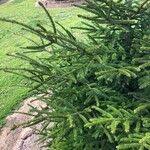
Picea orientalis
Caucasian spruce · Oriental Spruce · Spruce
Description
Source: leafsnapPicea orientalis, commonly known as the Oriental spruce, is a coniferous evergreen tree belonging to the Pinaceae family. Native to the Caucasus Mountains in Eurasia, it can reach heights of up to 30 meters and have a trunk diameter of up to 1 meter. The tree has a conical shape and dense foliage composed of short, dark green needles arranged spirally on its branches. The Oriental spruce is prized for its ornamental value and is frequently used in landscaping as an accent or specimen tree. It thrives in moist, well-drained soils and can tolerate both full sun and partial shade. Although it has a slow growth rate, the tree can live for several hundred years. Beyond its aesthetic appeal, Picea orientalis also has practical applications, such as timber production, owing to its strong wood properties. Additionally, its bark contains resin that has been used in traditional medicine to treat respiratory ailments. Overall, Picea orientalis is an impressive evergreen species with both ornamental and practical uses, making it an important plant in many parts of the world today.
Care Guide
💧 Water Every 7 days
Originating from mountainous regions, the oriental spruce prefers moderate moisture and can tolerate brief periods of dryness. It thrives with consistent moisture, as long as the soil is not waterlogged. It is recommended to water the tree every 1-2 weeks, allowing the soil to partially dry between waterings. As an evergreen, the oriental spruce requires careful watering during the growing season to maintain its foliage year-round.
How should I water my Oriental spruce?
Watering your Oriental spruce is an easy task. Simply use your garden hose to slowly soak the soil. This is the ideal watering method for large trees, as they require a high volume of water. However, smaller trees can be watered with a watering can or another smaller tool. It's important to avoid overhead watering as it can cause disease, especially in young trees.
What should I do if I give too much or too little water to my Oriental spruce?
Poor soil can sometimes lead to overwatering, causing the decline of your Oriental spruce. To address this issue, you can either improve the soil's drainage by amending it or relocate your plant to a more suitable spot. If you have your Oriental spruce in a container, you might need to use looser soil that allows for better drainage. Overwatering can also make your plant more susceptible to diseases, which should be treated promptly. On the other hand, if your Oriental spruce is underwatered, simply increase the frequency of watering to revive its health. To determine if you have overwatered your plant, check the foliage, especially the new growth. If new growth is discolored or easily breaks, it may indicate excessive moisture. Additionally, standing water or slow drainage in the plant's area can be signs of overly moist soil. Underwatered Oriental spruce trees will exhibit symptoms such as sparse, brown foliage. Consider recent heavy rainfall or consistently high temperatures when evaluating the cause of these symptoms.
How often should I water my Oriental spruce tree?
A mature Oriental spruce is very water-efficient and can survive on rainfall alone. During the hottest months, you may need to water it once a week, but the rest of the year it may not need any watering at all. Newly planted spruces need regular watering to help their roots establish, but be cautious not to overwater as Oriental spruces can't tolerate standing water.
How much water does my Oriental spruce tree require?
During the height of summer, you usually need to water your Oriental spruce once a week, giving it about one inch of water. But if it has rained an inch or more that week, you don't need to water it. For newly planted Oriental spruce, it requires more water during the establishment period. This means watering it once every one to two weeks for the first few growing seasons.
How often and in what way should I water my Oriental spruce tree throughout the different seasons?
During the summer months, when the weather is at its hottest, the Oriental spruce tree requires the most water. At this time, it is recommended to water the plant once a week if there is no rainfall. In other seasons, the tree can often survive without any water. However, in spring and fall, there might be a need for occasional watering if the weather is exceptionally hot, although this is rare. Unlike many other plants, the Oriental spruce does not go into full dormancy during winter. This means that it will continue to grow even in the coldest months. However, the water requirements during winter remain low because the cool temperatures do not cause the soil to dry out quickly.
☀️ Light Full sun
Oriental spruce comes from open habitats, such as sunny meadows and forest edges, which supply abundant light. It thrives in Full Sun but can also tolerate Partial Sun, adjusting well to different light conditions.
What are the sunlight requirements for Oriental spruce?
The Oriental spruce, or Picea orientalis, thrives in conditions that meet specific sunlight requirements. For optimal growth, it requires 'Full sun', which is characterized by receiving above 6 hours of sunlight daily. It can also do well in 'Partial sun' conditions, meaning about 3-6 hours of sunlight per day. When choosing a planting spot for your Oriental spruce, it's important to observe the movement of sunlight through your garden throughout the day. This observation will help you find the perfect balance of light and shade, ensuring the well-being of your plants. The provided warning highlights the importance of carefully selecting a location that meets these sunlight requirements to ensure the happiness and health of your Oriental spruce.
🌡️ Temperature 5–32.2°C
Oriental spruce is highly adaptable to a range of climatic conditions, whether facing hot summers or cold winters. Still, it has an optimal temperature range for growth. When temperatures become too high, the plant is susceptible to stress from heat and humidity, which can lead to its death. In areas where temperatures approach the lower limit of its cold tolerance, it is important to use insulation to protect the plant.
What is the Oriental spruce's botanical name?
The botanical name of the Oriental spruce is Picea orientalis.
💨 Humidity
🪴 Soil 6-8
🌱 Fertilizer
The Oriental spruce has specific nutrient needs and does not require heavy fertilization. Fertilizing in spring is the best time to encourage optimal growth. Supplying nutrients enhances its health, increases its resistance to pests and diseases, and helps sustain its long lifespan.
Why should I put plant food on my Oriental spruce tree?
Adding nutrients to the soil in the spring is beneficial for Oriental spruce, as it promotes healthy growth. Since this type of plant has a long lifespan, it requires support to thrive. Moreover, enriching the soil with nutrients not only improves the overall health of the plant but also helps it resist common pests and diseases, thus preventing stagnated growth or premature decline.
When should I fertilize my Oriental spruce tree?
Oriental spruce is not like typical garden plants as it does not need a lot of additional nutrients to grow well. In fact, the growing medium may not provide enough nutrients on its own. To support healthy growth, the best time to fertilize Oriental spruce is in the spring, before new growth starts to appear.
When is it not a good idea to add fertilizer to my Oriental spruce tree?
While some plants benefit from regular fertilization, Oriental spruce does not require excessive nutrients. In fact, over-fertilizing can lead to its decline. Therefore, it is best to only apply fertilizer during the spring season, and refrain from adding any fertilizer or organic matter during the summer, fall, and winter.
What kind of plant food does my Oriental spruce tree require?
The age of your plant is important for choosing the right fertilizer. However, Oriental spruce doesn't need a lot of extra nutrients. Look for a balanced plant food that promotes healthy root development and growth, but avoid fertilizers with high nitrogen contents.
How can I fertilize my Oriental spruce?
To fertilize Oriental spruce effectively, follow these steps: in the spring, apply the fertilizer around the base of the plant. Be careful not to get any fertilizer on the trunk. If you're using granulated fertilizer, cover the pellets with a light layer of soil. This will aid in the absorption of the fertilizer into the soil.
🪴 Pot & Repot
✂️ Pruning
Oriental spruce benefits from pruning during its dormant period, which is from early to late winter. During this time, focus on removing dead branches and reducing overcrowding to improve air circulation and sunlight exposure. Minimal pruning will help maintain the tree's shape. Use clean, sharp tools to make precise cuts, which promotes healthier growth and minimizes sap loss.
🌿 Propagating
🐛 Diseases & pets
☠️ Toxicity
Characteristics
- Plant Type
- Tree
- Life Cycle
- Perennial
- Genus
- Picea
- Family
- Pinaceae
- Hardiness Zone
- 4-7
- Mature Height
- 15.24 m to 18.29 m
- Mature Spread
- 4.57 m to 7.62 m
- Leaf Color
- Green
- Leaf Type
- Evergreen
- Flower Color
- Yellow, Purple, Red, Brown, Lavender, Burgundy, Gold
- Bloom Time
- Mid spring, Late spring
- Planting Time
- Spring, Summer
- Harvest Time
- Late summer, Early fall, Mid fall
- Native Area
- Turkey, Armenia, Azerbaijan