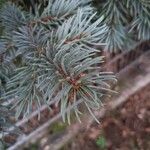
Picea pungens
Colorado Blue Spruce · Blue spruce · Colorado spruce · Pino real · Silver Spruce
Description
Source: leafsnapPicea pungens, commonly known as the Colorado blue spruce, is a species of evergreen conifer native to the Rocky Mountains of North America. It is a popular ornamental tree due to its striking blue-gray needles and conical shape. These sharp, stiff needles can reach up to 3 cm in length and are arranged in a spiral pattern around the branches. The tree produces cylindrical cones that can grow up to 10 cm long. Colorado blue spruce trees can reach heights of up to 30 meters and have trunk diameters of up to one meter. They prefer well-drained soils with full sun exposure but can also tolerate some shade. These hardy trees are capable of withstanding cold temperatures as low as -40°C. Beyond its ornamental appeal, Picea pungens has several practical uses, including lumber for construction and paper production, thanks to its strong wood fibers. Overall, Picea pungens is an attractive evergreen tree that enhances the beauty and value of any landscape where it is planted.
💡 The blue spruce held significant importance for the Navajo and Keres indigenous tribes. In their cultures, blue spruce twigs were gifted to bring good luck to the recipient. The wood from this tree was used in constructing structures, while its needles were brewed into tea infusions for treating ailments.
🌳 Blue spruce's vivid blue-green foliage decorates many homes at Christmas. Historically, native tribes relied on it to stave off starvation and harvested its resin for varnish, while its needles were brewed into a tea rich in vitamin C. Today, blue spruce wood is valued for producing top-quality timber, organ soundboards, and comfortable furniture. It is also a source of essential oils for fragrances and beauty products that capture its crisp, coniferous aroma.
🎭 brightness, vitality, origin, regeneration
Care Guide
💧 Water Every 7 days
Blue spruce thrives in dry, high-altitude habitats and is known for its drought tolerance and low water requirements. It is recommended to water the tree every 1 to 2 weeks. With its striking blue needles, blue spruce is a popular choice for landscaping. It adapts well to different levels of rainfall and soil moisture while maintaining its evergreen characteristics.
When should I water my Blue Spruce?
To determine the optimal watering time for Blue Spruce, check the soil moisture by inserting your finger about 1 to 2 inches deep into the soil; if it feels dry at this depth, it's time to water the plant. Additionally, observe the plant's leaves for wilting and the color and texture of the needles for signs of water stress, such as fading, yellowing, or brittleness. Seasonal changes also influence watering needs, requiring more frequent watering during hot and dry periods and less during cooler seasons or dormant periods. It's important to avoid watering too early when the soil is moist to prevent risks such as root rot and too late which might stunt the plant's growth.
How should I water my Blue Spruce?
To water Blue Spruce properly, adopt a deep and infrequent watering technique, focusing on the soil's top inch dryness as an indicator. Utilize a watering can with a narrow spout for targeted watering at the base of the plant to avoid wetting foliage, which can lead to disease. Considering using a moisture meter for precise soil moisture assessment, ensure that the planting area or container has adequate drainage to prevent waterlogged soil conditions. Misting can provide additional humidity, especially in dry environments, but avoid excess moisture and evening misting. Water earlier in the day, consider mulching to retain soil moisture, and use room temperature, chlorine-free water.
How much water does Blue Spruce really need?
Blue Spruce requires a considerable amount of water, which varies depending on the pot and plant size—from half a gallon for young plants in small pots to several gallons for mature plants. Aim to water deeply enough so moisture reaches several inches below the soil surface, mimicking the natural deep watering pattern of their native habitats. The signs of correct watering include shiny, silvery-blue needles and new growth. Monitor for signs of both over and underwatering, such as needle drooping or yellowing and adjust your watering practices accordingly to avoid risks of fungal diseases or plant death.
What kind of water is best for Blue Spruce?
Blue Spruce thrives on rainwater, tap water, or filtered water due to their natural mineral content. Distilled water is less preferable for regular use as it lacks the minerals essential for optimal growth. While Blue Spruce shows no significant sensitivities to tap water contaminants like chlorine or fluoride, letting tap water sit out before use helps evaporate residual chlorine, maintaining plant health. Moderate-temperature water is recommended to prevent temperature shock.
How do Blue Spruce's watering needs change with the seasons?
Blue Spruce's watering needs vary seasonally. In spring, increased activity and warming temperatures mean the tree requires proper hydration without waterlogging. Summer might call for more frequent watering due to higher evaporation rates, while in autumn, as the plant prepares for dormancy, reduce watering to keep the soil just barely damp. During winter, water needs significantly decrease; avoid overwatering to prevent root rot, adjusting for slower water consumption and ensuring soil does not freeze.
☀️ Light Full sun
The blue spruce performs best in full sunlight for optimal growth and tolerates moderately lit conditions well. It comes from regions where continuous sun is common. Too much light can scorch its needles, while too little light can diminish its sturdiness and overall health.
What are the sun requirements for blue spruce?
Blue spruce thrives in conditions of full sun, meaning it requires more than 6 hours of direct sunlight daily for optimum growth. It can also tolerate partial sun, which is about 3-6 hours of sunlight. However, it's important to monitor the sunlight exposure throughout your garden to ensure there's a suitable balance of light and shade for the well-being of your plants. Observing the movement of sunlight can help in selecting the ideal spots that fulfill the plant's needs while avoiding areas that might either overexpose or underexpose it to sunlight.
What are the essential growing conditions for blue spruce regarding light?
The blue spruce requires full light exposure to achieve its best growth, as it is naturally accustomed to environments with constant sun. While it can manage moderately lit environments, optimal growth is seen under full sun conditions. In cases where natural sunlight is insufficient, especially during winter or in less sunny areas, artificial lighting becomes essential. LED lights, which can provide specific wavelengths needed for plant growth, are recommended. The intensity of artificial light should be adjusted according to the plant's type; full sun plants need 30-50W/sq ft, partial sun plants require 20-30W/sq ft, and full shade plants should get 10-20W/sq ft. Furthermore, the artificial light source should be placed 12-36 inches above the plant and kept on for 8-12 hours per day to mimic natural daylight conditions. Overexposure to sunlight might cause needle scorching, whereas insufficient sunlight can weaken the blue spruce's robust nature.
What symptoms indicate that a blue spruce is getting inadequate light?
Blue spruce, when exposed to less than optimal lighting, may exhibit symptoms such as smaller new leaves compared to previous ones, leggy or sparse growth with increased spaces between leaves or stems, faster leaf drop, slower or halted growth, and pale or irregularly colored new leaves indicating a lack of chlorophyll. In addition, conditions like chlorosis (yellowing leaves due to chlorophyll breakdown), sunscald (damage from intense sunlight), leaf curling (a defense mechanism against excessive sunlight), wilting (loss of turgor pressure), and leaf scorching (brown, dry edges or patches on leaves) can occur under extreme sunlight conditions or insufficient light, indicating the plant's struggle with the current light environment.
What solutions can help improve light conditions for blue spruce?
To improve light conditions for blue spruce, consider these strategies: For indoor plants, gradually shift them to sunnier spots until they receive at least 6 hours of direct sunlight, using south-facing windows for maximum exposure. Artificial lighting, such as desk lamps or grow lights, can supplement sunlight, especially for large or immobile plants, for at least 8 hours a day. For outdoor plants, moving them gradually to better-lit areas can help them adapt without the risk of sunburn. It's crucial to make these changes progressively to avoid shocking the plants. For ground-planted species, reducing obstructions like pruning tree branches can increase sunlight access. If necessary, transplant smaller plants during their dormant period to a location with better sunlight and drainage. It's important to note that while affected parts might not recover, new growth will be healthy with improved light conditions.
🌡️ Temperature 0–32.2°C
In its native habitat, blue spruce grows best in temperatures from -40 to 23 ℉ (-40 to -5 ℃). It can, however, tolerate temperatures of 0 to 32 ℉ (-18 to 0 ℃) and prefers cooler conditions. During winter, it is important to avoid sudden temperature fluctuations that can harm its roots.
What are the optimal growth conditions for Blue Spruce?
Blue spruce (Picea pungens) thrives in its native growth environment with temperatures ranging from -40°F to 23°F (-40°C to -5°C). It can adapt to broader ranges from 0°F to 32°F (-18°C to 0°C), preferring cooler temperatures overall. It's crucial to avoid sudden temperature changes in winter that might harm its roots. Blue spruce is notably cold-tolerant and doesn't need special frost protection. However, it's beneficial to water the plant generously before the first freeze of autumn to keep the soil moist and help prevent drought and water scarcity during winter and early spring.
What should I do if the winter temperature drops below -40°C for a Blue Spruce?
Although Blue Spruce is extremely cold-tolerant, maintaining winter temperatures above -40°C is crucial. Temperatures dropping below this threshold can lead to the branches becoming brittle and dry by spring, with no new shoots emerging. To counteract this, prune any dead branches that failed to produce new leaves come spring.
How does high temperature affect Blue Spruce and what are the solutions?
Blue Spruce struggles with high temperatures, particularly those exceeding 32°C. Such conditions may result in significant leaf drop or, in severe cases, the entire plant withering and dying. To mitigate these effects, trim away sunburned and dried parts of the plant. Relocate the plant to a shadier spot or use a shade cloth to protect it from midday and afternoon sun. Ensure the soil is kept moist by watering the plant during cooler times of the day, such as morning and evening.
💨 Humidity high (>60%)
This plant needs special care because it loves high humidity levels of 60-80% or more. The best way to achieve this is by placing a humidifier near the plant. Daily misting is also essential! Make sure the room has good ventilation.
🪴 Soil 5-6
🌱 Fertilizer
Blue spruce has specific nutrient needs and does not require heavy fertilization. The best time to apply fertilizer for optimal growth is in spring. Providing nutrients improves its health, increases its resistance to pests and diseases, and helps sustain a long lifespan.
Why should I put plant food on my Blue spruce tree?
To promote healthy growth of Blue spruce in the spring, it is important to fertilize the plant. With its long lifespan, the plant requires support. Additionally, adding nutrients to the soil not only improves the plant's overall health but also enhances its ability to withstand common pests and diseases that can harm growth and lifespan.
When should I fertilize my Blue spruce tree?
Blue spruce, unlike garden annuals and perennials, doesn't need excessive nutrients and can grow well without them. Although the growing medium might not provide enough nutrients, Blue spruce doesn't require a lot of extra nourishment. To fertilize it, the best time is in the spring before new growth starts to appear.
When shouldn't I add fertilizer to my Blue spruce tree?
Unlike other plants, Blue spruce does not require frequent fertilization. Applying too much fertilizer can actually cause it to start dying back. To ensure its health, it is important to only apply fertilizer during the spring season and avoid doing so in the summer, fall, and winter. During these seasons, it is also recommended to refrain from adding any additional organic matter to the soil.
What kind of fertilizer should I use for my Blue spruce?
Consider the age of your plant when choosing a fertilizer. It's important to note that Blue spruce doesn't need excessive nutrients. Opt for a balanced plant food that promotes healthy root development and growth. Avoid fertilizers with high nitrogen contents.
How should I give my Blue spruce tree fertilizer?
When fertilizing Blue spruce, it is important to consider both the timing and method. In the spring, apply the fertilizer once, focusing on the base of the plant. Be careful not to get any fertilizer on the trunk. If you are using granulated fertilizer, cover the pellets with a thin layer of soil to promote absorption into the soil.
🪴 Pot & Repot 2-3 years
When repotting Blue spruce, select a pot 1-2 inches (2.5–5.1 cm) larger with ample drainage. Use a well-draining potting mix. Repot in spring or fall, making sure the root ball is slightly lower than the rim of the flower pot. Water thoroughly after repotting and place in a warm spot with indirect sunlight.
✂️ Pruning
The blue spruce is a resilient evergreen known for its striking blue-green needles. To maintain its health and appearance, prune it during the winter. Focus on removing dead branches and thinning out crowded areas to improve air circulation. Be careful not to cut the central leader, as preserving this natural shape encourages denser foliage and reduces the risk of disease.
🌿 Propagating
🐛 Diseases & pets
☠️ Toxicity
The Colorado blue spruce is a non-toxic plant for people and pets.
Characteristics
- Plant Type
- Tree
- Life Cycle
- Perennial
- Genus
- Picea
- Family
- Pinaceae
- Hardiness Zone
- 2-7
- Mature Height
- 10.06 m to 49.99 m
- Mature Spread
- 4.88 m
- Leaf Color
- Green, Blue, Gray, Silver
- Leaf Type
- Evergreen
- Flower Color
- Yellow, Red, Green
- Flower Size
- 7.62 cm to 15.24 cm
- Bloom Time
- Mid spring, Late spring
- Planting Time
- Spring, Autumn
- Harvest Time
- Mid summer, Late summer, Early fall
- Native Area
- From northern New Mexico through Colorado and Utah to Wyoming and into Alberta and British Columbia