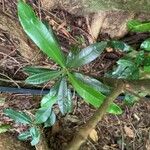
Pimenta racemosa
Bay rum tree · Bayrumtree · West Indian bay · Bay-rum-tree · Bayberry
Description
Source: leafsnapPimenta racemosa, commonly known as the West Indian bay tree, is a small to medium-sized evergreen tree that belongs to the Myrtaceae family. Native to the Caribbean, it can be found in countries such as Jamaica, Cuba, and Haiti. The plant features a dense crown of glossy leaves that release a pleasant aroma when crushed. These lance-shaped leaves can grow up to 10 centimeters long. The West Indian bay tree produces small white flowers that form clusters at the ends of branches. These flowers are followed by small black berries, each containing one or two seeds. For centuries, the plant has been valued for its medicinal properties. Its essential oil is used in aromatherapy for its calming effects on the mind and body, and its antiseptic properties make it useful for treating skin infections. In addition to its medicinal applications, Pimenta racemosa is also prized as a culinary herb, thanks to its aromatic flavor, which is reminiscent of a blend of cinnamon, clove, and nutmeg. Overall, Pimenta racemosa is an important plant with a range of uses, from medicinal to culinary, all owing to its unique aroma.
Care Guide
💧 Water Every 7 days
☀️ Light Full sun
The bay rum tree is found in open habitats, like sunny meadows and the edges of forests, which offer abundant light. It grows best in Full Sun but can tolerate Partial Sun, adjusting well to different light conditions.
🌡️ Temperature 20–37.8°C
The bay rum tree comes from tropical areas, where the climate is generally warm and humid. Consequently, it is well suited to high temperatures and humidity. It does not tolerate abrupt temperature changes and prefers a steady thermal environment, so it is important to avoid temperature fluctuations indoors. It usually cannot withstand cold temperatures and requires warmer conditions to grow. If the surrounding temperature falls too low, the plant may stop growing or even die.
💨 Humidity normal (40-60%)
This plant will thrive in moderate humidity, which is probably the level in your home. However, misting it a few times a week can be very beneficial. Make sure the room has good ventilation.
🪴 Soil 6-8
🌱 Fertilizer
The best time to fertilize a Bay rum tree is in early spring as it breaks dormancy. This encourages overall growth and flower development. Fertilizing improves the foliage, stems, and branches, while encouraging flowers that are large, vibrant, and long-lasting. It helps move nutrients from the roots to the flowers and enhances the plant's health and resistance to disease.
🪴 Pot & Repot
✂️ Pruning
🌿 Propagating
🐛 Diseases & pets
☠️ Toxicity
Characteristics
- Plant Type
- Tree, Shrub
- Life Cycle
- Perennial
- Genus
- Pimenta
- Family
- Myrtaceae
- Hardiness Zone
- 10-12
- Mature Height
- 7.92 m to 11.89 m
- Mature Spread
- 3.96 m to 6.1 m
- Leaf Color
- Dark Green, Forest Green
- Leaf Type
- Evergreen
- Flower Color
- White
- Flower Size
- 0.51 cm to 1.02 cm
- Bloom Time
- Summer, Early fall
- Planting Time
- Spring, Summer, Autumn
- Harvest Time
- Late summer, Fall
- Native Area
- Colombia, Cuba, Honduras, Haiti, Jamaica, Venezuela, Guyana, Brazil, Dominican Republic, Suriname, Costa Rica, Panama, Trinidad and Tobago