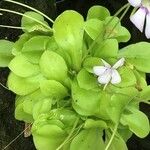
Pinguicula moranensis
Butterwort · Tropical butterwort
Description
Source: leafsnapPinguicula moranensis is a perennial rosette-forming insectivorous herb native to Mexico and Guatemala. A species of butterwort, it forms summer rosettes of flat, succulent leaves up to 10 centimeters (4 in) long, which are covered in mucilaginous (sticky) glands that attract, trap, and digest arthropod prey. Nutrients derived from the prey are used to supplement the nutrient-poor substrate that the plant grows in. In the winter the plant forms a non-carnivorous rosette of small, fleshy leaves that conserves energy while food and moisture supplies are low. Single pink, purple, or violet flowers appear twice a year on upright stalks up to 25 centimeters long. The species was first collected by Humboldt and Bonpland on the outskirts of Mina de Morán in the Sierra de Pachuca of the modern-day Mexican state of Hidalgo on their Latin American expedition of 1799–1804. Based on these collections, Humboldt, Bonpland and Carl Sigismund Kunth described this species in Nova Genera et Species Plantarum in 1817. The extremely variable species has been redefined at least twice since, while several new species have been segregated from it based on various geographical or morphological distinctions, although the legitimacy of some of these is still debated. P. moranensis remains the most common and most widely distributed member of the Section Orcheosanthus. It has long been cultivated for its carnivorous nature and attractive flowers, and is one of the most common butterworts in cultivation. The generic name Pinguicula is derived from the Latin pinguis (meaning "fat") due to the buttery texture of the surface of the carnivorous leaves. The specific epithet moranensis refers to its type location, Mina de Moran.
Care Guide
💧 Water
The Butterwort is an insectivorous plant native to moist tropical environments. It thrives in conditions with high humidity and consistent moisture, though it’s important to avoid waterlogging. For optimal hydration, it should be watered twice a week. Typically grown indoors, the Butterwort has sticky leaves that capture prey and also help reduce water loss, allowing the plant to make efficient use of the available moisture.
How should you water your Butterwort plant?
To adequately water your Butterwort, grow it in a pot with good drainage and place it in a plastic dish or tray. Fill the dish with about a third to half an inch of water, which will be drawn up by the roots as the soil dries. Make sure the dish doesn't dry out completely and adjust the amount of water based on how quickly the plant absorbs it. Avoid using terra cotta pots, as they allow water to seep through and filter out dissolved solids. If you want to use a terra cotta pot, place it inside a larger pot and only add water to the outer pot. The mineral content of the water is crucial for watering your Butterwort effectively. Rainwater is the best choice, but distilled water or water from a reverse osmosis system are also suitable. Purified water can be used, but it may contain some minerals within the tolerable range for Butterwort. If using tap water, ensure that it has lower than 50 parts per million of total dissolved solids. You can purchase a meter to measure this easily. It's recommended to fill your watering device 24 hours in advance to let the chlorine dissipate from the water.
What do I do if I give too much or too little water to Butterwort plant?
If you overwater your Butterwort, you may notice brown spots on the undersides of the leaves, white mold in the soil, and a wilted appearance. The wilted look happens because the plant cannot take up water properly through the stem. Overwatering can also lead to root rot. If you find that the roots have rotted and have a bad smell, it's best to remove the plant from the soil, rinse it with distilled water, trim away the rotted roots and affected leaves, rinse again with distilled water, and replant it in fresh soil. On the other hand, if your Butterwort is underwatered, the leaves will become brittle. In this case, you should trim away the affected leaves, ensure that the soil is moist, and mist the leaves. With proper watering, the plant will gradually recover, but you may notice yellow leaves drying out in the short term due to root damage.
How often should I give water to my Butterwort plant?
The tray method is the most common way to water insectivorous plants. Here's how to do it: 1. Place a Butterwort plant in a pot with drainage holes and put it in a tray or dish filled with water, about one-third full. 2. As the soil dries, the plant will naturally draw water up. 3. Keep an eye on the water level and add more promptly after it drops. Don't let the dish dry out completely. 4. This method helps you understand the plant's watering needs. Since Butterworts are native to humid environments, finding the right balance is crucial. 1. During the active seasons (spring to autumn), water the plant 2-3 times per week and more frequently in the summer to keep the soil moist. 2. In winter and early spring, when the plant goes dormant, reduce the amount of water you give it. Let some of the soil dry out and allow the water level in the tray to dry out for a few days before adding more. 3. For areas with naturally dry air, misting the plant beyond regular watering may be necessary to replicate its humid growing conditions. It's best to do this in the morning. Proper water spraying is essential in dry environments.
How much water does my Butterwort plant need?
Butterwort is a carnivorous plant that usually lives in humid environments. Many people keep them as houseplants because they are one of the few carnivorous plants that can be successfully grown indoors. To keep a Butterwort healthy, it is important to replicate its natural growing conditions, which means maintaining high humidity levels. The best way to grow them is in a bog garden, which is a special kind of garden that provides the high humidity needed. However, most people choose to grow them as houseplants instead. To do this, you should use a pot that can retain moisture, such as a plastic pot. A self-watering pot is even better. To replenish the water, use the tray method. Make sure the water in the tray reaches the small hole at the bottom of the pots. Add water before the trays dry out to keep the pots from drying out as well. The amount of water you add should be enough to keep the plants hydrated and thriving.
Do I need to water Butterwort in a different way when I plant it indoors instead of outdoors?
When growing butterwort indoors, it needs less water when it receives less sunlight. The more sunlight it gets, the more water it needs. Adequate light and water are essential for its health. However, it's important to create a humid environment for indoor plants. One effective way to maintain humidity is to grow butterwort in a terrarium or as part of a plant display in an aquarium. The enclosed sides will help retain the necessary humidity. Just remember to ensure proper air circulation.
☀️ Light Partial sun
Originally thriving in places with limited light, the butterwort still prefers dim surroundings, which supports its healthy development. Throughout its growth stages it favors steady low light levels. Excessive exposure can be damaging, while too little light can stunt its growth.
What are the sunlight requirements for Butterwort?
Butterwort, or Pinguicula moranensis, thrives under specific light conditions due to its natural habitat that originally flourished in areas with scarce light. It requires less than 3 hours of direct sunlight, preferring full shade to ensure its healthy development. During its growth phases, consistent levels of low light are favored, as overexposure can harm the plant while insufficient light can stunt its growth. It's crucial to observe how sunlight moves through your garden to find spots that offer the ideal balance of light and shade, promoting the plant's well-being.
How can artificial lighting be used for Butterwort indoor care?
In conditions where natural sunlight is insufficient, especially during winter or in less sunny indoor spaces, artificial lighting becomes essential for Butterwort's growth. LED lights are recommended for their ability to provide specific wavelengths required by plants. For optimal growth, it's necessary to adjust the artificial light's intensity based on the plant's needs: full sun plants require 30-50W/sq ft, partial sun plants need 20-30W/sq ft, and full shade plants need 10-20W/sq ft. Properly determining the distance (12-36 inches above the plant) and duration (8-12 hours per day) of artificial light exposure is also key to mimicking the natural light environment.
What are the symptoms of incorrect light exposure in Butterwort?
Butterwort shows several signs when exposed to incorrect light conditions. Symptoms of insufficient light include small, mature leaves, leggy or sparse growth, early leaf drop, slower or halted growth, and lighter-colored or pale new leaves. On the other hand, excessive light exposure can lead to chlorosis, where leaves turn yellow, sunscald characterized by damaged plant tissues, leaf curling as a defense mechanism, wilting due to water loss, and leaf scorching with brown, dry patches on leaves. These symptoms indicate the need for adjusting the plant's light environment.
What solutions can help Butterwort recover from incorrect light exposure?
To aid Butterwort's recovery from incorrect light exposure, it's essential to adjust its placement and light source. For indoor plants, moving them to spots that receive ample filtered light, including short periods of direct morning sunlight, can be beneficial. Keeping a desk or ceiling lamp on for at least 8 hours daily or investing in professional plant grow lights helps. Outdoors, gradually transitioning the plants to sunnier spots while avoiding sudden changes prevents sunburn. Reducing obstructions such as tree branches and, for small plants, transplanting during the dormant period to locations with sufficient sunlight and good drainage is advised. Although parts of the plant damaged by insufficient light may not recover, new growth will be healthy with improved light conditions.
🌡️ Temperature 20–37.8°C
Butterwort originates from habitats where temperatures generally fall between 68 and 100°F (20 and 38°C). It does well in warm climates and needs those same consistent temperatures year-round to grow properly.
What is the ideal temperature range for growing Butterwort?
Butterwort, scientifically known as Pinguicula moranensis, is indigenous to warm environments, thriving in temperatures typically ranging from 68 to 100°F (20 to 38°C). It requires these warm climates or similarly maintained temperatures year-round for proper growth. The plant gradually stops growing and enters a dormant state during winter. It's essential to move Butterwort indoors for cultivation if outdoor temperatures drop below 5°C to continue providing it with as much sunlight as possible, preferably near a south-facing window, or use supplemental lighting if natural light is insufficient.
How should Butterwort be cared for in low temperatures?
Butterwort thrives best in high temperatures and is not tolerant of low temperatures, requiring conditions above 20°C for optimal growth. During winter, its environment should be kept above 5°C to avoid damage. If the temperature falls below 1°C, the plant may weaken, wilt, and be prone to root rot. In the event of mild frost damage, symptoms may not appear immediately, but the plant will gradually wither. To counter frost damage, trim the frostbitten areas, examine and possibly cut off rotted roots, and propagate through cuttings if necessary. The plant should be immediately moved to a warm environment indoors, near a south-facing window for ample sunlight. Supplemental lighting can be used if natural light is not sufficient.
How does Butterwort react to high temperatures, and what are the solutions?
During the summer, it is important to ensure that Butterwort is kept below 38°C to prevent growth cessation, water loss, wilting, and susceptibility to sunburn when temperatures exceed 43°C. If the plant has sunburned or rotten parts, those should be removed. It is recommended to protect the plant from the afternoon sunlight until it recovers and begins to grow again. For plants affected by root rot due to overwatering or excessive heat, watering should be ceased until new roots develop.
💨 Humidity
🪴 Soil 5-6
🌱 Fertilizer
Butterwort requires only light fertilizer applications once or twice a year during the growing season. Do not fertilize in winter or in summer when the plant is dormant. Reduce the amount of fertilizer for repotted plants and wait a couple of months after repotting before applying fertilizer. Fertilizing promotes healthy growth and encourages blooms.
Why do I need to give fertilizer to my Butterwort plant?
When you fertilize Butterwort, you provide nutrients to the growing medium which supports healthy growth. Although it already stores water and nutrients, applying plant food during the growing season further boosts its health. Fertilizing also has the added benefit of encouraging mature Butterwort plants to produce blooms in the growing season.
When should I fertilize my Butterwort plant?
Butterwort plants only require a small amount of fertilizer during the growing season. It is recommended to fertilize them 1-2 times a year, specifically in the spring and autumn. Avoid fertilizing them in the dormant periods of winter and summer. When repotting Butterwort plants, be cautious and use less fertilizer. It is also advisable to wait a few months after repotting before applying any fertilizer.
When is the best time to not use fertilizer on my Butterwort?
Butterwort, like other plants, goes through a dormancy period during which you should avoid fertilizing. The plant stops growing in both summer and winter, so that's when you should refrain from applying fertilizer. Additionally, it's recommended to stop fertilizing for a few months after repotting in the spring.
What kind of fertilizer does my Butterwort plant need?
When fertilizing Butterwort, it is recommended to use a liquid plant food made specifically for succulents and cacti. To avoid fertilizer buildup in the soil, dilute the fertilizer with water to half-strength. Apply the diluted fertilizer to the base of the plant and make sure to water thoroughly. Make sure any excess moisture drains from the container or seeps into the ground.
How can I help my Butterwort plant grow better?
When fertilizing Butterwort, liquid plant food is easier to use compared to granules. However, granules are still an option. To ensure proper application, follow the instructions on the packaging. When using liquid fertilizers, remember to dilute them to half-strength. Whether you choose granules or liquid plant food, always apply it to the soil. For granules, cover them with a thin layer of soil and water accordingly.
🪴 Pot & Repot 2-3 years
When repotting Butterwort, select a pot 1–2 inches (2.5–5.1 cm) larger with good drainage. Use a well-draining potting mix. Repot in spring or fall, making sure the root ball sits slightly below the rim of the flower pot. Water thoroughly after repotting and place it in a warm spot with indirect sunlight.
✂️ Pruning
🌿 Propagating
🐛 Diseases & pets
☠️ Toxicity
Characteristics
- Plant Type
- Herb
- Life Cycle
- Perennial
- Genus
- Pinguicula
- Family
- Lentibulariaceae
- Hardiness Zone
- 10-11
- Mature Height
- 5 cm to 10 cm
- Mature Spread
- 10 cm to 15 cm
- Leaf Color
- Light Green, Yellow
- Leaf Type
- Evergreen
- Flower Color
- Purple, Pink
- Flower Size
- 2.03 cm to 4.06 cm
- Bloom Time
- All year round
- Planting Time
- Spring, Summer, Autumn
- Harvest Time
- Late spring, Summer, Fall, Winter, Early spring, Mid spring
- Native Area
- Honduras, Mexico, Guatemala