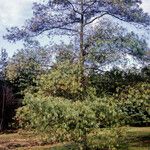
Pinus armandii
Chinese white pine · Armand pine · Armand's Pine
Description
Source: leafsnapPinus armandii, the Armand pine or Chinese white pine, is a species of pine native to China, occurring from southern Shanxi west to southern Gansu and south to Yunnan, with outlying populations in Anhui. It grows at altitudes of 2200–3000 m in Taiwan, and it also extends a short distance into northern Burma. In Chinese it is known as "Mount Hua pine" (华山松). It grows at 1,000–3,300 m altitude, with the lower altitudes mainly in the northern part of the range. It is a tree reaching 35 m (115 ft) height, with a trunk up to 1 m (3 ft 3 in) in diameter.
Care Guide
💧 Water Every 1-2 weeks
☀️ Light Full sun
Armand's pine thrives in locations that are consistently exposed to sunlight. Too much shade can hinder its growth. Its natural habitat is generally sunny, which promotes healthy development at every stage. Excessive shading or a lack of light can slow its growth and decrease its vigor.
What are the sunlight requirements for Armand's pine?
Armand's pine flourishes remarkably in full sun environments, requiring more than 6 hours of sunlight daily. It thrives in its native habit, which is characteristically sunny, supporting its healthy development at all stages of growth. Partial sun, defined as about 3-6 hours of sunlight, is also beneficial, but the tree may not perform as well compared to full sun conditions. Insufficient sunlight, particularly excessive shading, could hinder its growth and vitality. It's important to observe how sunlight moves through your garden to find the perfect spot that provides a balance of light and shade, ensuring the plants' happiness.
How do artificial lights support plant growth?
Artificial lighting becomes crucial when natural sunlight is inadequate, especially during winter or in less sunny spaces indoors. It promotes faster, healthier growth by providing essential light for photosynthesis. LED lights are a popular choice because they can be tailored to deliver specific wavelengths needed by plants. Full sun plants require 30-50W/sq ft of artificial light, partial sun plants need 20-30W/sq ft, and full shade plants need 10-20W/sq ft. The light source should be placed 12-36 inches above the plants to mimic natural sunlight, and the lights should be kept on for 8-12 hours per day to simulate the natural daylight hours necessary for optimal plant growth.
What symptoms indicate that Armand's pine is not getting enough light?
When Armand's pine does not receive adequate light, several symptoms may manifest, including smaller new leaves, leggy or sparse growth, premature leaf drop, slower or halted growth, lighter-colored new leaves, and symptoms of chlorosis, where leaves lose their green color and turn yellow. Additionally, under excessive sunlight, symptoms such as sunscald, leaf scorching, curling, wilting, and leaf scorching may appear, indicating damage caused by intense light exposure. These signs show the plant's struggle with either too little or too much light, affecting its ability to perform photosynthesis and overall health.
What solutions can alleviate symptoms of poor lighting for Armand's pine?
To address poor lighting conditions for Armand's pine, gradually increase sunlight exposure to at least 6 hours daily by positioning plants near a south-facing window or employing artificial lighting for those that are large or immobile. Outdoor plants should also be gradually moved to sunnier locations, avoiding sudden light intensity changes to prevent sunburn. Reducing obstructions like pruning trees or relocating the plant to a sunnier spot can help. Remember, areas of the plant damaged by insufficient light may not recover, but subsequent growth should be healthy with improved light conditions.
🌡️ Temperature 10–35°C
Armand's pine is native to temperate regions and grows best in temperatures from 50 to 95 °F (10 to 35 ℃). During colder seasons, raise the temperature moderately to meet its preferences, avoiding sudden changes.
What are the temperature preferences and cold resistance capabilities of Armand's pine?
Armand's pine is native to temperate regions and thrives in temperatures ranging from 50 to 95 °F (10 to 35 °C). It has a strong resistance to cold and doesn't usually require special frost protection measures even during winter. However, if temperatures are expected to drop below -25°C, it's important to protect the plant by wrapping its trunk and branches with non-woven fabric or cloth. To prepare for winter, it's recommended to water the plant abundantly before the first freeze, ensuring the soil remains moist and enters a frozen state, which helps prevent drought and water scarcity during the colder months.
What should I do if the temperature falls beyond Armand's pine survival range?
Armand's pine shows considerable cold tolerance and ideally should be kept in temperatures above 10°C, but it can survive down to -15°C. If temperatures plummet below -25°C, the plant may not show immediate distress during winter, but come spring, branches may become brittle and dry, failing to produce new shoots. To manage this, prune away any dead branches that have failed to produce new leaves in the spring. Conversely, if temperatures soar above 35°C to 38°C, leaves may lighten in color, and the plant can become more susceptible to sunburn. In such cases, trim away the sunburned sections, move the plant to a shaded area or use a shade cloth to protect it from intense midday and afternoon sun. Additionally, watering the plant in the morning and evening can help keep the soil moist and further protect the plant.
💨 Humidity
🪴 Soil 5-6
🌱 Fertilizer
Armand's pine has specific nutrient needs and does not require heavy fertilization. Fertilizing in spring is best for encouraging optimal growth. Providing nutrients improves its health, increases resistance to pests and diseases, and helps maintain a long lifespan.
🪴 Pot & Repot
✂️ Pruning
Armand's pine is known for its elegant growth and unique white bark, which can thrive with proper pruning. To maintain these features, it is important to employ key techniques such as removing dead branches and thinning the tree to improve airflow. This should ideally be done between early and late winter. These practices encourage healthy regrowth, reduce the risk of pests, and enhance the tree's beauty. For the best results, always use clean, sharp tools.
🌿 Propagating
🐛 Diseases & pets
☠️ Toxicity
Characteristics
- Plant Type
- Tree
- Life Cycle
- Perennial
- Genus
- Pinus
- Family
- Pinaceae
- Hardiness Zone
- 6-9
- Mature Height
- 35.05 m
- Mature Spread
- 7.92 m
- Leaf Color
- Green
- Leaf Type
- Evergreen
- Flower Size
- 1.52 cm
- Bloom Time
- Mid spring, Late spring
- Planting Time
- Spring
- Harvest Time
- Late summer, Early fall, Mid fall
- Native Area
- Myanmar, Japan, China