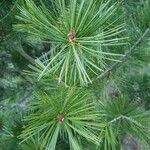
Pinus bungeana
Lacebark pine · Bunge's pine · Lace-bark Pine · White-barked pine
Description
Source: leafsnapPinus bungeana, commonly known as the lacebark pine or white-barked pine, is a species of coniferous tree native to China. This slow-growing evergreen can reach heights of up to 20 meters and feature a trunk diameter of up to 1 meter. Its bark is particularly striking, displaying a mosaic of white and green patches that peel away in thin layers. The needles of Pinus bungeana are long and slender, measuring between 5–10 cm in length. They are arranged in bundles of two or three and exhibit a bluish-green color. The tree produces small, oval-shaped cones, which are 3–6 cm long and have prickly scales. While Pinus bungeana prefers well-drained soils, it can tolerate some moisture and acidic conditions. It thrives under full sun exposure but can also grow in partial shade. The lacebark pine is valued for its ornamental appeal, thanks to its unique bark pattern, making it an attractive addition to gardens and parks for landscaping purposes. Moreover, its wood is durable and used in construction, including furniture making. Overall, Pinus bungeana is a fascinating species that adds beauty to its surroundings and serves practical purposes, such as wood production. It is both aesthetically pleasing and functionally beneficial in today's society.
Care Guide
💧 Water Every 7 days
Bunge's pine flourishes in temperate climates and becomes drought-tolerant once it is established, needing water only every two weeks. As an evergreen species, it can adapt to a range of climates. However, it requires well-drained soil to prevent root rot and to enhance water retention.
How should I water my Bunge's pine tree to keep it healthy?
Watering your Bunge's pine is a straightforward task. To do this, simply use your garden hose to slowly soak the soil. Larger Bunge's pine trees may require a high volume of water, making the garden hose the ideal tool. However, for smaller trees, a watering can or smaller tool will suffice. It is important to avoid overhead watering, as too much moisture on the leaves can cause disease, particularly in young trees.
What should I do if I give too much or too little water to my Bunge's pine?
Poor soil can lead to overwatering of Bunge's pine. If the soil doesn't drain well, the plant will start to decline. To fix this, you can improve the soil's drainage or move the plant to a better location. If your Bunge's pine is in a pot, you may need to repot it with looser soil for better drainage. Overwatering can also cause diseases, so treat them promptly. If your Bunge's pine is underwatered, simply water it more often and it will recover. To determine if your plant is overwatered, examine the foliage, particularly new growth. Overwatered plants may have discolored or fragile new growth. Standing water or slow drainage can also indicate overly wet soil. Underwatered Bunge's pine will have sparse, brown leaves. Consider recent rainfall or high temperatures if you see these symptoms, as they can affect the plant's health.
How often do I need to water my Bunge's pine tree?
A mature Bunge's pine requires very little water. It can typically rely on rainfall alone and become drought tolerant. During the hottest months, it may need to be watered once per week, but during other seasons, watering may not be necessary. However, if it has recently been planted, regular watering is important to help the roots establish. It is crucial to avoid standing water as Bunge's pine does not tolerate it. When unsure, it is safer to under-water rather than over-water.
How much water does my Bunge's pine tree need?
During the height of summer, you typically need to water your Bunge's pine about one inch per week. However, this amount can vary depending on the amount of rainfall. If it has rained one inch or more that week, you don't need to water the plant. It's important to note that newly planted Bunge's pine requires more water during the establishment period. Generally, you should water it once every one to two weeks for the first few growing seasons.
How often should I water my Bunge's pine tree throughout the year?
The Bunge's pine tree requires the most water during the summer when it's hottest outside. Give it water about once a week if it's not raining. The tree can often survive without water during other times of the year. In spring and fall, you may need to water it if the weather is unusually hot, but that's not common. Unlike other plants, the Bunge's pine doesn't go dormant in the winter, so it keeps growing even in the coldest months. However, it doesn't need much water during winter because the cool temperatures don't cause the soil to dry out quickly.
☀️ Light Full sun
Bunge's pine favors sites that let it receive as much sunlight as possible during the day. It thrives in full sun, though it shows some flexibility by tolerating partly shaded areas. In its native range, the tree readily adapts to sunlit environments.
What are the sunlight requirements for Bunge's Pine?
Bunge's pine requires full sun, meaning it thrives best with more than 6 hours of sunlight daily. It can also tolerate partial sun, which involves about 3-6 hours of sunlight. Adequate sun exposure is key for its growth and health, ensuring it gains the benefits of both light and shade in your garden.
How does Bunge's Pine adapt to its environment and light conditions?
Bunge's Pine shows a strong preference for sunny locations, maximizing its exposure to sunlight throughout the day for optimal growth. It has a degree of flexibility, being capable of adapting to partially shaded conditions as well. In indoor settings or less sunny locations, artificial lighting can be employed to support its growth, especially during winter. LED lights are recommended, with specific wattage based on the plant's sun exposure needs.
What are the main symptoms of light deficiency in Bunge's Pine?
When Bunge's pine is not receiving adequate light, it may exhibit symptoms such as smaller new leaves, leggy or sparse growth, faster leaf drop, halted growth, and irregularly colored or pale new leaves. Chlorosis and sunscald can also occur, alongside leaf curling and wilting due to inadequate sunlight exposure. Leaf scorching is another symptom indicating excessive sunlight.
How can I address light deficiency issues in Bunge's Pine?
To mitigate light deficiency in Bunge's Pine, gradually increase its sunlight exposure to at least 6 hours daily. This can be achieved by moving the plant closer to a south-facing window or providing artificial light for plants that are large or not easily movable. Outdoor plants should be moved gradually to sunnier spots to adapt without risk of sunburn. Additionally, removing obstructions to sunlight and considering transplanting during the plant's dormant period can enhance light access.
🌡️ Temperature 5–32.2°C
Bunge's pine naturally occurs in areas with temperatures between 41 and 89.6 °F (5 and 32 °C). It prefers mild to warm climates. For optimal growth, adjust temperatures during extreme seasons so they fall within its preferred range.
What is the native climate for Bunge's pine?
Bunge's pine thrives in environments where the temperature ranges between 41 to 89.6 °F (5 to 32 °C). It prefers mild to warm climates and is highly cold-tolerant. During extreme seasons, it's beneficial to adjust temperatures to match its preferred range for optimal growth. Despite its cold tolerance, it is recommended to water the plant generously before the first freeze in autumn to ensure the soil remains moist throughout winter and early spring, helping to prevent drought and water scarcity for the plant.
How does Bunge's pine react to very low temperatures?
Bunge's pine is extremely cold-tolerant and can withstand winter temperatures above -30°C. However, if the temperature drops below this threshold, there might not be immediate noticeable changes during winter. But come spring, the branches may become brittle and dry, and no new shoots will emerge. To address this, prune away any dead branches that have failed to produce new leaves in the spring.
What should be done if Bunge's pine experiences high temperatures?
Bunge's pine does not tolerate high temperatures well. When the temperature exceeds 32°C, it may start to lose leaves significantly, and in severe cases, the entire plant may wither and die. To mitigate damage, trim away the sunburned and dried-up parts. Relocating the plant to a shaded area during the midday and afternoon sun or using a shade cloth can also protect it. Ensure the soil is kept moist by watering the plant in the morning and evening.
💨 Humidity
🪴 Soil 5-6
🌱 Fertilizer
Bunge's pine has specific nutrient needs and does not require heavy fertilization. Spring is the best time to apply fertilizer for optimal growth. Supplying nutrients improves its health, strengthens its resistance to pests and diseases, and helps maintain its long lifespan.
Why should I put fertilizer on my Bunge's pine tree?
To support the healthy growth of Bunge's pine, it is recommended to fertilize it in the spring. Remember that this plant has a long lifespan, so it requires proper support. By adding nutrients to the soil, you can improve the plant's overall health, allowing it to better resist common pests and diseases that can hinder growth or reduce its lifespan.
When should I fertilize my Bunge's pine tree?
Sometimes, the growing medium may not provide sufficient nutrients for healthy growth. However, Bunge's pine is unlike your typical garden plants, as it doesn't need a lot of additional nutrients. It is best to fertilize Bunge's pine in the spring, before new growth starts.
When is it not a good idea to fertilize my Bunge's pine tree?
Bunge's pine is a low-maintenance plant that doesn't need frequent fertilization. Applying too much fertilizer can harm it and cause it to wither. It's best to only fertilize it in the spring and avoid doing so in the summer, fall, and winter. Additionally, refrain from adding any organic matter to the soil during these seasons.
What kind of plant food does my Bunge's pine tree need?
Consider the age of your plant when choosing fertilizer. Bunge's pine doesn't need much nutrients. Opt for a balanced plant food, as it promotes root development and growth. Avoid fertilizers high in nitrogen.
How do I make my Bunge's pine tree grow better?
When fertilizing Bunge's pine, the timing and method are both equally important. It's best to apply the fertilizer during spring and directly around the plant's base. Be cautious not to get any fertilizer on the trunk. In case you are using granulated fertilizer, cover the pellets with a thin layer of soil. This will enhance the absorption of the fertilizer into the soil.
🪴 Pot & Repot
✂️ Pruning
Bunge's pine is characterized by its multiple trunks and distinctive peeling bark. To maintain its health, it's best to prune the tree from early to late winter. During pruning, remove any dead branches and thin out crowded areas to improve air circulation. Always use sterilized tools to prevent the spread of disease. Regular maintenance not only encourages healthy growth but also reduces sap loss and minimizes the risk of pests.
🌿 Propagating
🐛 Diseases & pets
☠️ Toxicity
Characteristics
- Plant Type
- Tree
- Life Cycle
- Perennial
- Genus
- Pinus
- Family
- Pinaceae
- Hardiness Zone
- 4-7
- Mature Height
- 9.14 m to 15.24 m
- Mature Spread
- 3.66 m to 6.1 m
- Leaf Color
- Green
- Leaf Type
- Evergreen
- Flower Color
- Yellow, Green
- Flower Size
- 2.54 cm to 7.62 cm
- Bloom Time
- Mid spring, Late spring
- Planting Time
- Spring, Winter
- Harvest Time
- Late summer, Early fall, Mid fall
- Native Area
- China