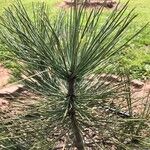
Pinus jeffreyi
Jeffrey pine · Jeffrey's Pine · Black pine
Description
Source: leafsnapPinus jeffreyi, commonly known as Jeffrey pine, is a species of pine tree native to the western United States. It was named after John Jeffrey, a Scottish botanist who first documented the tree in 1852. Jeffrey pine trees can grow up to 80 feet tall and feature a straight trunk with reddish-brown bark that becomes deeply furrowed as the tree ages. The needles are long and slender, measuring up to 10 inches in length, and grow in bundles of three. The cones of the Jeffrey pine are large and heavy, reaching up to 12 inches in length. They have thick scales that protect the seeds from fire damage. Jeffrey pines are typically found at elevations between 4,000 and 7,000 feet in mountainous regions throughout California and Nevada. They prefer well-drained soils but can tolerate some drought conditions. The wood from Jeffrey pines is highly valued for its strength and durability, making it ideal for construction lumber and furniture making. Overall, Pinus jeffreyi plays an important role in its ecosystem. It provides habitat for wildlife such as birds and squirrels, and its deep root system helps in soil stabilization.
🎭 Optimism, Sympathy
Care Guide
💧 Water Every 7 days
The Jeffrey pine thrives in mountainous, arid habitats and exhibits significant drought tolerance. It should be watered every one to two weeks, with the soil allowed to dry out between waterings. As an evergreen, the Jeffrey pine has needle-like leaves that minimize water loss, demonstrating its adaptation to low-water environments.
☀️ Light Full sun
Jeffrey pine does well in places that receive steady sun throughout the day. Its photosynthetic activity is most efficient under these conditions, supporting healthy growth. In the wild, it occupies habitats with unobstructed sunlight. It can tolerate areas without shade, but too little light impairs its growth and development, while too much light can potentially cause damage.
What are the sunlight requirements for Jeffrey pine?
Jeffrey pine thrives in full sun, necessitating more than 6 hours of sunlight daily for optimal growth. It can also tolerate partial sun, which means about 3-6 hours of sunlight. It's crucial to observe the movement of sunlight through your garden to choose locations that provide the perfect balance of light and shade, ensuring the plants' well-being.
What essentials does Jeffrey pine need for healthy growth?
Jeffrey pine requires exposure to persistent sun throughout the day for healthy growth. It flourishes in areas with unobstructed sunlight, which is vital for its photosynthetic processes. While it can endure lack of shade, insufficient light can hinder its growth and development, and excessive sunlight may cause damage. For indoor plants, artificial lighting, such as LED lights that provide specific wavelengths, can offer a solution during less sunny seasons or in less sunny spaces, ensuring plants grow faster and healthier.
What are common symptoms of improper lighting in Jeffrey pine?
In suboptimal lighting, Jeffrey pine may exhibit several symptoms: smaller new leaves, leggy or sparse growth, faster leaf drop, slowed or halted growth, irregular color patterns or pale leaves indicating lack of chlorophyll, and symptoms related to excessive sunlight like chlorosis, sunscald, leaf curling, wilting, and leaf scorching. These symptoms highlight the plant's sensitivity to light conditions and the need for proper sunlight exposure.
How can I address lighting issues for Jeffrey pine?
To address lighting issues for Jeffrey pine, follow these steps: Gradually move plants to sunnier spots, ensuring at least 6 hours of direct sunlight for those kept indoors by using south-facing windows or artificial light sources like desk lamps or plant grow lights for 8 hours daily. For outdoor plants, avoid sudden changes in light intensity to prevent sunburn. If obstructions cause shading, consider pruning or transplanting to sunnier locations. Remember, while parts of the plant affected by poor lighting may not recover, increased light exposure promotes healthy new growth.
🌡️ Temperature 5–32.2°C
Jeffrey pine originates from temperate regions where temperatures range from 41 to 90 °F (5 to 32 ℃). Adjusting its surroundings to match these temperature ranges can improve its growth during the corresponding seasons.
What is the native climate for Jeffrey pine?
Jeffrey pine, with its botanical name Pinus jeffreyi, is native to temperate climates. It thrives in temperature ranges between 41°F to 90°F (5°C to 32°C). Maintaining these temperature fluctuations in its environment can significantly enhance its growth across different seasons. The species exhibits strong cold resistance, making it well-suited to the varied conditions of temperate climates.
How can you protect Jeffrey pine during extremely cold winters?
Despite its strong cold resistance, Jeffrey pine may require special protection when winter temperatures are expected to fall below -25°C. Such protection can be provided by wrapping the plant's trunk and branches with insulating materials like non-woven fabric or cloth. Additionally, it's beneficial to water the plant abundantly before the first freeze of autumn to ensure the soil remains moist and freezes in that state, aiding in the prevention of drought and water scarcity during the winter and early spring.
What are the symptoms of low temperature stress in Jeffrey pine and how can you manage it?
Jeffrey pine is cold-tolerant but prefers temperatures above 5°C. In winters, keeping the temperature above -20°C is advisable. If temperatures plunge below -25°C, you might not notice immediate changes, but come spring, the branches could become brittle and dry, failing to sprout new shoots. To manage this, prune away any dead branches that haven't produced new leaves in the spring, promoting healthier growth.
What are the symptoms of high temperature stress in Jeffrey pine and how can you manage it?
During the summer, it's best to keep Jeffrey pine below 32°C. Exceeding 35°C can cause the plant's leaves to lighten in color and the tips to dry and wither, making the pine more prone to sunburn. To counteract high temperature stress, trim away the sunburned and dried-up parts. Relocating the plant to a shaded area or employing a shade cloth to protect it from the midday and afternoon sun can be beneficial. Additionally, watering the plant in the morning and evening helps keep the soil adequately moist.
💨 Humidity
🪴 Soil 5-6
🌱 Fertilizer
The Jeffrey pine has specific nutrient needs and does not require heavy fertilization. Fertilizing in spring is the best time to encourage optimal growth. Providing nutrients enhances its health, strengthens resistance to pests and diseases, and supports its long lifespan.
🪴 Pot & Repot Every 12 months
✂️ Pruning
The Jeffrey pine benefits from careful pruning during its dormant season, ideally between early and late winter. When pruning, concentrate on removing any dead or diseased branches, but avoid over-pruning to minimize stress on the tree. Regular pruning improves air circulation, helps prevent pest issues, and encourages healthy, attractive growth.
🌿 Propagating
🐛 Diseases & pets
☠️ Toxicity
Characteristics
- Plant Type
- Tree
- Life Cycle
- Perennial
- Genus
- Pinus
- Family
- Pinaceae
- Hardiness Zone
- 5-8
- Mature Height
- 24.99 m to 53.04 m
- Mature Spread
- 6.1 m
- Leaf Color
- Green, Gray, Silver
- Leaf Type
- Evergreen
- Bloom Time
- Mid spring, Late spring
- Planting Time
- Spring, Summer, Autumn
- Harvest Time
- Late summer, Early fall, Mid fall
- Native Area
- Mexico