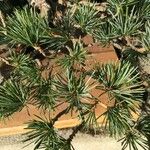
Pinus parviflora
Five-needle pine · Japanese white pine · Goyo-matsu · Hime-ko-matsu · Ulleungdo white pine
Description
Source: leafsnapPinus parviflora, commonly known as the Japanese white pine, is a pine tree species native to Japan. This slow-growing evergreen can reach heights of up to 25 meters and possesses a conical shape with dense foliage. The needles, which are blue-green, are arranged in bundles of five. The tree produces small cones, measuring only 4-7 cm in length, with thin scales that open to release the seeds. The Japanese white pine is highly valued for its ornamental qualities and is often used as an accent plant in gardens or shaped into bonsai trees due to its unique form and texture. In Japan, it has been cultivated for centuries, commonly found in traditional settings such as rock gardens and Zen gardens. Beyond its aesthetic appeal, Pinus parviflora has practical applications as well. Its strong wood is ideal for timber production and is commonly used in construction. In summary, Pinus parviflora is an attractive evergreen tree that offers both aesthetic and practical benefits, underscoring its cultural significance.
Care Guide
💧 Water Every 7 days
The Japanese white pine, which comes from various seasonal regions, is moderately drought-tolerant but requires weekly watering during its growth period. It thrives in soil that is well-moistened but not waterlogged. As an outdoor ornamental plant, mulching is useful for retaining moisture and protecting the roots during dry spells and cold winters.
How should I water my Japanese white pine tree?
Watering your Japanese white pine is a simple task. One way to do it is by using a garden hose to slowly soak the soil. This is especially ideal for mature trees that require a lot of water. However, smaller trees can be watered using a watering can or other smaller tools. It is important to avoid overhead watering, as too much moisture on the leaves can cause disease, particularly in young trees.
What do I need to do if I give my Japanese white pine too much water or not enough water?
Overwatering can occur when the soil is inadequate for drainage, which can cause your Japanese white pine to deteriorate. To fix this, you can either improve the soil's drainage or move the plant to a more suitable location. If you have your Japanese white pine in a pot, you may need to repot it with looser soil and a container that allows for better drainage. Overwatering can also lead to disease, so it's important to address that immediately. On the other hand, underwatering can be resolved by watering more frequently. One way to determine if your white pine is overwatered is to examine its foliage, especially the new growth. Discolored or fragile new growth indicates too much moisture. If you notice standing water or slow drainage in the plant's area, the soil may be too wet. Underwatered pines will have sparse, brown leaves. It's worth considering recent rainfall or consistently high temperatures as factors contributing to your plant's symptoms.
How many times should I water my Japanese white pine?
A mature Japanese white pine is highly drought tolerant and can survive on rainfall alone. Usually, you only need to water it once a week during the hottest months. However, during other seasons, watering may not be necessary at all. The exception is for newly planted trees, which require regular watering to establish their roots. It's important to note that Japanese white pine should never be left in standing water. If unsure, it's safer to avoid watering too much than to risk overwatering.
How much water should I give my Japanese white pine tree?
During the summer, it is important to water your Japanese white pine regularly, especially if it hasn't rained much. Typically, giving it one inch of water per week is sufficient, but adjust this amount if it has rained significantly. However, for newly planted Japanese white pines, you will need to water them more frequently during the first few growing seasons. Typically, watering once every one to two weeks should be enough during this establishment period.
How often should I water my Japanese white pine throughout the year?
The Japanese white pine tree requires the most water during the summer when it is hottest. It should be watered about once a week if there is no rainfall. However, in other seasons, this plant can often survive without any water. If the weather is exceptionally hot in spring or fall, you may need to provide some water, but this is rare. Unlike many other plants, the Japanese white pine does not go into full dormancy in winter, so it continues to grow even during the coldest months. However, the water needs during winter are still low because the cool temperatures do not cause the soil to dry out quickly.
☀️ Light Full sun
The Japanese white pine thrives best in full, open sun. It evolved in sunny landscapes and can tolerate all-day exposure. Too little light harms its health and restricts growth. Sunlight is essential at every stage of development because it powers photosynthesis. Insufficient light does not provide enough energy, while excessive sun can lead to sunscald.
What are the sunlight requirements for a Japanese White Pine?
A Japanese White Pine thrives in locations that provide an open exposure to the sun, needing full sun exposure, defined as above 6 hours of direct sunlight, for optimal growth. It can endure long hours of sunlight which is crucial for its health and growth at all development stages, as sunlight fuels photosynthesis. Insufficient light can impair the plant's health, leading to growth and health issues. There's a balance to be found, as both lack and excess of sunlight can either not provide enough energy or cause issues like sunscald.
How can artificial lighting be used for indoor plants, and what are the specific requirements?
For indoor plants where natural sunlight is insufficient, artificial lighting serves as a vital solution to ensure optimal growth. This is particularly useful during winter or in less sunny spaces. LED lights are recommended because they can be customized to provide specific wavelengths needed by the plants. Full sun plants require 30-50W/sq ft, partial sun plants need 20-30W/sq ft, and full shade plants need 10-20W/sq ft of light. The light source should be placed 12-36 inches above the plant to mimic natural sunlight. Most plants benefit from 8-12 hours of artificial light per day to mimic natural daylight hours.
What are the symptoms of insufficient light in a Japanese White Pine, and how does excessive sunlight affect it?
When a Japanese White Pine does not get enough light, it shows symptoms such as small and lighter-colored new leaves, leggy or sparse growth, faster leaf drop, and slower or no new growth, indicating light deficiency and a struggle in photosynthesis and growth. Excessive sunlight, on the other hand, can cause chlorosis (leaves turning yellow from the breakdown of chlorophyll), sunscald (damage from intense sunlight exposure), leaf curling (a defense mechanism to minimize water loss), wilting (loss of turgor pressure causing droopiness), and leaf scorching (brown, dry, and crispy leaf edges). These symptoms reflect the plant's struggle to adjust to its light conditions and maintain health.
What are the solutions for addressing light-related issues in Japanese White Pine?
To address light-related issues in Japanese White Pine, gradual adjustment to the proper light conditions is key. For indoor plants, gradually moving the plant to a sunnier location each week to receive at least 6 hours of direct sunlight daily or using artificial lighting such as a desk or ceiling lamp for at least 8 hours daily are effective strategies. Outdoor plants also benefit from gradual movement to sunnier spots to prevent sunburn. Additionally, for plants on the ground, reducing obstructions to sunlight is crucial; this may involve pruning trees or transplanting smaller plants to areas with ample sunlight and good drainage. It's important to note that parts of the plant already affected by poor light may not recover, but new growth will be healthy with improved light exposure.
🌡️ Temperature 15–35°C
The Japanese white pine is native to cooler regions and does well in temperatures from 59 to 95 °F (15 to 35 ℃). If temperatures rise above or drop below this preferred range, seasonal adjustments may be needed.
What is the ideal temperature range for Japanese white pine?
Japanese white pine is best suited to cooler climates, thriving in temperatures between 59 to 95 °F (15 to 35 °C). It has strong cold resistance, making it less necessary to take special frost protection steps in winter. However, if temperatures are expected to fall below -15°C, it's important to protect the tree by wrapping its trunk and branches with material like non-woven fabric or cloth. To help the pine through winter, it's recommended to water it abundantly before the first freeze in autumn, ensuring the soil is moist as it freezes. This helps prevent drought and water scarcity during the colder months.
How does Japanese white pine react to temperatures below its ideal range?
When temperatures drop below 15°C, Japanese white pine generally remains tolerant, showing its resilience down to -10°C. However, if the temperature falls below -15°C, the tree might not exhibit immediate damage during winter, but come spring, its branches might become brittle and dry, and fail to produce new shoots. To address this, prune any dead branches in the spring that haven't produced new leaves, helping the tree maintain its health and vigor.
What should be done if Japanese white pine experiences high temperatures?
In the summer, it's critical to ensure that the temperature around Japanese white pine does not exceed 35°C. Exposure to temperatures above 41°C can lead to lighter leaf color, dry and withered tips, and increased susceptibility to sunburn. To mitigate these risks, trim away sunburned and dried parts of the plant, relocate it to a shaded area, or use a shade cloth to protect it from direct midday and afternoon sun. Additionally, watering the pine in the morning and evening will help keep the soil moist and reduce stress on the plant.
💨 Humidity
🪴 Soil 5-6
🌱 Fertilizer
The Japanese white pine has specific nutrient needs and does not require excessive fertilization. Spring is the best time to apply fertilizer for optimal growth. Providing nutrients improves its health, enhances resistance to pests and diseases, and helps sustain a long lifespan.
Why is it important to add fertilizer to my Japanese white pine?
To support the healthy growth of Japanese white pine, it is important to fertilize it in the spring. This plant has a long lifespan and requires adequate support. By adding nutrients to the soil, the plant's overall health can be improved, increasing its resistance to common pests and diseases. This, in turn, protects against stunted growth or a shortened lifespan.
When should I fertilize my Japanese white pine?
The growing medium might not always have enough nutrients for healthy growth. But, Japanese white pine is unique compared to typical garden plants. It doesn't need a lot of extra nutrients. The ideal time to fertilize it is in the spring, before new growth starts.
When is it not a good idea to fertilize my Japanese white pine?
While many plants benefit from regular fertilization either monthly or weekly, Japanese white pine is an exception. This particular plant does not require a significant amount of extra nutrients. In fact, over-fertilizing can actually cause it to deteriorate. Therefore, it is recommended to only apply fertilizer during the spring season and abstain from doing so during the summer, fall, and winter. It is also important to avoid adding any additional organic matter to the soil during these non-fertilizing seasons.
What kind of fertilizer should I use for my Japanese white pine?
The age of your plant determines the type of fertilizer it needs. However, Japanese white pine does not require excessive nutrients. It is best to use a balanced plant food that promotes healthy root development and growth, while avoiding fertilizers with high nitrogen levels.
How do I make my Japanese white pine grow better?
When fertilizing Japanese white pine, it is important to consider both the timing and application method. In the spring, only apply the fertilizer once, focusing on the base of the plant. Be careful not to get any fertilizer on the trunk. If you are using granulated fertilizer, cover the pellets with a light layer of soil to enhance absorption into the soil.
🪴 Pot & Repot 2-3 years
Repot your Japanese white pine every 2-3 years in the spring, using a deep pot to accommodate its roots. Use well-draining soil and keep the moisture consistent, being careful not to overwater. Handle the tree gently during repotting to minimize stress and encourage recovery.
✂️ Pruning
Pruning Japanese white pine during early to late winter promotes healthy growth. Important techniques include removing dead branches, thinning crowded areas to improve airflow, and selectively trimming for desired shape. Pruning during this dormant period minimizes sap loss and stress, which enhances the pine's strength and appearance.
🌿 Propagating
🐛 Diseases & pets
☠️ Toxicity
Characteristics
- Plant Type
- Tree
- Life Cycle
- Perennial
- Genus
- Pinus
- Family
- Pinaceae
- Hardiness Zone
- 7-10
- Mature Height
- 6.1 m to 15.24 m
- Mature Spread
- 6.1 m to 14.94 m
- Leaf Color
- Green, Blue, Silver
- Leaf Type
- Evergreen
- Flower Color
- Red, Brown, Yellow, Green, Burgundy
- Flower Size
- 7.62 cm to 15.24 cm
- Bloom Time
- Mid spring, Late spring
- Planting Time
- Winter
- Harvest Time
- Late summer, Early fall, Mid fall
- Native Area
- Japan, South Korea