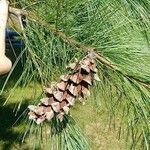
Pinus strobus
Eastern white pine · White Pine · Weymouth pine · Northern White Pine · Soft Pine
Description
Source: leafsnapPinus strobus, commonly known as the Eastern White Pine, is a large coniferous tree native to eastern North America. This fast-growing tree can reach heights of up to 80 feet and has a straight trunk with branches that grow in whorls. The needles of the Eastern White Pine are soft and flexible, ranging between 2 to 5 inches in length, and are arranged in bundles of five. The tree produces long, slender cones that typically measure between 4 to 8 inches. The Eastern White Pine has significant commercial and ecological value. Historically, its straight trunk and resistance to rotting made it ideal for shipbuilding. Today, it continues to be used for lumber production and plays a crucial role in reforestation efforts due to its rapid growth on disturbed sites. Additionally, the Eastern White Pine provides habitat for various species, including birds like the bald eagle and red-tailed hawk, which use its branches for nesting. In summary, Pinus strobus is an iconic species of eastern North America, offering both economic and ecological benefits. Its conservation is essential due to its valuable contributions to both commercial industries and natural ecosystems.
🌳 Aside from timber and paper, the eastern white pine has an important ecological role, providing habitat for a variety of wildlife. It also yields less obvious byproducts such as resin, which can be processed into turpentine and rosin—materials important to both manufacturing and the music industry.
🎭 Optimism, compassion, reconciliation, clearness
Care Guide
💧 Water Every 7 days
Eastern white pine flourishes in temperate climates with moderate moisture levels and can withstand short periods of dryness. It prefers well-drained soil and typically needs watering every 1-2 weeks. Adapted to seasonal changes in water availability, the eastern white pine is an excellent choice for temperate gardens and is usually grown outdoors.
When Should I Water My Eastern White Pine?
Determining when to water Eastern white pine involves observing several key indicators related to soil moisture, needle health, and environmental factors. Firstly, check for soil dryness by feeling the top 1 to 2 inches of soil; if dry, the pine likely needs water. Watch for yellowing needles as a sign of under-watering and wilting or curling needles, which indicate dehydration. Brittle branches suggest water stress, while the absence of dew early in the morning signals a need for watering. Additionally, temporary wilting in the late afternoon indicates insufficient moisture. Ignoring these signs can lead to stunted growth or increased susceptibility to pests and diseases, whereas overwatering poses risks of root rot and fungal infections. Hence, recognizing and responding to these indicators is critical for the health and longevity of Eastern white pine.
How Should I Water My Eastern White Pine?
Watering Eastern white pine effectively requires deep but infrequent waterings to mimic natural rainfall patterns, saturating the root zone and then allowing the top few inches of soil to dry out before the next watering. Use a watering can with a gentle shower spout to evenly distribute water at the base of the plant, avoiding the foliage. This method helps prevent root rot and ensures adequate moisture for the pine's needs.
How Much Water Does Eastern White Pine Really Need?
The amount of water needed by Eastern white pine varies with pot size, root depth, and plant size. Aim to provide enough water to keep the soil evenly moist but not waterlogged, roughly 2-3 cups per session for a medium-sized pot. Healthy, hydrated pines exhibit green needles and robust growth, whereas over or under-watering can lead to yellowing needles, wilting branches, and other health issues. Balancing the watering routine is essential to avoid root rot or dehydration, promoting a thriving Eastern white pine.
What Kind of Water is Best for Eastern White Pine?
Rainwater or distilled water is preferable for Eastern white pine due to the absence of contaminants often found in tap water. If using tap water, let it sit for 24 hours to allow chlorine to evaporate. Eastern white pine prefers room-temperature water to avoid shock and is sensitive to chlorine and excessive fluoride or minerals, which can impact its growth and health. Therefore, dechlorinated or filtered water is recommended to meet the pine's hydration needs without the risk of harmful effects.
How Do Eastern White Pine's Watering Needs Change with the Seasons?
Seasonal changes significantly affect watering practices for Eastern white pine. In spring, maintain moist soil to support new growth, adjusting for rainfall levels. During summer's active growth phase, ensure soil moisture to prevent stress from dry conditions, with deep watering recommended. Autumn requires moderate moisture to prepare for winter, avoiding overwatering. In winter, reduce watering in cold regions where the pine becomes dormant, but in milder climates, keep the soil consistently moist without over-saturation. Adjusting watering based on seasonal needs ensures optimal growth and health throughout the year.
☀️ Light Full sun
Eastern white pine does best with abundant sunlight but can tolerate lower light levels. In its native range it grows right to the forest edge where sunlight is plentiful. Reduced light slows its growth, and too much exposure can scorch the foliage. Different stages of growth have similar sunlight needs. Sunlight is essential to its health and vitality.
What are the sunlight requirements for Eastern White Pine (Pinus strobus)?
Eastern White Pine requires copious sunlight for optimal growth and health, thriving best in full sun, which is above 6 hours of sunlight per day. It can also endure partial sun, roughly 3-6 hours of sunlight, but less light may slow its growth, and overexposure could risk scorching its foliage. This species adapts well up to the forest edge where sunlight is abundant, indicating that different growth stages have similar sun requirements. It's important to observe how sunlight moves through your garden, choosing spots that offer a good balance of light and shade to ensure the plants' well-being.
Can indoor Eastern White Pine thrive with artificial lighting?
Yes, indoor Eastern White Pines can thrive with artificial lighting, especially when natural sunlight is insufficient, such as in winter or less sunny spaces. The right type of artificial light, like LED lights, can be customized to provide specific wavelengths needed by the plants. Full sun plants need 30-50W/sq ft, partial sun plants require 20-30W/sq ft, and full shade plants need 10-20W/sq ft of artificial light. Placing the light source 12-36 inches above the plant can mimic natural sunlight, and most plants will need 8-12 hours of light per day to mimic the length of natural daylight hours.
What are the symptoms of light deficiency or overexposure in Eastern White Pine?
Symptoms of light deficiency in Eastern White Pine include small new leaves, leggy or sparse growth, faster leaf drop, slower or no new growth, and lighter-colored new leaves, indicating a lack of chlorophyll and essential nutrients. Overexposure to sunlight can cause chlorosis, where leaves lose their green color and turn yellow, sunscald with pale or necrotic areas on the plant, leaf curling as a defense mechanism, wilting due to increased transpiration, and leaf scorching characterized by brown, dry edges on leaves. These symptoms highlight the plant's sensitivity to both insufficient and excessive sunlight.
How can I address sunlight-related issues for an Eastern White Pine?
To address sunlight-related issues for an Eastern White Pine, start by gradually increasing its exposure to sunlight, moving it weekly to sunnier spots until it achieves at least 6 hours of direct sunlight daily for outdoor plants or uses a south-facing window for indoor plants. If a plant is large or not easily movable, consider using artificial lighting, ensuring it's kept on for at least 8 hours daily or investing in grow lights for sufficient light. For outdoor plants, gradual adaptation to sunlight is crucial to prevent sunburn. If relocating a plant for better sun exposure, do so during its dormant period, typically late winter or early spring, ensuring a location with ample sunlight and good drainage. Note that parts of the plant already affected by sunlight issues may not recover, but new growth will be healthy after adjusting the light exposure.
🌡️ Temperature 5–35°C
Eastern white pine is a temperate woody species whose native growing conditions have temperature requirements from -40 to 35 ℉ (-40 to 2 ℃). Generally it prefers temperatures of 41 to 95 ℉ (5 to 35 ℃), but it can withstand lows as cold as -40 ℉ (-40 ℃). In winter, this plant needs a dormant period with temperatures ranging from -40 to 45 ℉ (-40 to 7 ℃).
What is the Eastern white pine and its native temperature requirements?
The Eastern white pine (Pinus strobus) is a temperate woody plant known for its strong cold resistance and preference for a temperature range of 41 to 95°F (5 to 35°C). It originates from environments that can experience extreme temperatures ranging from -40 to 35°F (-40 to 2°C). This plant can tolerate low temperatures down to -40°F/C during winter, requiring a dormant period with temperatures between -40 to 45°F (-40 to 7°C). Despite its resilience to cold, protection may be necessary when winter temperatures drop below -30°C.
How can you protect Eastern white pine from extreme cold?
To protect Eastern white pine from extreme cold, especially when temperatures are expected to drop below -30°C, it's advised to wrap the trunk and branches with non-woven fabric or cloth. Additionally, watering the plant abundantly before the first freeze in autumn ensures the soil remains moist and enters a frozen state, helping to prevent drought and water scarcity during winter and early spring.
What are the symptoms of low and high temperature stress in Eastern white pine?
For Eastern white pine, low temperature stress becomes apparent when temperatures fall below -30°C. While the plant is cold-tolerant, experiencing temperatures below -25°C may lead to branches becoming brittle and dry in spring, with no new shoots emerging. High temperature stress occurs when temperatures exceed 35°C, leading to lighter leaf color, dry and withered tips, and increased susceptibility to sunburn. These conditions show the plant's need for temperature management to thrive.
What are the solutions for managing temperature stress in Eastern white pine?
To manage temperature stress in Eastern white pine, start by pruning away any dead branches in spring to help the plant recover from low temperature stress. For high temperature stress, trimming sunburned and dried parts, relocating the plant to a shaded area, or using a shade cloth can help. Additionally, water the plant in the morning and evening to maintain soil moisture, which is crucial for its health under varying temperature conditions.
💨 Humidity high (>60%)
This plant needs special care because it loves high humidity levels of 60-80% or more. The best way to achieve this is by placing a humidifier near the plant. Daily misting is also essential! Make sure the room has good ventilation.
🪴 Soil 4-6
🌱 Fertilizer
Eastern white pine has specific nutrient needs and does not require heavy fertilization. Fertilizing in spring is best for optimal growth. Providing nutrients improves its health, increases its resistance to pests and diseases, and supports its long lifespan.
Why is it necessary to add fertilizer to my Eastern white pine?
To promote healthy growth of the Eastern white pine, it is recommended to fertilize it in the spring. This is important because the plant has a long lifespan and requires support. By adding nutrients to the soil, you can improve the plant's overall health, which helps it resist pests and diseases that may hinder growth or reduce its lifespan.
When should I add fertilizer to my Eastern white pine tree?
Eastern white pine is unique when it comes to nutrient needs, as it doesn't require much extra nourishment compared to other plants. While the growing medium may not always provide enough nutrients for healthy growth, the best time to fertilize Eastern white pine is in the spring, right before new growth emerges.
When is not a good time to add fertilizer to my Eastern white pine?
While some plants benefit from regular fertilization either monthly or weekly, Eastern white pine is an exception. This plant does not require excessive amounts of nutrients, and too much fertilizer can actually harm it by causing it to die back. It's best to apply fertilizer only in the spring and refrain from doing so during the summer, fall, and winter. Additionally, during these seasons, it is advisable to avoid adding any fertilizer or organic matter to the soil.
Which fertilizer is best for my Eastern white pine?
The age of your plant affects the kind of fertilizer it needs. Keep in mind that Eastern white pines don't need a lot of extra nutrients. Prioritize a well-rounded plant food to promote strong root development and growth, avoiding fertilizers with high nitrogen levels.
How can I make my Eastern white pine tree grow better?
The way you fertilize Eastern white pine is just as important as the timing. The best approach is to apply the fertilizer once during spring, around the base of the plant. It's important to avoid getting any fertilizer on the trunk. If you're using granulated fertilizer, be sure to cover the pellets with a thin layer of soil. This will help guarantee that the fertilizer is absorbed into the soil.
🪴 Pot & Repot Every 12 months
✂️ Pruning
The Eastern white pine is characterized by its soft, bluish-green needles and rapid growth. To maintain its health and shape, it is best to prune this tree from early to late winter. During this time, remove any dead or crossing branches to improve air circulation and maintain a desirable form. Pruning in winter also helps minimize sap loss and stress, promoting healthy growth. Remember to check for pests after pruning to ensure optimal care.
🌿 Propagating
🐛 Diseases & pets
☠️ Toxicity
Characteristics
- Plant Type
- Tree
- Life Cycle
- Perennial
- Genus
- Pinus
- Family
- Pinaceae
- Hardiness Zone
- 4-9
- Mature Height
- 29.87 m to 67.06 m
- Mature Spread
- 6.1 m to 11.89 m
- Leaf Color
- Green, Blue
- Leaf Type
- Evergreen
- Flower Color
- Yellow, Green, Red
- Bloom Time
- Early spring, Mid spring
- Planting Time
- Spring, Autumn
- Harvest Time
- Mid summer, Late summer, Early fall
- Native Area
- Mexico, Guatemala