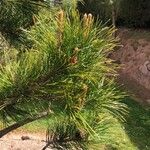
Pinus thunbergii
Black pine · Japanese black pine · Thunberg Pine
Description
Source: leafsnapPinus thunbergii, commonly known as the Japanese black pine, is a species of pine tree native to Japan and Korea. This slow-growing evergreen can reach heights of 20-30 meters and widths of 5-10 meters. Its bark is dark brown or black with deep fissures, giving it a rugged appearance. The needles of Pinus thunbergii are dark green, grow in pairs, and measure about 5-10 cm in length. The cones are also dark brown or black and can grow up to 8 cm long. This species is highly valued for its ornamental qualities and its timber, which is used in construction, furniture making, and paper production. It is also popular in bonsai cultivation due to its unique appearance. Pinus thunbergii prefers well-drained soil with full sun exposure but can tolerate some shade. Once established, it is drought-tolerant but requires regular watering during the first few years after planting. Overall, Pinus thunbergii is an attractive evergreen tree that enhances the beauty of any landscape while providing valuable resources such as timber and shade.
🌳 The Japanese black pine can uniquely adjust to and flourish in sandy soils and areas exposed to salt spray, making it an important species in coastal regions where such conditions can endanger other plants. Its toughness makes it suitable for landscaping and also provides a potential resource for studying plant resilience and adaptation in challenging ecosystems. Additionally, it could play a key role in the future in restoring and stabilizing threatened coastal ecosystems.
🎭 Optimism, Sympathy
Care Guide
💧 Water Every 7 days
Japanese black pine thrives in coastal regions, where it adapts well to sandy soils and salt spray. Although it tolerates drought, it does require moderate moisture and well-drained soil conditions. You should water it every two weeks, and it benefits from natural rainfall during the growing season. Due to its size, Japanese black pine is typically grown outdoors.
How should I water my Japanese black pine tree?
Watering your Japanese black pine is a simple task. To do so, you can use your garden hose to slowly soak the soil. For larger trees, it is best to use the garden hose as they need more water. However, for smaller trees, a watering can or other smaller watering tool may suffice. Avoid overhead watering as this can cause disease, especially in young trees.
What should I do if I give my Japanese black pine too much or too little water?
Overwatering your Japanese black pine can occur when the soil is poor and doesn't allow for effective drainage. This can result in the decline of the plant. If this happens, you have two options: improve the soil's drainage by amending it or find a better location for your Japanese black pine. If your plant is in a pot, you may need to repot it with looser soil and a container that allows for better drainage. Overwatered plants can also be more susceptible to diseases, so it's important to treat any symptoms promptly. On the other hand, if your Japanese black pine is underwatered, simply water it more frequently and it should bounce back to full health. To determine if your plant is overwatered, examine the foliage, particularly the new growth. Discolored or easily breakable new growth indicates excessive moisture. Additionally, standing water or slow drainage in the plant's growing area is a sign of overly moist soil. Underwatered Japanese black pines will have sparse, brown leaves. It's also helpful to consider recent rainfalls or consistently high temperatures when assessing symptoms.
How frequently should I give water to my Japanese black pine?
A mature Japanese black pine is highly adaptable to drought conditions and can typically survive solely on rainfall. In the hottest months, you may only need to water it once a week, and during other seasons, watering may not be necessary at all. However, if you have recently planted a Japanese black pine, it's important to water it regularly to ensure the soil remains moist and to help the roots establish. It's crucial to avoid overwatering this species, as standing water is not well-tolerated. When unsure, it's best to refrain from watering rather than risking overwatering.
How much water does my Japanese black pine tree need?
During the height of summer, it is necessary to water your Japanese black pine. Normally, you should give it about one inch of water per week. However, this amount may vary if it has rained that week. If it has rained one inch or more, there is no need to water your Japanese black pine. When it is newly planted, the Japanese black pine will require more water during the establishment period. Typically, this means watering once every one to two weeks for the first few growing seasons.
What is the best way to water my Japanese black pine throughout the year?
During the summer, the Japanese black pine tree needs the most water due to the hot weather. It is best to give it water once a week if there is no rainfall. However, during other seasons, this plant can survive without any water. In the spring and fall, you may need to water it occasionally if the weather gets very hot, but this is not common. Unlike many other plants, the Japanese black pine tree does not fully go dormant in the winter, so it continues to grow even in the coldest months. However, the water needs during winter are still low because the cool temperatures do not cause the soil to dry out quickly.
☀️ Light Full sun
Japanese black pine grows best in places that receive sunlight for most of the day. Native to regions with abundant sun, these trees perform best when given plenty of light. Too much or too little light usually does not harm its health.
What are the sunlight requirements for Japanese black pine?
Japanese black pine thrives in conditions where it receives more than 6 hours of sunlight daily, classified as full sun exposure. However, it can also tolerate partial sun, defined as about 3-6 hours of sunlight per day. It's important to observe the movement of sunlight through your garden to find spots that offer the right balance of light and shade, ensuring your plants grow happily and healthily.
What essentials should be considered for the health of Japanese black pine?
Japanese black pine does best when exposed to full sunlight for most of the day, as it originates from environments with abundant light. Its health isn't significantly affected by variations in light exposure. For indoor plants or those in less sunny locations, artificial lighting can play a crucial role in optimal growth, especially during winter or in darker spaces. Utilizing LED lights, which can be customized to provide specific wavelengths needed by the plant, is beneficial. For full sun plants, a requirement of 30-50W per square foot of artificial light is suggested, with a light source placed 12-36 inches above the plant for 8-12 hours per day to mimic natural sunlight conditions.
What are the symptoms of incorrect lighting conditions for Japanese black pine?
Japanese black pine, which thrives in full sunlight, can show signs of light deficiency when grown in less than optimal conditions. These symptoms include smaller new leaves, leggy or sparse growth, faster leaf drop, delayed or halted growth, paler new leaves or irregular color patterns indicating a lack of chlorophyll, chlorosis (yellowing of leaves due to chlorophyll breakdown), sunscald (damage from intense light causing pale or bleached spots), leaf curling as a defense against sunlight, wilting due to water loss, and leaf scorching characterized by brown or crispy leaf edges. Proper sunlight management is crucial for avoiding these issues.
What solutions exist for light-related issues in Japanese black pine?
To combat light-related issues in Japanese black pine, gradual adjustment to sunlight is crucial. For indoor plants or those difficult to move, consider increasing exposure to sunlight by placing them near a south-facing window or using artificial lights for at least 8 hours a day. Outdoor plants should be gradually moved to sunnier spots to prevent sunburn. Addressing obstructions, such as pruning trees to enhance sunlight penetration or transplanting smaller plants during their dormant period to a more suitable location with ample sunlight and good drainage, can make a significant difference. While some damage from light deficiency may not be reversible, new growth after adapting to better light conditions should be healthy.
🌡️ Temperature 15–35°C
Japanese black pine is native to temperate regions and performs best in temperatures between 59 and 95 °F (15 and 35 °C). Seasonal variations can influence its growth, so adjustments to accommodate changing temperatures may be required.
What is the native climate for Japanese black pine?
Japanese black pine, or Pinus thunbergii, is native to temperate climates. It thrives best in temperatures ranging from 59 to 95 °F (15 to 35 °C). The plant has some cold tolerance and generally does fine when the temperature is above -5°C. However, adjustments may be necessary to accommodate seasonal temperature changes, and temporary measures for cold protection are recommended if temperatures are expected to drop below -5°C.
How does cold weather affect Japanese black pine and what are the solutions?
Japanese black pine has a moderate tolerance to low temperatures and thrives best above 15°C. In winter, it's important to keep it above -5°C. If temperatures fall below -10°C, the leaves may droop, and in severe cases, wilt and fall off. To protect the plant in cold weather, you should trim off frost-damaged parts and wrap the plant with non-woven fabric or cloth. Additionally, constructing a wind barrier can help protect it from cold winds.
What should be done if a Japanese black pine experiences high temperatures?
During the summer, it's crucial to keep Japanese black pine below 35°C. Temperatures exceeding 41°C can lead to lighter leaf color, dry and withered leaf tips, curled leaves, and increased susceptibility to sunburn. To mitigate these issues, trim away sunburned and dried-up parts, move the plant to a shaded location during midday and afternoon sun, or use a shade cloth. It's also beneficial to water the plant in the morning and evening to maintain soil moisture.
💨 Humidity
🪴 Soil 5-6
🌱 Fertilizer
Japanese black pine has specific nutrient needs and does not require heavy fertilization. Spring is the best time to apply fertilizer for optimal growth. Supplying nutrients enhances its health, increases its resistance to pests and diseases, and helps preserve its long lifespan.
Why should I put fertilizer on my Japanese black pine?
To promote healthy growth, it is important to fertilize Japanese black pine in the spring. Given its long lifespan, it requires proper support. Adding nutrients to the soil can also enhance its health, enabling it to effectively combat common pests and diseases that may inhibit growth or shorten its lifespan.
When should I fertilize my Japanese black pine tree for the best results?
The growing medium may not provide sufficient nutrients for healthy growth, but Japanese black pine is an exception to this. Unlike garden annuals and perennials, it does not need many additional nutrients. For optimal results, it is best to fertilize Japanese black pine in the spring, just before new growth begins.
When is it not a good idea to fertilize my Japanese black pine?
While some plants benefit from regular fertilization, Japanese black pine is an exception. It doesn't need an excess of nutrients and too much fertilizer can actually harm it. Therefore, it's best to only apply fertilizer in the spring and avoid doing so during the summer, fall, and winter seasons. Additionally, refrain from adding any organic matter to the soil during these times.
What kind of fertilizer should I use for my Japanese black pine tree?
The age of your plant is important for choosing the right fertilizer. Keep in mind that Japanese black pine doesn't need a lot of extra nutrients. Look for a balanced plant food that promotes healthy root development and growth, but avoid fertilizers with high nitrogen content.
How can I give nutrients to my Japanese black pine?
To fertilize Japanese black pine effectively, it is crucial to pay attention to both the timing and method. Apply the fertilizer during the spring, specifically around the plant's base, while being mindful to avoid any contact with the trunk. In the case of granulated fertilizers, it is beneficial to cover the pellets with a thin layer of soil to enhance absorption into the soil.
🪴 Pot & Repot 2-3 years
When repotting Japanese black pine, select a pot 1–2 inches (2.5–5.1 cm) larger with ample drainage. Use a well-draining potting mix. Repot in spring or fall, ensuring the root ball sits slightly lower than the rim of the flower pot. Water thoroughly after repotting and place it in a warm spot with indirect sunlight.
✂️ Pruning
Japanese black pine is a hardy conifer known for its distinctive structure and dense needles. To encourage healthy growth, prune it during the early to late winter months. This allows you to remove dead branches and thin out crowded areas, which helps increase light penetration. Pruning during this period also minimizes sap loss and reduces the risk of disease, ensuring the plant remains vibrant and well-shaped.
🌿 Propagating
🐛 Diseases & pets
☠️ Toxicity
Characteristics
- Plant Type
- Tree
- Life Cycle
- Perennial
- Genus
- Pinus
- Family
- Pinaceae
- Hardiness Zone
- 8-10
- Mature Height
- 39.93 m
- Mature Spread
- 3.66 m to 6.1 m
- Leaf Color
- Green
- Leaf Type
- Evergreen
- Flower Color
- Yellow, Orange, Gold
- Flower Size
- 2.54 cm to 7.62 cm
- Bloom Time
- Early summer, Mid summer
- Planting Time
- Spring, Autumn
- Harvest Time
- Mid summer, Late summer, Early fall
- Native Area
- Koppen, Japan, South Korea