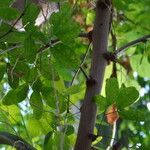
Pithecellobium unguis-cati
Cat's-claw · Blackbead · Catclaw Blackbead · Crab Wood · Money Bush
Description
Source: leafsnapPithecellobium unguis-cati, commonly known as the cat's claw or wait-a-minute tree, is a flowering plant species in the Fabaceae family. Native to Central and South America, it thrives in diverse habitats such as forests, savannas, and disturbed areas. The plant can reach heights of up to 20 meters, with a trunk diameter of up to 50 cm. Its bipinnate leaves feature small leaflets that are sensitive to touch or movement. The most distinctive characteristic of this plant is its thorns, which resemble a cat's claws, hence the common name. These thorns can grow up to 10 cm long and curve downwards, making it challenging for animals or humans to pass through without getting caught. The flowers of Pithecellobium unguis-cati are small, white, and sweetly fragrant, attracting bees for pollination. The plant produces pod-like fruits that contain several seeds, providing food for birds and other animals. Traditionally, various parts of the Pithecellobium unguis-cati plant have been used in medicine for their properties in treating skin infections, reducing fever, and relieving pain, among other benefits. Overall, this unique tree holds ecological significance by supplying food sources for wildlife and cultural importance through its use in traditional medicinal practices.
Care Guide
💧 Water Every 7 days
☀️ Light Full sun
Catclaw blackbead is native to open habitats, such as sunny meadows and forest edges, which offer abundant light. It prefers Full Sun but can tolerate Partial Sun, adjusting well to various light conditions.
🌡️ Temperature 20–37.8°C
Catclaw blackbead shows good tolerance for heat and can handle wider temperature fluctuations. In hot weather, attention should be paid to watering and suitable shading should be provided to prevent sunburn. However, it is relatively sensitive to low temperatures; while it can survive some cold, very cold conditions may cause frost damage.
What is the common name of Pithecellobium unguis-cati?
The common name of Pithecellobium unguis-cati is Catclaw blackbead.
What are the main characteristics of Catclaw blackbead?
Currently, there are no detailed characteristics provided for Catclaw blackbead. The information on its main features, including growth habits, leaf shape, and any distinctive attributes, has not been specified.
What symptoms does Catclaw blackbead have?
There are no symptoms detailed for Catclaw blackbead in the provided information, which suggests that there might be no common or notable symptoms associated with this plant, or simply that such data hasn't been included.
💨 Humidity
🪴 Soil 6-7
🌱 Fertilizer
Correct timing matters for fertilizing Catclaw blackbead. Apply fertilizer in early spring and continue monthly until early summer. Fertilizer encourages attractive blooms and provides energy both during dormancy and active growth.
🪴 Pot & Repot
✂️ Pruning
Catclaw blackbead is characterized by its claw-like thorns and dense foliage. To promote growth, improve air circulation, and increase bloom size, it's best to prune the plant in early spring. Regular trimming helps prevent it from becoming invasive. Always use clean, sharp tools to minimize damage and speed up the healing process, ensuring the plant remains healthy and vigorous.
🌿 Propagating
🐛 Diseases & pets
☠️ Toxicity
Characteristics
- Plant Type
- Vine
- Life Cycle
- Perennial
- Genus
- Pithecellobium
- Family
- Fabaceae
- Hardiness Zone
- 10-11
- Mature Height
- 3.05 m to 6.1 m
- Mature Spread
- 3.05 m to 4.88 m
- Leaf Color
- Dark Green
- Leaf Type
- Evergreen
- Flower Size
- 1.02 cm to 2.03 cm
- Bloom Time
- Late spring, Summer
- Planting Time
- Spring, Summer, Autumn
- Harvest Time
- Late summer, Fall