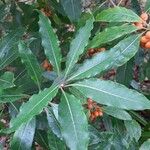
Pittosporum undulatum
Australian cheesewood · Sweet pittosporum · Cheesewood · Orange-berry pittosporum · White-holly
Description
Source: leafsnapPittosporum undulatum, commonly known as Victorian box or sweet pittosporum, is a species of evergreen tree or shrub native to Australia. Belonging to the Pittosporaceae family, it can reach up to 30 meters in height within its natural habitat. Its glossy, dark green leaves with wavy edges give the plant a distinctive appearance. While its flowers are small and inconspicuous, they emit a sweet fragrance that attracts bees and other pollinators. Pittosporum undulatum is widely cultivated in gardens as an ornamental plant due to its attractive foliage and fragrant flowers. It is also popularly used for hedging or screening purposes because of its dense growth habit. Additionally, the wood from this plant is highly valued for making furniture, musical instruments, and other decorative items. However, Pittosporum undulatum has become an invasive species in some parts of the world where it has been introduced outside its native range. Its rapid growth in disturbed areas can cause it to outcompete native vegetation, potentially having negative impacts on local ecosystems. In summary, Pittosporum undulatum is an appealing evergreen tree with unique foliage that offers both ornamental beauty and practical uses such as wood production. Nevertheless, it should be used cautiously outside its natural range to avoid potential invasiveness issues if not properly managed.
💡 The Australian cheesewood has been classified as a serious invasive species across four continents, including parts of Australia where it is not native. This plant grows rapidly and reproduces both through seeds and suckers. The seeds are covered in a sticky pulp, which allows them to be spread by fruit-eating birds, animals' fur, and even by hitching a ride on human feet.
🌳 Although regarded as invasive in some areas, australian cheesewood offers ecological benefits by providing habitat and food for native birds, which aids in seed dispersion. Its hardiness and rapid growth make australian cheesewood of interest for reforestation projects and ecological restoration efforts. In addition, australian cheesewood's attractive foliage and fragrant flowers have made it a popular ornamental plant in various landscapes.
🎭 Innocent love, or pure thoughts; chastity and sincerity of heart
Care Guide
💧 Water Every 7 days
Australian cheesewood thrives in environments with moderate humidity, similar to the intermittent rainfall of its native habitat. It is best to water it every 2 to 3 weeks, making sure to let the soil dry out between waterings to prevent overwatering. Pay attention to natural rain patterns, particularly during the growing season, to help meet its moisture requirements.
How should I water my Australian cheesewood plant?
Your Australian cheesewood doesn't require specific watering methods. You can use any common watering tool, such as watering cans, hoses, or even cups, to water the plant. Regardless of the tool you choose, it's important to directly apply water to the soil and ensure equal moisture distribution for the entire root system. Filtered water is preferred over tap water, as tap water may contain harmful particles. Using water at room temperature or slightly above is recommended, as extremely cold or hot water can shock the plant. However, the Australian cheesewood typically responds well to any type of water.
What should I do if I give my Australian cheesewood plant too much or too little water?
Outdoor plants, especially newly planted ones or plant seedlings, are prone to not being watered enough. It's important to keep watering them regularly for a few months while the tree is still small or recently planted. Once the roots are established, Australian cheesewood can usually rely on rain for hydration. However, when Australian cheesewood is planted in pots, there is a higher risk of overwatering. If you accidentally overwater your Australian cheesewood, there are steps you can take to remedy the situation. First, stop watering the plant immediately to minimize the effects of overwatering. Then, remove the plant from its pot and inspect the roots for any signs of root rot. If there is no root rot, you can return the plant to its container. But if there is root rot, trim away the affected roots and apply a fungicide to prevent further damage. Finally, repot the Australian cheesewood in well-draining soil. On the other hand, underwatering is an easy fix. If you notice the plant's leaves drooping, drying out, or falling off, simply water it more frequently. Correct the watering frequency as soon as you notice underwatering occurring.
How frequently should I water my Australian cheesewood?
Most plants can rely on rainfall for their water needs when grown outdoors. However, if you live in an area with low rainfall, you should water your plants every 2 weeks in spring and fall. In summer, you'll need to water more often, while in winter, when growth slows down, you can water less frequently or not at all. If you have a young or newly planted Australian cheesewood, watering it more frequently will help it establish and become more adaptable to drought conditions. As for potted plants, there are two main approaches to determining their watering frequency. One way is to set a regular watering schedule, such as once a week or every other week. However, this might not take the specific conditions of your Australian cheesewood's environment into account. Another approach is to gauge the soil moisture. Let the top two to four inches of soil dry out completely (about ⅓ to ½ of the pot's depth) before watering again. This method can be adjusted based on the season, as the plant's water needs are highest during summer.
How often should I water my Australian cheesewood plant?
When watering your Australian cheesewood, you may be surprised to learn that it doesn't always require a lot of water. Instead, if only a few inches of soil have dried since the last watering, you can give it about five to ten ounces of water to support healthy growth. You can also determine the amount of water based on the moisture level of the soil. Take note of how many inches of soil have dried out between waterings. To ensure the Australian cheesewood receives enough moisture, water it enough to moisten all the dry soil layers since the last watering. If over half of the soil is dry, consider giving more water. Keep adding water until excess water drains from the pot's drainage holes. If your Australian cheesewood is planted in a rainy outdoor area, it may not require additional watering. When the plant is young or establishing, make sure it receives 1-2 inches of rain per week. As it continues to grow and establish, it can rely solely on rainwater. Only when the weather is hot and there has been no rainfall for 2-3 weeks should you consider giving a full watering to prevent stress.
How do I know if I'm watering my Australian cheesewood plant enough?
Overwatering is a common issue for the Australian cheesewood, and there are clear signs to look out for. An overwatered plant will have yellowing leaves and may shed some leaves. In addition, overwatering can cause the plant's structure to shrink and promote root rot. Conversely, an underwatered plant will also start to droop and may have brown or brittle leaves. If you notice signs of either overwatering or underwatering, it is important to take action and restore the health of your Australian cheesewood.
☀️ Light Full sun
Australian cheesewood prefers continuous sunlight for best growth. It can tolerate some periods of shade during the day. However, too much shade can stunt its growth and harm its health. This preference for abundant sun reflects its native habitat.
What are the sunlight requirements for Australian cheesewood?
Australian cheesewood thrives best with constant exposure to the sun's rays for optimal growth, although it can also tolerate periods of partial shade throughout the day. An excessively shaded environment may hinder its growth and overall health. It's crucial to ensure that your Australian cheesewood receives a sufficient amount of sunlight, reflective of its native habitat conditions. To adapt to varying indoor lighting conditions, especially in less sunny spaces or during winter, artificial lighting can be utilized. Specifically, indoor plants may need LED lights or other forms of artificial light placed 12-36 inches above the plant and turned on for 8-12 hours per day, based on the plant's requirements.
What should I do if my Australian cheesewood shows symptoms of light deficiency?
If your Australian cheesewood exhibits signs of light deficiency such as small or lighter-colored new leaves, leggy growth, faster leaf drop, slower or no new growth, chlorosis, sunscald, leaf curling, wilting, or leaf scorching, it's indicative of inadequate lighting. For indoor plants, gradually increasing exposure to natural sunlight by moving the plant to a sunnier spot each week or using artificial lighting like desk or grow lights for at least 8 hours daily can help. Outdoor plants should also be moved progressively to sunnier locations to avoid shock. If obstructions like trees block sunlight, consider pruning or transplanting smaller plants to brighter areas during their dormant period.
How can I protect my Australian cheesewood from excessive sunlight exposure?
To prevent symptoms associated with excessive sunlight exposure such as chlorosis, sunscald, leaf curling, wilting, and leaf scorching, it's important to watch how sunlight moves through your garden and find spots that offer a balanced distribution of light and shade. This ensures your Australian cheesewood's happiness and health by avoiding the negative impacts of too much direct sunlight.
🌡️ Temperature 20–37.8°C
In its native habitat, Australian cheesewood commonly thrives where temperatures range from 68 to 100 ℉ (20 to 38 ℃). Because it prefers warmth, it's important to keep Australian cheesewood within a comparable temperature range. Minor seasonal adjustments may be needed to mimic its natural environment.
What is the preferred temperature range for Australian cheesewood?
Australian cheesewood thrives best in temperatures ranging from 68 to 100°F (20 to 38°C). To replicate its native environment, it is crucial to maintain it within this temperature range. Slight adjustments may be necessary seasonally to ensure the plant experiences conditions similar to its natural habitat. It is particularly important to avoid exposing Australian cheesewood to cold temperatures, as it is extremely heat-loving and can be damaged by the cold. During autumn, plants grown outdoors should be brought indoors and placed near a bright window, though not too close to heaters, to keep them above 20°C throughout winter. Ensuring the temperature does not approach 0°C is essential for the plant's well-being.
What should I do if my Australian cheesewood experiences low temperatures?
If your Australian cheesewood is exposed to low temperatures, particularly below -5°C, the leaves may lighten in color, and after frost damage, they may turn brown or black. Symptoms such as wilting and drooping may also occur. To mitigate frost damage, trim off the frosted parts and move the plant indoors to a warm location immediately. Place it near a south-facing window to ensure it receives ample sunlight, but avoid placing it directly near heaters or air conditioning vents to prevent the air around it from becoming excessively dry. Keeping the plant above 20°C during winter and away from temperatures approaching 0°C is beneficial for its health.
How should I care for my Australian cheesewood during high temperatures?
During the summer, it's important to ensure the temperature around your Australian cheesewood does not exceed 38°C. Temperatures above 43°C can cause the leaves to lighten in color and increase the plant's susceptibility to sunburn. To care for a plant affected by high temperatures, trim away any sunburned or dried-up parts. Relocate the plant to an area that offers shade during the midday and afternoon sun to protect it from excessive heat. Watering the plant in the morning and evening will help keep the soil moist and support the plant's health during hot periods.
💨 Humidity normal (40-60%)
This plant will thrive in moderate humidity, which is probably the level in your home. However, misting it a few times a week can be very beneficial. Make sure the room has good ventilation.
🪴 Soil 5-7
🌱 Fertilizer
The best time to fertilize an Australian cheesewood is in early spring as it breaks dormancy. Doing this stimulates overall growth and flower development. Fertilizing improves the foliage, stems, and branches, while encouraging flowers that are large, vibrant, and long-lasting. It helps move nutrients from the roots to the flowers and enhances the plant's health and resistance to disease.
Why is it necessary to add fertilizer to my Australian cheesewood plant?
Australian cheesewood requires regular fertilization because its showy leaves demand a large amount of energy for production and maintenance. This poses a challenge as the tree needs to allocate enough energy not only for leaf health but also for the growth of its stems, branches, roots, and other essential structures. Neglecting fertilization can lead to two likely outcomes. The first is a decline in the natural color and texture of the leaves, resulting in an overall unhealthy appearance that diminishes its ornamental value. The second outcome is a decrease in overall growth or the development of weak growth that may be prone to breakage.
When should I fertilize my Australian cheesewood?
Australian cheesewood plants do not require a strict feeding schedule, but they will benefit from occasional feedings. A simple way to fertilize these plants is to apply fertilizer while watering them. During the growing season, it is important to provide a sufficient amount of water to the Australian cheesewood. Feeding the plant every two to three weeks is recommended, especially during periods of new growth.
When is the best time to not put fertilizer on my Australian cheesewood plant?
For the majority of the year, you can follow a regular fertilization schedule for your Australian cheesewood. This includes the active growing season of spring, summer, and early fall. However, during the winter, it is important to avoid fertilizing the plant altogether. During this time, the Australian cheesewood enters a dormant growth phase where little to no new growth occurs. Since the plant is using less energy during this phase, fertilization is not necessary.
What kind of plant food does my Australian cheesewood need?
The fertilizer needed for Australian cheesewood contains a specific blend of nutrients, each present in low amounts. Ideally, the fertilizer should have an N-P-K ratio of 3-1-2. However, a general-purpose fertilizer with an even balance of nutrients can still work well in some cases. When using a balanced fertilizer, make sure the ratio numbers for each nutrient are 3 or lower. You can choose to use either granular or liquid-based fertilizer. If you opt for liquid fertilizer, it is recommended to dilute its strength by half. Granular fertilizer does not have many downsides, but using liquid fertilizer, especially if you water the Australian cheesewood at the same time, is often the most sensible choice.
How should I put fertilizer on my Australian cheesewood plant?
One of the easiest ways to fertilize an Australian cheesewood is by feeding it when you water it. Here are two methods you can use: Method 1: 1. Gather your fertilizer and a water container, like a watering can. 2. Dilute the fertilizer by mixing it with water. 3. Pour the water with the fertilizer onto the soil and let it soak down to the roots. Method 2: 1. Use a granular fertilizer instead. 2. Sprinkle the fertilizer on the soil where your Australian cheesewood lives. 3. Granular fertilizers are usually slow-release, so you won't need to fertilize as often compared to liquid fertilizers. 4. Remember to water your Australian cheesewood while you feed it. Either way, remember to water your Australian cheesewood as you feed it for optimal results.
🪴 Pot & Repot Every 12 months
✂️ Pruning
Australian cheesewood is known for its glossy, wavy leaves and fragrant white-cream flowers. To maintain its shape and size, prune the plant from early to late winter. Start by removing any dead branches and thinning out crowded areas to improve air circulation. Make sure to use sharp and clean tools to promote optimal health and flowering.
🌿 Propagating
🐛 Diseases & pets
☠️ Toxicity
Characteristics
- Plant Type
- Tree, Shrub
- Life Cycle
- Perennial
- Genus
- Pittosporum
- Family
- Pittosporaceae
- Hardiness Zone
- 9-11
- Mature Height
- 9.14 m to 15.24 m
- Mature Spread
- 9.14 m to 11.89 m
- Leaf Color
- Dark Green, Forest Green
- Leaf Type
- Evergreen
- Flower Color
- White
- Flower Size
- 2.54 cm
- Bloom Time
- Mid spring, Late spring, Early summer
- Planting Time
- Spring, Summer
- Harvest Time
- Mid summer
- Native Area
- Japan