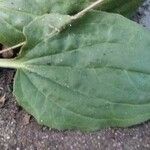
Plantago major
بارهنگ · Common plantain · Broadleaf Plantain · Plantain · Ženska bokvica
Description
Source: leafsnapPlantago major, commonly known as broadleaf plantain or greater plantain, is a perennial herbaceous plant belonging to the Plantaginaceae family. Native to Europe and Asia, it has now spread worldwide and can be found in many regions. The leaves of this plant are broad and oval-shaped, with prominent parallel veins. The small, greenish-brown flowers grow on tall stems that can reach up to 60 cm in height. Broadleaf plantain has been used for centuries for its medicinal properties. It contains several active compounds, such as aucubin, allantoin, and mucilage polysaccharides, which have anti-inflammatory properties. These make it useful for treating skin irritations like insect bites or burns. In addition to its medicinal uses, broadleaf plantain is also used as a food source in some cultures, where its leaves are eaten raw or cooked like spinach. Overall, broadleaf plantain is an important herbaceous perennial with many uses, both medicinal and culinary, making it a significant part of our natural world today.
🌳 The common plantain has a little-known role in phytoremediation. It can reveal the presence of heavy metals in soil, a fact that matters for environmental monitoring. Researchers use common plantain to evaluate soil health and to point out areas that may be contaminated by toxins.
🎭 Power, recovery, defense
Care Guide
💧 Water Every 3 days
Common plantain, native to temperate climates, thrives best in moderately moist, well-drained soil. It prefers consistent moisture but can tolerate occasional drought. To keep the plant healthy, water it weekly. As an herbaceous perennial, common plantain adapts well to different moisture conditions, making it a versatile choice for gardens in diverse climates.
When Should I Water My Common Plantain?
It is essential to water your common plantain regularly and timely to maintain its growth and health. Start by checking the soil's moisture; if the top 1-2 inches of soil feel dry, it's time to water the plant. Droopy leaves are another sign that your common plantain needs water. This condition occurs because the plant cannot maintain its structure due to insufficient water. Examining leaf turgor pressure is another method; if a leaf doesn't bounce back after being gently squeezed, the plant needs water. Additionally, stunted growth can indicate a need for more water. However, be wary of overwatering or underwatering, as both can lead to adverse effects such as root rot or stunted growth.
How Should I Water My Common Plantain?
Common plantain thrives in moist but well-drained soils. To achieve this, bottom-watering or using a watering can with a narrow spout to target water at the base is preferable. This method helps prevent over-saturation of leaves and promotes healthier root development. Additionally, a moisture meter can be invaluable for ensuring your plant receives the optimal amount of water without becoming too dry or overly saturated. Focus your watering around the base to avoid fungal issues. It's best to water in the morning hours so any excess moisture can evaporate, enhancing overall plant health.
How Much Water Does Common Plantain Really Need?
The common plantain, adaptable to a range of soil moisture conditions, requires consistent watering to keep the top layer of soil moist. The amount of water needed varies with the size of the plant and pot, ranging from 1-2 cups for smaller plants and pots to 2-4 cups for larger ones. A well-hydrated plant will display green, healthy leaves and stems. Adequate moisture, without over-saturation, supports the plant's growth and health. Overwatering or underwatering can cause issues such as root rot or hindered growth, respectively. Ensure good drainage to prevent waterlogging.
What Kind of Water is Best for Common Plantain?
Rainwater is ideal for common plantain due to its purity, but distilled or filtered water works well too, minimizing potential contaminants like chlorine and fluoride. If tap water is used, it should be treated or left out for about 24 hours to allow chlorine to evaporate. Common plantain is sensitive to cold water and high mineral content; therefore, using room temperature water and avoiding hard water is recommended. Regular dechlorination and defluoridation treatments benefit the plant, along with maintaining a neutral pH level. Consistently moist, well-draining soil is key for its health.
How Do Common Plantain's Watering Needs Change with the Seasons?
In spring, the common plantain's watering needs increase as it enters its growing stage. The soil should be kept moderately moist. During the hot summer months, despite the plant's drought resistance, it's crucial not to let the soil dry out completely and provide regular morning watering. As autumn arrives and temperatures drop, reduce watering, allowing the soil to nearly dry out between sessions. Winter is a dormant period for the plant, requiring minimal watering to prevent the soil from becoming soggy, which can lead to root rot and other issues.
☀️ Light Full sun
Common plantain thrives when it is subjected to abundant and consistent sunlight, although it can also endure somewhat less optimal light conditions. Optimal growth and health are guaranteed with ample sunlight, a fact supported by its native habitat. Nevertheless, insufficient or excessive lighting can have a detrimental effect on the growth of the common plantain.
What are the sunlight requirements for common plantain?
Common plantain requires full sun, which means it thrives best with more than 6 hours of sunlight daily, though it can also grow in partial sun, with about 3-6 hours of sunlight. It's important to observe how sunlight moves through your garden to find spots that offer the right balance of light and shade, ensuring your plants grow healthy. Common plantain's native habitat supports its need for abundant sunlight, and both insufficient and excessive sunlight can negatively affect its growth.
How does artificial lighting benefit indoor common plantain plants?
Indoor common plantain plants benefit significantly from artificial lighting, especially when natural sunlight is lacking. This is particularly useful during winter or in less sunny indoor spaces. Artificial lights, such as LED lights, can be tailored to provide the specific wavelengths needed by plants, supporting faster and healthier growth. For full sun plants, 30-50W/sq ft of artificial light is recommended, partial sun plants require 20-30W/sq ft, while full shade plants need 10-20W/sq ft. The light should be placed 12-36 inches above the plant, mimicking natural sunlight for 8-12 hours per day.
What are the symptoms of inadequate sunlight for common plantain?
When common plantain does not receive enough sunlight, several symptoms may appear. These include smaller new leaves, leggy or sparse growth, a faster rate of leaf drop, slower or stopped growth, and lighter-colored or yellow new leaves. Conditions like chlorosis and sunscald can occur, along with leaf curling and wilting as direct responses to excessive sunlight or insufficient light. Leaf scorching is also a symptom of too much direct sunlight, resulting in brown, dry edges on leaves.
What solutions can be applied to address common plantain's sunlight needs?
To address sunlight needs for common plantain, gradually increase the plant's exposure to sunlight by moving it to a sunnier location each week until it receives at least 6 hours of direct sunlight daily. For indoor plants, use a south-facing window or artificial lights to provide at least 8 hours of light daily. For outdoor plants, a gradual relocation helps them adapt without the risk of sunburn. Reducing obstructions and, for smaller plants, transplanting during their dormant period to a sunnier location with good drainage can also help.
🌡️ Temperature 5–35°C
The typical temperature range for common plantain is between 41 and 95 ℉ (5 to 35 ℃), and it can tolerate cold conditions down to 23 ℉ (-5 ℃). Although it originates in Europe, it can also thrive in Asia, North America, and Africa. To adapt to changes in temperature, it might enter a dormant state in winter and experience growth increases in spring.
What is the preferred temperature range for common plantain?
Common plantain thrives in a temperature range of 41 to 95°F (5 to 35°C) but can withstand cold temperatures down to 23°F (-5°C). It is well-equipped to adjust to varying temperatures, entering dormancy during winter and experiencing growth spurts in spring. Originating from Europe, it has successfully adapted to various regions including North America, Asia, and Africa. Despite its strong cold resistance, providing protection when temperatures are expected to drop below the critical limit is beneficial. This includes measures such as covering the plant with soil or straw and watering it abundantly before the first freeze in autumn to keep the soil moist, thereby preventing drought and water scarcity.
How does common plantain respond to low and high temperatures, and what are the solutions?
Common plantain is notably cold-tolerant, ideally requiring temperatures above a certain minimum for optimal growth. It sustains minimal visible damage over winter even when temperatures fall below the critical growth limit, yet this can result in reduced or absent sprouting in spring. To address this, removing any non-sprouting parts in spring is recommended. Conversely, during high temperatures, specifically above a certain maximum, common plantain's leaves may lighten, curl, become prone to sunburn, or in extreme cases, the plant might wilt and dry completely. Solutions include trimming away sunburned and dried parts of the plant, relocating it to a shaded area or using a shade cloth to avoid midday and afternoon sun, and ensuring the soil remains moist by watering in the morning and evening.
💨 Humidity
🪴 Soil 5-7
🌱 Fertilizer
Typically, a one-time fertilizer application in the spring is adequate for Common plantain, however, periodic nourishment can optimize its growth. Apply the feed approximately every one to one and a half months. Fertilizing improves the look and operation of the leaves, leading to uniform color and robust texture. Moreover, it fosters the development of roots and the uptake of nutrients, thereby boosting the plant's overall health in the long run.
Why should I put fertilizer on my Common plantain?
Properly fertilizing your Common plantain is crucial for both the appearance and function of its leaves. Fertilization promotes consistent color and a healthy texture in the leaves. Additionally, it supports the plant's root system, helping it generate new roots and maintain existing ones. By fertilizing, you not only keep your plant healthy in the present but also enhance its ability to absorb soil nutrients in the future.
When should I fertilize my Common plantain to get the best results?
When you grow your Common plantain outdoors, it will start sending out new growth in early spring. This is a signal that it's time to fertilize for the year. Usually, a single application of fertilizer in the spring is sufficient for a Common plantain to thrive. However, if you want to maximize its growth, you can feed it multiple times during the spring and early summer. If you choose this option, you can fertilize your Common plantain approximately once every month to a month and a half.
When is it not a good idea to fertilize my Common plantain?
During late fall and winter, your Common plantain goes into a dormant phase where it stops growing. It's important to not fertilize it during this time. In the spring and summer, if you choose to fertilize multiple times, you should gradually reduce the amount of fertilizer as summer approaches since the plant's growth rate slows down. It's always a bad idea to fertilize your Common plantain when it's unusually hot or the soil is extremely dry as this can harm the plant and cause it to die prematurely.
What kind of fertilizer does my Common plantain plant need?
Luckily, selecting the right fertilizer for a Common plantain is straightforward. These plants do well with a general-purpose garden fertilizer that has equal amounts of nitrogen, phosphorus, and potassium. An effective option is a fertilizer with a 10-10-10 ratio or something similar. It's important to avoid fertilizers with high levels of nitrogen if unsure. The best fertilizers for Common plantains are typically in granular form, preferably slow-release for easy application to the soil. Additionally, feeding your plants with organic compost can be beneficial.
How should I fertilize my Common plantain?
1. In early spring, wait until your Common plantain's first leaves have just emerged from the soil. 2. Once you see this sign, apply a granular slow-release fertilizer with a balanced formula to the soil around the base of your plant. 3. You can repeat this process later in the season if desired. 4. When reapplying fertilizer, again apply it to the soil at the base of the plant, not directly to the plant itself. You may need to move some leaves aside to access the soil above the roots. 5. It's also recommended to water your Common plantain before and after fertilizing.
🪴 Pot & Repot
✂️ Pruning
To improve the growth and appearance of common plantain, prune it in early spring. Remove any spent flowers and damaged leaves, and thin out overcrowded areas to improve air circulation. This seasonal maintenance rejuvenates the plant, ensuring it remains healthy and lush while enhancing the garden's aesthetics throughout the growing season.
🌿 Propagating
🐛 Diseases & pets
☠️ Toxicity
Characteristics
- Plant Type
- Herb
- Life Cycle
- Perennial
- Genus
- Plantago
- Family
- Plantaginaceae
- Hardiness Zone
- 5-9
- Mature Height
- 10 cm to 49 cm
- Mature Spread
- 10 cm
- Leaf Color
- Green
- Leaf Type
- Evergreen, Semi-evergreen
- Flower Color
- Green, White
- Flower Size
- 2.54 cm
- Bloom Time
- Late spring, Early summer, Mid summer
- Planting Time
- Spring, Autumn, Winter
- Harvest Time
- Summer
- Native Area
- Sri Lanka, Turkey, Sweden, India, Slovakia, Montenegro, Pakistan, Slovenia, Croatia, Belarus, Germany, Indonesia, Romania, Latvia, Belgium, Portugal, Netherlands, Saudi Arabia, Cyprus, Bulgaria, Laos, Ukraine, Lebanon, China, Afghanistan, Syria, Kyrgyzstan, Kazakhstan, Italy, Mongolia, Finland, Iran, Azerbaijan, Egypt, Malaysia, Austria, Yemen, Uzbekistan, Russia, Iraq, Cambodia, Estonia, Oman, France, Nepal, Tajikistan, Czech Republic, Armenia, Poland, Greece, Serbia, Lithuania, Norway, Spain, Switzerland, Vietnam, Myanmar, Denmark, Bhutan, Albania, Ireland, United Kingdom, Hungary, Turkmenistan