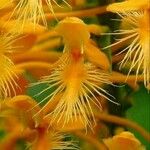
Platanthera ciliaris
Yellow Fringed Orchid
Description
Source: leafsnapPlatanthera ciliaris, commonly known as the yellow fringed orchid, yellow-fringed orchid, or orange-fringed orchid, is a large and showy species of orchid. It grows in "acid soil of hillside seepage bogs" in the longleaf pine landscapes of the Gulf Coast of the United States. Like many species in these habitats, including flatwoods, it is dependent upon recurring fire to create open conditions. Further north it is found in bogs, but even here it may be dependent upon fire to create open conditions. It is pollinated by large butterflies, mostly swallowtails.The species is at risk in some areas from loss of habitat and collecting. For example, it is endangered in Michigan. It has been recorded from extreme southern Ontario, but is now thought to be extirpated.
🎭 Affection, Augury, Fortune
Care Guide
💧 Water
The Yellow Fringed Orchid thrives in wet meadows and marshes, where it requires high moisture levels. To mimic its natural environment, it needs to be watered weekly. As an evergreen plant, it keeps its foliage throughout the year, so it’s important to maintain consistent moisture levels, even during the winter.
How should I water my Yellow Fringed Orchid?
To properly water the Yellow Fringed Orchid, consider the plant's growth phase. During active growth, water the soil and occasionally mist the leaves in warm weather. However, during winter or cool, wet weather, stick to watering the soil only. Determine if the plant needs water by checking for dryness or discoloration in the roots and leaves. Over-watering will result in a mushy and limp appearance. Ideal conditions for growing the orchid include using a well-draining potting mix and ensuring the pot has good drainage. During the growing season, water the plant multiple times per week, ensuring each watering drains quickly. The size of the pot affects the frequency of watering, with larger pots needing less water and smaller pots needing more frequent watering. When watering, use rainwater or distilled water that matches the air temperature as closely as possible.
What do I do if I give my Yellow Fringed Orchid too much water or too little water?
One of the most common ways to kill a Yellow Fringed Orchid is by keeping it in overly moist soil for too long. While these plants require frequent watering during active growth, it is important for them to be in a well-draining growing medium. Overwatering can result in mushiness and root rot in the plant. If this happens, you can use sterile pruning shears to remove any roots showing signs of rot. After that, it is recommended to repot the orchid in a container that allows for drainage and fill it with a fast-draining potting mix. However, it is important to note that Yellow Fringed Orchids may not respond well to excessive repotting, so getting the watering rate right is crucial. If the orchid is underwatered, it will start to shrivel and feel dry to the touch. In this case, it is likely that the soil is drying out faster than expected, and increasing the watering frequency is necessary.
How frequently should I water my Yellow Fringed Orchid?
To keep your Yellow Fringed Orchid healthy, adjust your watering frequency throughout the year. During the active growth stage in spring and summer, water once or twice per week. Increase watering to three times per week or more if it's hot and dry for a long time. In winter, still water your orchid, but not as much. Two to three times per month should be enough during the coldest months. However, if you keep your orchid indoors, be aware that indoor locations can cause the soil to dry out quicker. Consider increasing the number of monthly waterings. In autumn, gradually reduce watering from multiple times per week to your reduced winter schedule.
What should I think about when watering my Yellow Fringed Orchid at different times of the year and while it is growing?
When planning the watering schedule for your Yellow Fringed Orchid, it's important to consider two growth phases. The first phase occurs in spring and summer and is known as the active growth period. During this time, the plant requires frequent watering, multiple times per week. The second phase is the rest period, which happens during winter for about two to three months. During this period, the Yellow Fringed Orchid needs much less water and fertilization than usual. It's sufficient to water the plant just once or twice per month. To prepare for winter, gradually reduce the watering frequency from multiple times per week in the fall. This will help transition the plant to its appropriate winter watering schedule of once or twice per month.
How should I water my Yellow Fringed Orchid if I keep it indoors?
The Yellow Fringed Orchid thrives in humid environments. However, indoor growing locations often lack the necessary air moisture, causing the plant and soil to dry out quickly. To remedy this, it is recommended to place a humidifier in the room where you grow your orchid and increase watering frequency. It is important to note that while the orchid prefers humidity, it also needs proper air circulation to prevent excessive moisture and potential diseases. To achieve this, consider using a fan in the room as well.
☀️ Light Full sun
The yellow Fringed Orchid does best in settings where sunlight is abundant throughout the day, encouraging healthy growth. It needs plenty of natural light during every stage of its life. Native to regions where sunlight is never scarce, it can tolerate conditions with partially filtered light. Both too little and too much exposure can impede its growth.
What are the sunlight requirements for Yellow Fringed Orchid?
The Yellow Fringed Orchid requires full sun, which means it thrives in environments with more than 6 hours of sunlight daily. It can also tolerate partial sun, approximately 3-6 hours of sunlight. Observing the movement of sunlight through your garden and choosing locations that offer a balance of light and shade ensures the optimal growth of your plants.
How important is sunlight for the growth of Yellow Fringed Orchid?
Sunlight is crucial for the healthy growth of the Yellow Fringed Orchid, as it originates from areas with abundant natural light. It prefers generous sunlight throughout its lifecycle and can tolerate partially filtered sunlight. However, insufficient or excessive exposure can negatively impact its growth, leading to various growth issues.
What artificial lighting requirements do plants have?
Indoor plants, including the Yellow Fringed Orchid, require adequate lighting when natural sunlight is insufficient, such as in winter or less sunny spaces. Using the right type of artificial light, like LED lights customized to provide specific light wavelengths, is essential. Full sun plants need 30-50W/sq ft, partial sun plants need 20-30W/sq ft, and full shade plants need 10-20W/sq ft of artificial light. The light source should be placed 12-36 inches above the plant, mimicking natural sunlight conditions for 8-12 hours per day.
What are the symptoms of inadequate lighting for Yellow Fringed Orchid?
Symptoms of light deficiency in Yellow Fringed Orchid include smaller new leaves, leggy or sparse growth, faster leaf dropping, slower or halted new growth, lighter-colored new leaves, chlorosis, sunscald, leaf curling, wilting, and leaf scorching. These symptoms indicate the plant is not receiving the optimal amount of sunlight for growth.
What solutions exist for lighting issues with Yellow Fringed Orchid?
To address lighting issues, you can gradually move the plants to sunnier locations indoors or outdoors, ensuring they receive at least 6 hours of direct sunlight. Using artificial light sources, like desk lamps or professional grow lights, can supplement sunlight for indoor plants. Outdoors, reducing obstructions such as overhanging branches can help, and for smaller plants, transplanting during their dormant period to a brighter location with good drainage is beneficial. Note that parts of the plant affected by insufficient light may not recover, but new growth will be healthy with improved lighting.
🌡️ Temperature 5–37.8°C
The Yellow Fringed Orchid is native to habitats with temperatures from 41 to 100 °F (5 to 38 °C). It grows best under those temperature conditions. During different seasons, slight adjustments within that range may be needed for optimal growth.
What are the ideal temperature conditions for Yellow Fringed Orchid?
Yellow Fringed Orchid, or Platanthera ciliaris, thrives in temperatures ranging from 41 to 100 °F (5 to 38 °C). Optimal growth of this native orchid is seen within these temperature ranges, though moderate adjustments might be necessary to cater to different seasonal conditions. The orchid possesses strong cold resistance, typically not requiring special frost protection measures in winter. However, to guard against extreme cold, specifically if temperatures are expected to drop below -25°C, protective measures like covering the plant with soil or straw are recommended. It's also advised to water the orchid abundantly before the first freeze in autumn to maintain soil moisture, thereby preventing drought and water scarcity through winter into early spring.
How does the Yellow Fringed Orchid react to low temperatures, and what are the recommended solutions?
The Yellow Fringed Orchid is notably cold-tolerant, ideally maintaining a status above -20°C during winter, with a preference for temperatures above 5°C for optimum growth. If temperatures dip below -25°C, the orchid may not show noticeable changes in winter; however, it could lead to decreased sprouting or failure to sprout come spring. The recommended solution for any parts of the orchid that fail to sprout with the arrival of spring is to remove these inactive components, allowing for rejuvenation and regrowth.
What should be done if the Yellow Fringed Orchid experiences high temperatures?
During summer, it is crucial to ensure the Yellow Fringed Orchid is kept below 38°C. Exposure to temperatures above 43°C can cause the leaves to lighten in color, become more prone to curling, suffer from sunburn, and in severe cases, lead to the wilting and drying of the entire plant. To mitigate these risks, it's advised to trim away any sunburned or dried-up parts immediately. Moving the plant to a shaded area or using a shade cloth to protect it from the intense midday and afternoon sun can help prevent further damage. Additionally, watering the plant during the cooler morning and evening hours can help maintain the necessary soil moisture levels for its health.
💨 Humidity
🪴 Soil 6-7
🌱 Fertilizer
The best time to fertilize a Yellow Fringed Orchid is in early spring, when it is coming out of dormancy and starting active growth. Fertilizer supplies important nutrients for healthy development. Although the Yellow Fringed Orchid has fairly low fertilizer requirements, feeding it once a year can improve its survival and encourage better, longer-lasting flowers.
Why is it important to add fertilizer to my Yellow Fringed Orchid?
The main structure of the Yellow Fringed Orchid is made up of its leaves. By fertilizing the orchid, you can improve the appearance and function of these leaves. Fertilization not only enhances the color and texture of the leaves, but also supports root growth. This enables the orchid to develop new roots and maintain existing ones, leading to improved nutrient absorption from the soil both now and in the future.
When should I fertilize my Yellow Fringed Orchid for the best results?
If you plant your Yellow Fringed Orchid outside each year, it will start growing new leaves in early spring. This is a sign that it's time to fertilize the plant for the year. Usually, one application of fertilizer in the spring is enough for the orchid to grow well. But if you want it to grow even more, you can fertilize it several times during the spring and early summer. In this case, you can feed the orchid approximately once every month to a month and a half.
When is the best time to not fertilize my Yellow Fringed Orchid?
During late fall and winter, your Yellow Fringed Orchid will go into a dormant phase, meaning it won't produce new growth. In this period, it's important to avoid fertilizing your orchid. When spring and summer arrive, you can start fertilizing multiple times, but as summer approaches and the growth rate of your orchid slows down, it's recommended to decrease the fertilization rate. In general, it's not a good idea to fertilize your Yellow Fringed Orchid during extremely hot weather or when the soil is very dry. Fertilizing during those conditions can stress the orchid and potentially cause it to die prematurely.
Which fertilizer does my Yellow Fringed Orchid need?
Choosing the best fertilizer for a Yellow Fringed Orchid is luckily quite simple. These plants thrive on a general-purpose garden fertilizer with equal amounts of nitrogen, phosphorus, and potassium. Those that have a 10-10-10 ratio or something similar will work effectively. To be safe, avoid fertilizers with high nitrogen content. Granular fertilizers, especially slow-release ones, are often the top choice for Yellow Fringed Orchids. They are easy to apply to the soil. Additionally, consider using organic soil amendments like compost to feed your Yellow Fringed Orchid, as they can be beneficial.
How should I fertilize my Yellow Fringed Orchid?
To ensure proper growth of your Yellow Fringed Orchid, wait until early spring when its first leaves begin to emerge from the soil. At this point, apply a balanced, slow-release fertilizer to the soil at the base of the plant. You can repeat this process later in the season if desired. Remember to apply the fertilizer to the soil rather than directly on the plant, which may require moving some leaves to access the soil. Additionally, it is recommended to water the orchid before and after fertilizing.
🪴 Pot & Repot
When repotting Yellow Fringed Orchid, pick a pot that is slightly larger and has good drainage, ideally a clear orchid pot. Use a well-draining, orchid-specific mix that includes bark or moss. Carefully clean the roots and trim any that are dead or rotting. Repot after flowering, typically in spring or fall, water well, and place in bright, indirect light. Do not disturb the roots once repotted.
✂️ Pruning
The Yellow Fringed Orchid boasts vibrant orange flowers and benefits from pruning between early and late spring. Begin by removing any dead foliage to encourage new growth and an abundance of blooms. Light trimming can help maintain the plant's shape, but be cautious not to prune too aggressively, as this may decrease the number of flowers. Pruning also improves air circulation and lowers the risk of disease.
🌿 Propagating
🐛 Diseases & pets
☠️ Toxicity
Characteristics
- Plant Type
- Herb
- Life Cycle
- Perennial
- Genus
- Platanthera
- Family
- Orchidaceae
- Hardiness Zone
- 5-11
- Mature Height
- 30 cm to 91 cm
- Mature Spread
- 30 cm to 37 cm
- Leaf Color
- Green
- Leaf Type
- Semi-evergreen
- Flower Color
- Orange, Yellow, Gold
- Flower Size
- 15.24 cm
- Bloom Time
- Early summer, Mid summer
- Planting Time
- Spring, Summer
- Harvest Time
- Late summer, Early fall