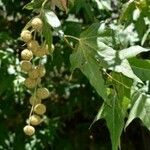
Platanus wrightii
Arizona sycamore
Description
Source: leafsnapPlatanus wrightii, commonly known as the Arizona sycamore, is a deciduous tree native to the southwestern United States and northern Mexico. Belonging to the Platanaceae family, this tree can grow up to 80 feet tall and have a trunk diameter of up to 4 feet. When young, its bark is smooth, but as the tree ages, the bark becomes rough and scaly, displaying patches of white, gray, and brown. The leaves of the Arizona sycamore are large, reaching up to 10 inches wide, and have three to five deeply incised lobes. They are bright green during the spring and summer, turning yellow in autumn before falling off for winter dormancy. In early spring, before the leaves emerge, Arizona sycamore trees produce small flowers arranged in clusters on long stalks called peduncles. The fruit consists of small nutlets surrounded by hairy bracts, resembling tiny balls hanging from long stalks known as pedicels. These fruit clusters remain on the tree throughout winter until they eventually fall off or are eaten by birds and other wildlife. Arizona sycamores prefer moist soils near streams or water sources but can tolerate drier conditions once established. They provide important habitats for many species, including birds, mammals, insects, and fungi. Overall, Platanus wrightii is a significant native plant species valued for its ecological importance and aesthetic qualities. Its attractive bark texture makes it popular among landscapers seeking an ornamental shade tree for arid regions like Arizona. Once established, this tree requires minimal maintenance, making it a suitable addition to landscape design plans in such climates.
🌳 The Arizona sycamore may not be well known for a wide range of uses, but its characteristically peeling bark is an important resource for local wildlife. The bark sheds in large patches, creating ideal spots where certain birds and insects can nest and feed. Notably, it provides a distinctive habitat for the endangered southwestern willow flycatcher, which often builds nests in the sycamore’s branches. Its substantial limbs also support plants such as wild grapevines, contributing to richer local biodiversity.
🎭 This tree symbolizes growth, persistence, and strength.
Care Guide
💧 Water Every 7 days
The Arizona Sycamore, native to the southwestern region of North America, is well-adapted to environments with infrequent rainfall and demonstrates a moderate tolerance to drought. For optimal growth, water the tree every 2 to 3 weeks, ensuring that the soil dries out between waterings. As a deciduous tree, the Arizona Sycamore requires less water during its dormant period in the cooler months, naturally adjusting its water needs according to seasonal changes.
☀️ Light Full sun
The Arizona sycamore grows best when it receives sunlight all day, though it also performs well in places with moderate light. Coming from a habitat with abundant sun, it needs a considerable amount of light for optimal development. Excessive or insufficient light can disturb its healthy growth.
What are the sunlight requirements for the Arizona Sycamore?
The Arizona Sycamore thrives best under full sun conditions, needing over 6 hours of sunlight a day. It can also manage well in partial sun, which is about 3-6 hours of sunlight. For indoor plants specifically, when natural sunlight is insufficient, artificial lighting provides a viable solution. Indoor plants under these conditions should ideally receive 30-50W/sq ft for full sun plants, 20-30W/sq ft for partial sun plants, and 10-20W/sq ft for full shade plants. The right kind of artificial light, such as LED lights, should be chosen, and these lights should be placed 12-36 inches above the plant to mimic natural sunlight as closely as possible.
What are some common symptoms of insufficient sunlight for the Arizona Sycamore?
The Arizona Sycamore can show several symptoms when it doesn't receive adequate sunlight, including small leaves, leggy or sparse growth, faster leaf drop, slower or no new growth, lighter-colored new leaves, chlorosis (leaves turning yellow), sunscald on leaves or stems, leaf curling, wilting, and leaf scorching. These symptoms indicate that the plant is in survival mode due to poor light conditions, leading to a decrease in chlorophyll and essential nutrients, which affects the plant's overall health.
How can I address and improve the sunlight conditions for my Arizona Sycamore?
To improve the sunlight conditions for your Arizona Sycamore, gradually adjust the plant to receive more sunlight, especially if it is being moved outdoors. This process involves slowly moving the plant each week to ensure it receives at least 6 hours of direct sunlight daily. For indoor plants not easily moved, consider keeping them near a south-facing window or using artificial light such as desk lamps or professional grow lights for at least 8 hours a day. Outdoor plants should be gradually exposed to sunlight to avoid sunburn. If your plants are located in shadowed areas, consider pruning nearby trees to reduce obstructions or transplant smaller plants to sunnier locations with good drainage during their dormant period.
🌡️ Temperature 15–35°C
Arizona Sycamore is a temperate woody plant that requires temperatures between 59 to 95 ℉ (15 to 35 ℃) for optimal growth. It naturally occurs in environments that are well suited to its temperature requirements. In summer, it is advisable to adjust irrigation to provide adequate moisture, since it prefers cooler temperatures for growth.
What are the optimal growth temperatures for Arizona Sycamore?
The Arizona Sycamore thrives in a temperature range between 59 to 95°F (15 to 35°C), which suits its temperate woody plant nature. It flourishes in environments that cater to its need for cooler growth temperatures, especially during the summer months. Adequate moisture through adjusted irrigation is crucial in these warmer periods. With its strong cold resistance, Arizona Sycamore generally does not require special frost protection in winter, although precautions should be taken if temperatures are expected to fall below -15°C by using non-woven fabrics or cloths to wrap the trunk and branches. Prior to the first freeze of autumn, it is beneficial to water the plant thoroughly to ensure the soil stays moist, aiding in drought prevention through the colder months.
How does Arizona Sycamore react to low temperatures?
Arizona Sycamore showcases remarkable cold tolerance, optimally growing in temperatures above 15°C and comfortably surviving winters above -10°C. When temperatures drop below -15°C, the plant may not exhibit immediate distress, but come spring, the branches could become brittle and dry. Under these conditions, the plant might fail to produce new shoots. To mitigate the effects of such a frostbite, it is advisable to prune any lifeless branches in the spring, allowing for healthy new growth.
What should be done if Arizona Sycamore experiences high temperatures?
During the hotter summer months, keeping the temperature below 35°C is essential for the Arizona Sycamore's well-being. Temperatures that spike above 38°C can cause the leaves to lose their vibrant color and dry out at the tips, increasing the plant's susceptibility to sunburn. Countermeasures include trimming away the affected parts of the plant, relocating it to a shadier spot, or using shade cloth to protect it from the harsh midday and afternoon sun. Ensuring the soil remains moist by watering the plant in the cooler morning and evening hours is also crucial during these high-temperature periods.
💨 Humidity
🪴 Soil 5-6
🌱 Fertilizer
To encourage healthy growth, fertilize your Arizona Sycamore in early spring. Regular feeding boosts the tree’s overall health, leading to vigorous growth, improved tolerance of difficult conditions, and increased resistance to pests and disease. Keep a consistent fertilization schedule for your Arizona Sycamore to maintain foliage that is vibrant, richly colored, and lush.
🪴 Pot & Repot
✂️ Pruning
The Arizona Sycamore is a deciduous tree that thrives when pruned strategically from early to late winter. This timing helps reduce the risk of disease. When pruning, aim to remove dead or crossing branches to improve the tree's growth and airflow, while preserving its natural shape. Proper pruning not only enhances the tree's appearance but also strengthens its structural integrity.
🌿 Propagating
🐛 Diseases & pets
☠️ Toxicity
Characteristics
- Plant Type
- Tree
- Life Cycle
- Perennial
- Genus
- Platanus
- Family
- Platanaceae
- Hardiness Zone
- 7-9
- Mature Height
- 24.99 m
- Mature Spread
- 16.46 m
- Leaf Color
- Green
- Leaf Type
- Evergreen
- Flower Color
- Green, Yellow
- Flower Size
- 1.27 cm
- Bloom Time
- Mid spring, Late spring
- Planting Time
- Spring
- Harvest Time
- Mid summer, Late summer
- Native Area
- Mexico