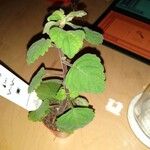
Plectranthus ernstii
Description
Source: leafsnapThe Plectranthus ernstii is a semi-succulent herbaceous perennial known as the Bonsai Mint. This herb can only reach up to 10 inches tall with a swollen base and branching, articulated gray stems that become brown with age. The Bonsai Mint is most popular for its aromatic semi-succulent leaves. Its leaves are somewhat ovate to triangular, covered in soft, fine hairs and pale, reddish-brown gland dots
Care Guide
💧 Water 1-2 times a week
Bonsai mint is well-suited for dry, semi-arid regions and is known for its drought tolerance. To mimic its natural habitat, it only requires weekly watering. Mainly cultivated indoors, bonsai mint thrives in containers where controlling moisture levels prevents over-saturation and promotes robust health through effective soil moisture management.
☀️ Light Partial sun
Bonsai mint comes from habitats with filtered light, like the understory of forests or rocky locations that provide natural shade. It favors partial sunlight but can also withstand full sun.
🌡️ Temperature 20–41.1°C
Bonsai mint prospers in warm conditions and requires higher temperatures during the growing season to encourage growth and metabolic activity. It prefers plenty of sunlight, proper moisture levels, and good airflow. However, it can be damaged by very low temperatures and by overwatering. It's important to maintain a balance and to avoid both excessively high temperatures and overly dry conditions.
💨 Humidity
🪴 Soil 6-7
🌱 Fertilizer
For Bonsai mint, small amounts of fertilizer once or twice a year during the growing season are enough. Do not fertilize in winter or during summer dormancy. Cut back on feeding for plants that have been repotted and wait a couple of months after repotting before applying fertilizer. Fertilizing helps maintain healthy growth and promotes flowering.
🪴 Pot & Repot Every 2 years
When repotting Bonsai mint, choose a pot slightly larger than the current one that provides good drainage. Use a gritty, well-draining succulent or cactus potting mix. Gently remove the plant from its old pot, brush off excess soil, and set it in at the same depth. Wait a few days before watering so any root injuries can heal. Repot in spring or fall and place it in a brightly lit spot.
✂️ Pruning
Bonsai mint is a small aromatic shrub that is ideal for bonsai cultivation. To maintain its shape and encourage a more compact form, prune the plant during winter. This involves removing any leggy branches and shaping the shrub. Regular pruning not only enhances the plant's appearance but also promotes healthy growth. Be sure to use clean, sharp tools to minimize stress on the plant.
🌿 Propagating
🐛 Diseases & pets
☠️ Toxicity
Although the Bonsai Mint has not been reported as toxic to either humans or animals, the oils from Plectranthus plants have been known to cause adverse effects. However, it would take ingesting a large amount to elicit symptoms of intoxication.
Characteristics
- Plant Type
- Tree, Shrub
- Life Cycle
- Perennial
- Genus
- Plectranthus
- Family
- Lamiaceae
- Hardiness Zone
- 9-13
- Mature Height
- 25 cm
- Mature Spread
- 25 cm
- Leaf Color
- Green
- Leaf Type
- Evergreen
- Flower Color
- Lavender
- Flower Size
- 1.02 cm to 1.52 cm
- Bloom Time
- Mid summer, Late summer, Early fall
- Planting Time
- Spring, Summer
- Harvest Time
- Fall
- Native Area
- South Africa