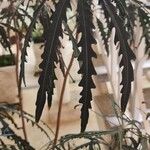
Plerandra elegantissima
False aralia
Description
Source: leafsnapPlerandra elegantissima, commonly known as False Aralia or Spider Aralia, is a tropical evergreen plant from the Araliaceae family. Native to the Pacific Islands and Southeast Asia, it is often grown indoors in homes and offices. False Aralia has a distinctive appearance with its long, slender stems adorned with glossy green leaves. These leaves are pinnately compound, consisting of 5 to 9 lance-shaped leaflets with serrated edges. The plant can grow up to 6 feet tall but can be pruned to maintain a more manageable size. Plerandra elegantissima thrives in bright, indirect light but can also tolerate low-light conditions. It prefers well-draining soil and regular watering, allowing the soil to dry out slightly between waterings. In addition to its ornamental appeal, False Aralia has air-purifying qualities, making it an excellent choice for improving indoor air quality. However, it’s important to note that all parts of the plant are toxic if ingested by humans or pets. Overall, Plerandra elegantissima is an attractive tropical houseplant with unique foliage patterns that add visual interest to any indoor space while also providing health benefits through its air-purifying properties.
🌳 False aralia is more than an ornamental plant; it has demonstrated potential as an indoor air purifier. This is critical in urban areas where air quality can be poor. Its broad leaves can absorb a variety of harmful pollutants, offering a natural way to enhance indoor air quality.
Care Guide
💧 Water Every 7 days
False aralia, which originates from tropical forest understories, thrives in environments with high humidity and consistent moisture. To care for it properly, water the plant every 1-2 weeks, allowing the soil to dry slightly between waterings. When grown indoors, misting the plant can help mimic the humid conditions it needs. Additionally, ensure that the container has proper drainage to prevent overwatering.
How should I water my False aralia?
Your False aralia is not particular about how you water it, so you can use any common watering tool to dampen its soil. Watering cans, hoses, or even cups will all work fine. Regardless of the tool you choose, make sure to water the soil directly and evenly to provide all parts of the root system with the necessary moisture. Using filtered water is a good idea, as tap water may contain harmful particles. It's also best to use water that is at or slightly above room temperature, as extremely hot or cold water may shock the plant. However, the False aralia generally responds well to any type of water.
What should I do if I give my False aralia too much water or too little water?
When planting outdoor plants, especially newly planted ones or plant seedlings, it's important to remember to water them enough for a few months while they are still small or newly planted. Once the roots are established, rainwater will usually be sufficient for False aralia plants. However, if you have potted False aralia plants, be careful not to overwater them. If you accidentally overwater your plant, act quickly to remedy the situation. Stop watering the plant immediately to minimize the impact of overwatering. Then, take the plant out of its pot to check the roots. If there is no root rot, you can put the plant back in the pot. If you find root rot, trim away the affected roots and consider using a fungicide to prevent further damage. Finally, repot the plant in well-draining soil. If your False aralia is underwatered, simply water it more frequently. This is usually an easy problem to fix, as the leaves will droop and dry out when the plant is underwatered, but will quickly bounce back after sufficient watering. Make sure to adjust your watering frequency as soon as you notice the plant is underwatered.
How frequently should I water my False aralia?
Most plants grow well with rainfall, but if your area lacks rain, you should water them every 2 weeks during the spring and fall. In the summer, they will need more frequent watering, but in the winter, they need less water, and you may not need to water them at all. If you have a young or newly planted False aralia, you should water it more often to help it establish and grow. For potted plants, there are two ways to determine watering frequency for False aralia. One way is to set a watering schedule, but this may not always work as it doesn't consider the specific growing conditions. Another approach is to check the soil moisture. Wait until the top 2 to 4 inches of soil have dried out before watering again.
How much water should I give my False aralia plant?
When watering your False aralia, remember that it doesn't always require a lot of water. If only a few inches of soil have dried since your last watering, giving it five to ten ounces of water should support healthy growth. You can also adjust the water volume based on how dry the soil is. If more than half of the soil is dry, give it more water until you see excess water draining from the pot's holes. If your False aralia is exposed to plenty of outdoor rain, it may not need extra watering. For young plants, ensure they receive 1-2 inches of rain per week. As they grow, they can survive solely on rainwater, unless there is a prolonged period of no rainfall during hot weather. In that case, give them a full watering to prevent stress.
How do I know if I'm giving enough water to my False aralia plant?
The False aralia often suffers from overwatering, and there are specific signs to watch out for. If overwatered, the plant's leaves will turn yellow and may even fall off. Additionally, overwatering can cause the plant to shrivel and promote root rot. On the other hand, an underwatered False aralia will show signs of wilting and may have brown or brittle leaves. Regardless of whether you observe overwatering or underwatering signs, it's important to take action and restore the plant's health.
☀️ Light Partial sun
The false aralia flourishes optimally in locations where sunlight is adequately filtered, although it can cope with surroundings that have abundant or insufficient sunlight. In its original environment, it had protection from strong sunrays due to the canopy. Too much sunlight could cause the leaves to burn, while too little may cause the plant to grow spindly.
What are the sunlight requirements for False Aralia?
False Aralia (Plerandra elegantissima) requires varying amounts of sunlight depending on its environment. It typically thrives in areas with partial sun, receiving about 3-6 hours of sunlight daily, but can also tolerate full sun and shade conditions, especially in cooler weather or natural canopy-sheltered habitats. It's important to be mindful of light exposure, as excessive sunlight may cause leaf burn, while insufficient light can lead to leggy growth. Observing how sunlight moves through your garden can help you place your plants in spots that offer an ideal balance between light and shade.
How can I support the growth of my False Aralia with artificial lighting?
Indoor False Aralia plants may require supplemental lighting to thrive, especially in spaces with limited natural sunlight or during winter. Artificial lights, such as LED lights, are effective in providing the necessary wavelengths of light for optimal plant growth. The intensity and type of artificial light needed vary: full sun plants need 30-50W/sq ft, partial sun plants require 20-30W/sq ft, and full shade plants need 10-20W/sq ft of artificial light. Position the artificial light source 12-36 inches above the plant, and mimic natural daylight hours by keeping the lights on for 8-12 hours per day.
What are common symptoms of improper lighting in False Aralia?
Inadequate or excessive lighting can cause several symptoms in False Aralia, such as faster leaf drop, where plants shed older leaves early due to low light; leggy or sparse growth, indicating insufficient light; and lighter-colored new leaves, showing a lack of chlorophyll. Other signs include slower or no new growth, chlorosis (yellowing leaves), sunscald, leaf curling, wilting, and leaf scorching. These symptoms showcase the plant's stress due to improper lighting conditions and necessitate adjustments in light exposure.
How can I resolve lighting issues for my False Aralia?
To address lighting issues with your False Aralia, gradually adapt your plant to the desired light levels by moving it to sunnier spots each week until it achieves 3-6 hours of direct sunlight daily. For indoor plants that can't be easily moved, or to supplement natural light, consider using desk lamps or professional plant grow lights for at least 8 hours daily. If your plants are blocked from sunlight by obstructions, such as trees, pruning branches may help increase sun exposure. For smaller plants, transplanting during the dormant period to a location with better light conditions and drainage can also be effective. It's crucial to make these adjustments gradually to prevent sunburn and ensure healthy new growth.
🌡️ Temperature 20–37.8°C
False aralia, in its natural habitat, favors temperatures between 20 and 38 ℃ (68 to 100 ℉). This temperate woody plant needs a moderate temperature spectrum but has the ability to adapt to seasonal variations if required.
What are the essential care requirements for False aralia?
False aralia (Plerandra elegantissima), in its native habitat, thrives in temperatures ranging from 20°C to 38°C (68°F to 100°F). It is a temperate woody plant that can adapt to seasonal temperature changes but has a strong preference for heat. During colder months, particularly in autumn, it is advisable to bring outdoor-grown False aralia indoors, positioning it near a bright window while ensuring it is not too close to heaters. Keeping the temperature above 20°C during winter supports the plant's growth, whereas exposure to temperatures around 5°C or lower can be harmful.
What should I do if my False aralia is exposed to low temperatures?
False aralia is sensitive to low temperatures and shows a preference for environments warmer than 20°C, requiring protection from temperatures dropping below 5°C. Exposure to temperatures below 1°C can lead to the leaves lightening in color, which after frost damage turn brown or black, with symptoms such as wilting and drooping becoming evident. To remedy frost damage, trim off the frost-damaged parts and move the plant to a warmer indoor setting promptly. It is best positioned near a south-facing window to ensure it receives enough sunlight. Moreover, placing the plant near heaters or air conditioning vents should be avoided to prevent air from becoming excessively dry.
How should I care for my False aralia during high temperatures?
During the hotter months, ensuring that False aralia's temperature stays below 38°C is crucial, as exposure to temperatures above 43°C can cause the leaves to lighten in color and increase the risk of sunburn. In such instances, it's advised to trim away the parts of the plant that are sunburned or have dried up. Moving the plant to a shaded area, particularly away from the harsh midday and afternoon sun, can help protect it. Additionally, to maintain soil moisture, watering the plant in the early morning or evening is beneficial.
💨 Humidity high (>60%)
This plant needs special care because it loves high humidity levels of 60-80% or more. The best way to achieve this is by placing a humidifier near the plant. Daily misting is also essential! Make sure the room has good ventilation.
🪴 Soil 5-6
🌱 Fertilizer
The care of False aralia greatly depends on consistent fertilization. Regular nourishment throughout the growth period is essential for maintaining vitality for lavish leaves and for supporting its total development. Overlooking the need for fertilization can lead to diseased leaves, reduced aesthetic attractiveness, and inhibited or fragile growth that is susceptible to damage.
Why should I put fertilizer on my False aralia plant?
False aralia requires regular fertilization primarily because its showy leaves demand significant energy for production and maintenance. The challenge lies in not only maintaining the leaves' vitality but also providing enough energy for growth in its stems, branches, roots, and other essential structures. Neglecting fertilization can result in two likely outcomes. Firstly, the leaves will lose their natural color and texture, appearing unhealthy and diminishing the plant's ornamental appeal. Secondly, the overall growth of the False aralia may slow down, or it may produce weak growth that is susceptible to breakage.
When should I fertilize my False aralia?
False aralia plants do not require a standard feeding schedule. However, they can benefit from occasional feedings. A simple way to fertilize them is by applying fertilizer when watering. During the growing season, it is important to provide them with a good amount of water. You can feed the plant once every two to three weeks, throughout its period of new growth.
When is it not a good idea to fertilize my False aralia plant?
You can maintain a regular fertilization schedule for your False aralia throughout most of the year, specifically during the active growing seasons of spring, summer, and early fall. However, it is important to note that during the winter, this plant should not receive any fertilizer. This is because False aralia enters a dormant growth phase during the winter, during which it either produces no or very little new growth. Since the plant is using less energy overall during this time, fertilizer is not necessary.
What kind of fertilizer should I use for my False aralia?
When fertilizing a False aralia, it is important to use a specific blend of nutrients in relatively low amounts. An ideal fertilizer for this plant has an N-P-K ratio of 3-1-2. However, a general-purpose fertilizer with an even blend of nutrients can still work well in some cases. It is crucial to ensure that the ratio number representing the volume of each nutrient is at 3 or lower, even when using a balanced fertilizer. You can choose between granular or liquid-based fertilizer. If you opt for liquid fertilizer, it is usually recommended to dilute its strength by half. While granular fertilizer has few drawbacks, using liquid fertilizer is often more sensible, especially if you water your False aralia while feeding it.
How can I fertilize my False aralia plant?
One of the easiest ways to fertilize a False aralia is by feeding it whenever you water. To do this, gather your fertilizer and a water container, like a watering can. Mix the fertilizer with water to dilute it, then pour this mixture onto the soil, ensuring it reaches the roots. Alternatively, you can use a granular fertilizer. Simply sprinkle it on the soil where your False aralia is planted. Granular fertilizers are usually slow-release, so you won't need to fertilize as frequently compared to using liquid fertilizers. Regardless of the method, remember to water your False aralia while you're feeding it for best results.
🪴 Pot & Repot 2-3 years
When replanting False aralia, select a container that is 1-2 inches (2.5-5 cm) larger and has plenty of drainage. Opt for a potting mix that drains well. Carry out the replanting in either spring or autumn, ensuring the root sphere is marginally below the lip of the plant pot. Drench thoroughly post-replanting and position in a cosy location with filtered sunlight.
✂️ Pruning
False aralia is known for its finely textured leaves and upright growth. To keep the plant healthy, prune it between early and late winter. This will help remove dead foliage, maintain its shape, and improve air circulation. When pruning, make your cuts just above a leaf node to encourage new growth. However, be careful not to over-prune, as this can weaken the plant.
🌿 Propagating
🐛 Diseases & pets
☠️ Toxicity
Characteristics
- Plant Type
- Shrub
- Life Cycle
- Perennial
- Genus
- Plerandra
- Family
- Araliaceae
- Hardiness Zone
- 10-12
- Mature Height
- 7.62 m to 15.24 m
- Mature Spread
- 1.22 m to 1.83 m
- Leaf Color
- Green, Yellow, Gold
- Leaf Type
- Evergreen
- Flower Color
- Yellow, Green, Gold
- Flower Size
- 2.54 cm
- Bloom Time
- Early summer, Mid summer
- Planting Time
- Spring, Summer, Autumn, Winter
- Harvest Time
- Mid summer
- Native Area
- South Pacific