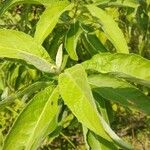
Pluchea carolinensis
Cure for all · Cattletongue · Sourbush · Shrubby fleabane · Sweet scent
Description
Source: leafsnapPluchea carolinensis, commonly known as Carolina fleabane or saltmarsh fleabane, is a perennial herbaceous plant in the Asteraceae family. Native to the southeastern United States, it thrives in salt marshes, wetlands, and along coastal areas. The plant features a woody stem that can reach up to 1 meter in height, with numerous branches. Its leaves are alternate, lance-shaped, and have serrated edges. The flowers are small, white or pinkish-purple with yellow centers, and form clusters at the ends of branches. Carolina fleabane has traditionally been used for medicinal purposes by Native Americans, who utilized it to treat ailments such as fever, coughs, colds, and skin infections. Ecologically, the plant plays a significant role by providing habitat for various insects, including butterflies and bees, which feed on its nectar. Additionally, it helps stabilize soil in coastal areas where it grows. Overall, Pluchea carolinensis is an important species, both ecologically and medicinally, making it a valuable addition to any ecosystem where it naturally grows or is intentionally cultivated for its benefits.
Care Guide
💧 Water Every 7 days
The "Cure for All" plant shows moderate drought tolerance, as it thrives when watered every 2-3 weeks. Being an evergreen, it retains its leaves throughout the year, requiring consistent moisture to support photosynthesis and other metabolic functions.
How should I water my Cure for all?
To water your Cure for all, you have several options. You can use a watering can, a hose, or even a cup. No matter which tool you choose, make sure to directly apply the water to the soil. It's important to moisten all areas of the soil evenly so that the entire root system gets the water it needs. Using filtered water is recommended to avoid harmful particles from tap water. Additionally, using water at or slightly above room temperature is ideal, as extremely cold or hot water can be a bit too much for the Cure for all. However, this plant is generally resilient and will respond well to any type of water you provide.
What should I do if I give my Cure for all plant too much or too little water?
Outdoor plants, especially newly planted ones or seedlings, can easily suffer from lack of watering. To ensure their survival, it is important to water them consistently for the first few months. Once the roots are established, they will usually rely on rain for hydration. When plants are potted, there is a higher risk of overwatering. If you accidentally overwater your potted plant, there are steps you can take to help it recover. First, stop watering immediately to minimize the damage. Then, remove the plant from its pot and inspect the roots for any signs of rot. If there is no rot, you can place the plant back in its container. However, if you find root rot, trim affected roots and consider applying a fungicide. Ultimately, repot the plant in well-draining soil. In the case of underwatered plants, simply water them more frequently. Underwatering can be easily corrected as the leaves will droop, dry out, and fall off. Once properly watered, the leaves will regain their fullness. It is crucial to adjust your watering frequency promptly when underwatering occurs.
How often should I water my Cure for all? -> How often do I need to water my Cure for all plant?
Most plants can grow naturally outdoors with rainfall. However, if your area lacks rainfall, you should water your plants every 2 weeks in the spring and fall. In the summer, you will need to water more frequently, and in the winter, you can water less because plants grow slower and need less water. You may not need to water at all during the winter. If your Cure for all is young or newly planted, you should water it more often to help it establish and grow into more adaptable and drought-tolerant plants. For potted plants, there are two main ways to determine watering frequency. The first option is to follow a predetermined schedule, such as watering once a week or once every other week. However, this may not always work as it doesn't consider the unique conditions of your Cure for all's growing environment. Watering frequency can also vary with the season. During the summer, the plant's water needs are highest, so a predetermined schedule may not be enough. An alternative approach is to base the watering schedule on soil moisture. It's generally best to wait until the top two to four inches of soil, about ⅓ to ½ depth of the pots, have completely dried out before watering again.
How much water does my Cure for all require?
When watering your Cure for all, you don't always need to give it a lot of water. If only a few inches of soil have dried since your last watering, giving it about five to ten ounces of water will support healthy growth. You can also determine the amount of water based on soil moisture. To ensure your plant gets enough moisture, water enough to moisten all the dry soil layers since the last watering. If more than half of the soil is dry, consider giving more water until it drains from the pot's holes. If the plant is in a rainy outdoor area, it may not need extra watering. When young or establishing, it needs 1-2 inches of rain per week. Once established, it can rely on rainwater, but if there is no rainfall for 2-3 weeks during hot weather, give it a full watering to prevent stress.
How can I know if I'm giving enough water to the Cure for All?
The Cure for all plant is more commonly affected by overwatering, which can be identified by yellowing leaves and leaf drop. Overwatering can also cause the plant to shrivel and promote root rot. On the other hand, an underwatered Cure for all will wilt and may develop brown or brittle leaves. In both cases, it's important to take action to restore the plant's health.
☀️ Light Full sun
Cure for all is native to open habitats like sunlit meadows and forest margins, where light is plentiful. It prefers Full Sun but will also tolerate Partial Sun, so it adapts to different sunlight conditions.
What are the sunlight requirements for Pluchea carolinensis (Cure for all)?
Pluchea carolinensis, commonly known as Cure for all, thrives best in full sun conditions, which means it requires more than 6 hours of direct sunlight a day. However, it can also grow well in partial sun, receiving about 3-6 hours of sunlight daily. It's important to observe how sunlight moves through your garden and choose spots that offer a balance of light and shade to ensure the plants grow healthily. Originating from open environments such as sunny meadows and forest edges, Cure for all adapts well to various sunlight conditions.
How to use artificial lighting for indoor plants like Pluchea carolinensis?
When natural sunlight is insufficient, particularly in winter or less sunny spaces, artificial lighting becomes crucial for the growth of indoor plants like Pluchea carolinensis. LED lights are recommended because they can be tailored to provide specific wavelengths needed by the plant. For full sun plants, 30-50W/sq ft of artificial light is needed, while partial sun plants require 20-30W/sq ft, and full shade plants need 10-20W/sq ft. The light source should be placed 12-36 inches above the plant to mimic natural sunlight, and most plants will need 8-12 hours of light per day.
What are the symptoms of light deficiency in Pluchea carolinensis?
When exposed to suboptimal lighting conditions, Cure for all may exhibit several symptoms indicating light deficiency. These include smaller new leaves, leggy or sparse growth, faster leaf drop, slower or no new growth, lighter-colored new leaves, and symptoms of overexposure like chlorosis, sunscald, leaf curling, wilting, and leaf scorching. These symptoms highlight the plant's struggle to adapt to insufficient light, leading to reduced growth and health.
How can I address light deficiency problems in Pluchea carolinensis?
To address light deficiency in Cure for all, gradually move the plants to sunnier locations to receive at least 6 hours of direct sunlight daily. For indoor plants, consider using artificial light if they're large or not easily movable, keeping a lamp on for at least 8 hours a day or using professional grow lights. Outdoors, adapt the plants gradually to prevent sunburn. Observing which areas are blocking sunlight and reducing obstructions can help, as well as transplanting smaller plants during their dormant period to spots with ample sunlight and good drainage. It's important to note that while affected parts of the plant may not recover, new growth should be healthy once the light exposure improves.
🌡️ Temperature 20–37.8°C
Cure for all comes from tropical areas, where the climate is generally warm and humid. Consequently, it is accustomed to high temperatures and moisture. It does not tolerate sudden temperature changes and prefers a consistent thermal environment, so it's important to prevent temperature fluctuations indoors. It generally cannot endure cold and needs warmer conditions to grow. If the ambient temperature becomes too low, the plant may stop growing or even die.
💨 Humidity
🪴 Soil 6-7
🌱 Fertilizer
Early spring, when a Cure for all breaks dormancy, is the best time to fertilize. This encourages overall growth and the formation of flowers. Fertilizer improves the foliage, stems, and branches, and supports flowers that are large, vibrant, and long-lasting. It assists in moving nutrients from the roots to the flowers and enhances the plant’s health and resistance to disease.
🪴 Pot & Repot
✂️ Pruning
To ensure the health and vitality of your plants, it is important to prune them during their dormant period, which occurs from early to late winter. Key techniques for effective pruning include removing dead branches, shaping overgrown areas, and thinning the foliage to improve airflow. These practices encourage healthy growth and abundant blooms. Be sure to use sharp, clean tools to prevent the spread of disease and to support the plant's recovery.
🌿 Propagating
🐛 Diseases & pets
☠️ Toxicity
Characteristics
- Plant Type
- Shrub
- Life Cycle
- Perennial
- Genus
- Pluchea
- Family
- Asteraceae
- Hardiness Zone
- 9-11
- Mature Height
- 2.44 m
- Mature Spread
- 0.91 m to 1.52 m
- Leaf Color
- Green
- Leaf Type
- Evergreen
- Flower Color
- White, Pink
- Flower Size
- 0.51 cm to 0.51 cm
- Bloom Time
- Summer, Early fall, Mid fall
- Planting Time
- Spring, Autumn
- Harvest Time
- Late summer, Fall, Early winter
- Native Area
- Belize, Honduras, Mexico, Guatemala, Dominican Republic, Trinidad and Tobago, Panama, Jamaica, Bahamas, Cuba, Haiti, Venezuela, El Salvador, Nicaragua, Ecuador, Costa Rica