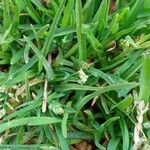
Poa annua
چبر یک ساله · Winter grass · Annual Meadow-grass · Annual bluegrass · Annual poa
Description
Source: leafsnapPoa annua, commonly known as annual bluegrass, is a cool-season grass native to Europe and Asia that has become widespread in many parts of the world. It is a small, tufted grass that typically grows to about 3-4 inches in height and has fine-textured leaves. The plant produces small green flowers during the spring and summer months. Annual bluegrass can be found in a variety of habitats, including lawns, golf courses, parks, meadows, and disturbed areas such as roadsides. It prefers moist soils but can also tolerate drought conditions. While annual bluegrass is appreciated for its fine texture and rapid growth from seed, it is often considered a weed due to its propensity to invade other turf species. Its short lifespan of only one year necessitates constant reseeding or natural reseeding for continued growth. Despite being viewed as an invasive species by some due to its aggressive growth habit, Poa annua is important as a food source for wildlife. Birds, for instance, rely on the seeds produced by this plant during the winter months when other food sources are scarce.
💡 Annual bluegrass is a common weed found in many lawns and turfs across North America. It spreads quickly, and mowing does not stop it from producing seeds. Each clump of this weed can generate up to 100 seeds in just eight weeks. The most effective way to control it is to remove the entire plant from the lawn, as using herbicides would also harm the surrounding grass.
🌳 This modest grass, annual bluegrass, not only covers golf greens around the world but also serves as an important winter feed for livestock. Its role goes beyond turf and farming: a specific oil extracted from annual bluegrass is essential for tuning brass musical instruments. Furthermore, its high protein content makes annual bluegrass a notable dietary component, and it shows potential as a renewable energy feedstock in the biofuel industry.
🎭 Psychic abilities, protection. It represents food, concealment and resilience.
Care Guide
💧 Water Every 7 days
Annual bluegrass originates from temperate climates and thrives in consistently moist environments. To maintain its health, it needs watering twice a week along with good soil drainage to prevent waterlogging. Although it's adaptable to various levels of sunlight, annual bluegrass performs best when grown outdoors during its active growing season.
When Should I Water My Annual Bluegrass?
Watering your annual bluegrass is essential for its health, ensuring it grows optimally and maintains vibrant coloration and disease resistance. To determine when to water, check the soil's moisture by inserting a finger 1 to 2 inches deep; if dry, it’s time to water. Observing the plant's leaves for wilting, loss of color, or curling edges can also indicate the need for water. Additionally, a footprint test can show if the soil is too dry. Weather conditions play a significant role; during hot, dry periods, your annual bluegrass will likely need more frequent watering. However, be cautious not to water too early or late in the plant's dryness cycle to avoid diseases or dehydration.
How Should I Water My Annual Bluegrass?
Annual bluegrass thrives with consistent, frequent watering targeting the root zone. The preferred methods are soaking, which involves applying water slowly at the base, and sprinkler irrigation for even moisture distribution. Using equipment like a moisture meter can help prevent overwatering, and choosing a fine spout watering can or a controlled sprinkler system allows for gentle watering. It's important to focus on watering the base to reach the roots and avoid late evening watering to prevent disease. Regular soil checks and adding organic matter can help maintain suitable moisture levels.
How Much Water Does Annual Bluegrass Really Need?
The amount of water needed for annual bluegrass varies but maintaining consistent moisture is key due to its preference for moist environments. Its root system suggests watering to keep the first few inches of soil moist is crucial. The soil should feel like a well-wrung sponge. Look for signs of over or underwatering such as yellowing or browning of the grass. Optimal watering will support annual bluegrass’s growth, making it strong and vibrant. The goal is to avoid both over and underwatering, focusing on keeping the soil consistently moist.
What Kind of Water is Best for Annual Bluegrass?
Annual bluegrass prefers water that mimics its natural environment, with rainwater being the best option due to its balanced pH and lack of chemicals. Distilled water is a good alternative, offering purity, while tap water is least favored because of potential chlorine, fluoride, and mineral content which can impact the plant’s health. If using tap water, letting it sit out for 24 hours or using a filter can remove harmful elements, making it safer for the plant. The best water temperature for annual bluegrass is room temperature, around 68-72°F (20-22°C).
How Do Annual Bluegrass's Watering Needs Change with the Seasons?
Annual bluegrass's watering needs vary seasonally. In spring, as temperatures rise and growth increases, ensure the soil does not dry out, adjusting for warmer, drier weather. Summer demands consistent moisture due to increased growth and sunlight, with careful watering to avoid disease in humid conditions. In autumn, reduce watering as growth slows and the weather cools. Winter requires minimal watering, focusing on preventing overwatering and ensuring good drainage to avoid root rot. Seasonal adjustments are essential for maintaining the health of annual bluegrass.
☀️ Light Full sun
Annual bluegrass performs best in plenty of uninterrupted sunlight, though it can tolerate reduced sun to some degree. It comes from environments where sunlight is present most of the day. Exposed to excessively strong sun or to low-light conditions, its healthy growth can be harmed.
What are the sunlight requirements for annual bluegrass?
Annual bluegrass thrives best in conditions where it can enjoy full sun, which means it should receive above 6 hours of sunlight per day. However, it can also cope with partial sun exposure, about 3-6 hours of sunlight. Observing how sunlight moves through your garden is crucial for finding spots that offer the ideal balance of light and shade, ensuring the well-being of your plants.
How important is sunlight for the growth of annual bluegrass?
Sunlight is crucial for the growth of annual bluegrass, as it originates from habitats that enjoy abundant sunlight throughout the day. While it can tolerate some shade, both extreme sunlight and insufficient light conditions can negatively impact its growth. To support optimal growth indoors, especially in less sunny spaces or during winter, artificial lighting can be used. Choosing the right type of artificial light, such as LED lights, and ensuring the proper distance (12-36 inches above the plant) and duration (8-12 hours of light per day) are important considerations.
What symptoms indicate light deficiency in annual bluegrass?
When annual bluegrass is not receiving enough light, it may show various symptoms indicating light deficiency. These include smaller new leaves, leggy or sparse growth, faster leaf drop, slower or no new growth, lighter-colored new leaves, and symptoms of chlorosis. Conversely, excessive sunlight can lead to sunscald, leaf curling, wilting, leaf scorching, and chlorosis, indicating the plant's inability to cope with intense light exposure.
What are some solutions for addressing light deficiency in annual bluegrass?
Addressing light deficiency in annual bluegrass involves both preventive and corrective measures. Indoors, gradually moving plants to sunnier locations to achieve at least 6 hours of direct sunlight daily, using artificial lights for additional support, and ensuring maximum sunlight exposure are effective strategies. Outdoors, the gradual relocation of plants to sun-lit spots and trimming obstructions can help. Additionally, transplanting smaller plants to sunnier locations and ensuring good drainage can significantly improve their sunlight intake. It's important to note that while these measures can promote healthy new growth, parts of the plant that have already been adversely affected by insufficient sunlight may not fully recover.
🌡️ Temperature 5–35°C
Because it comes from temperate regions, annual bluegrass does best when temperatures are between 68 and 95 °F (20 and 35 ℃). During colder months, it is recommended to moderately raise the surrounding temperature for optimal growth.
What is the optimal temperature range for Annual Bluegrass growth?
Annual bluegrass thrives in a temperature range of 68 to 95°F (20 to 35°C), as it is native to temperate climates. To ensure optimal growth, it's recommended to moderately increase the ambient temperature during colder seasons. The plant has strong cold resistance, meaning special frost protection measures aren't usually necessary. Nevertheless, if winter temperatures are expected to drop below -30°C, it's important to protect the plant by covering it with materials such as soil or straw. It's also advised to water the plant abundantly before the first freeze in autumn to keep the soil moist and prevent drought and water scarcity during winter and early spring.
How can you protect Annual Bluegrass from low temperatures?
Annual bluegrass is notably cold-tolerant, thriving best when the temperature remains above 20°C and should ideally be kept above 0°C during winter. However, temperatures falling below -30°C may not show immediate effects during winter, but could lead to decreased sprouting or absence of sprouting in the spring. To combat this, any parts of the plant that have failed to sprout by spring should be removed.
What should you do if Annual Bluegrass experiences high temperatures?
In summer, it's crucial to keep Annual bluegrass below 35°C, as temperatures exceeding 41°C can cause the leaves to lighten in color, become prone to curling and sunburn, and in severe cases, lead the entire plant to wilt and dry. To address this, trim away sunburned and dried-up parts of the plant. Move the plant to a shaded location or use a shade cloth to protect it from the midday and afternoon sun. Additionally, watering the plant in the morning and evening can help keep the soil moist, mitigating the impact of high temperatures.
💨 Humidity normal (40-60%)
This plant will thrive in moderate humidity, which is probably the level in your home. However, misting it a few times a week can be very beneficial. Make sure the room has good ventilation.
🪴 Soil 5-7
🌱 Fertilizer
Annual bluegrass is a warm-season grass which flourishes in summer and becomes dormant in winter. Fertilizing is crucial for promoting dense growth, a vivid green color, and resistance to stressors such as heat, drought, and cold. When lawns are neglected they weaken and thin and attract unwanted grasses, weeds, insects, and diseases.
🪴 Pot & Repot
✂️ Pruning
Annual bluegrass is a cool-season grass that grows densely. To prevent it from producing invasive seed heads, prune it in early to mid-spring, trimming it down to 1-2 inches. Regular mowing, once a week, helps promote healthy growth, maintain its appearance, and reduce the risk of disease.
🌿 Propagating
🐛 Diseases & pets
☠️ Toxicity
This plant is not considered toxic.
Characteristics
- Plant Type
- Grass
- Life Cycle
- Annual, Biennial
- Genus
- Poa
- Family
- Poaceae
- Hardiness Zone
- 4-10
- Mature Height
- 15 cm to 25 cm
- Mature Spread
- 20 cm
- Leaf Color
- Green
- Leaf Type
- Deciduous
- Flower Color
- White, Green, Yellow
- Flower Size
- 2.54 cm
- Bloom Time
- All year round
- Planting Time
- Spring, Summer
- Harvest Time
- All year round
- Native Area
- Sri Lanka, Libya, Turkey, Sweden, Pakistan, Morocco, Uganda, Tanzania, Belarus, Germany, Cameroon, Koppen, Ethiopia, Romania, Latvia, Belgium, Portugal, Netherlands, Saudi Arabia, Tunisia, Cyprus, Bulgaria, Ukraine, Lebanon, China, Afghanistan, Italy, Kazakhstan, Japan, Mongolia, Finland, Bosnia and Herzegovina, Iran, Kuwait, Egypt, Austria, Rwanda, Eritrea, Yemen, Kenya, Uzbekistan, Russia, Iraq, Burundi, Iceland, Estonia, France, Nepal, Tajikistan, Czech Republic, Poland, Greece, Lithuania, Norway, Spain, Switzerland, Vietnam, Myanmar, Israel, Albania, Ireland, United Kingdom, Hungary, Algeria, Turkmenistan