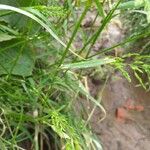
Poa trivialis
Rough Meadow-grass · Rough bluegrass · Rough-stalk bluegrass · Rough-stalk meadow grass · Rough-stalked Bluegrass
Description
Source: leafsnapPoa trivialis, commonly known as rough bluegrass, is a cool-season perennial grass native to Europe and Asia. It has been widely introduced and naturalized in North America, where it is frequently found in lawns, golf courses, and other turfgrass areas. This grass has a fine texture with narrow leaves that range from light green to bluish-green in color. It can grow up to 30 cm tall and possesses an extensive root system, which allows it to tolerate drought conditions. During the summer months, the plant produces small flowers on tall stems. Poa trivialis prefers moist soils but is adaptable to a wide range of soil types, including sandy and clay soils. It thrives best in cool temperatures ranging from 15-25°C. Due to its ability to grow well under low light conditions, such as in shaded or partially shaded areas of lawns or golf courses, Poa trivialis is often used for turfgrass purposes. However, Poa trivialis can also be considered invasive due to its rapid growth, which may outcompete other native plants if not properly managed. Overall, Poa trivialis is a versatile grass species that provides excellent ground cover for various purposes but requires appropriate management practices when used outside of its natural range or habitat.
Care Guide
💧 Water Every 7 days
Rough bluegrass is well-suited to temperate climates and thrives in moist environments, where it prefers consistent moisture. Although it has some drought tolerance, weekly watering is recommended to keep it optimally hydrated, particularly in cool, shady locations. To avoid over-saturation during the growing season, adjust your watering schedule according to the amount of rainfall.
What should I do if I give my Rough bluegrass too much or too little water?
If you overwater your Rough bluegrass, here are some steps you can take to restore its health. One option is to aerate your lawn to fix any compacted soil that may be preventing proper drainage. Another step is to dethatch your Rough bluegrass. On the other hand, if you underwater your Rough bluegrass, the solution is different. In this case, you should let your lawn grow a bit longer before mowing and increase the amount of water you give it.
How frequently do I need to water my Rough bluegrass?
The frequency of watering your Rough bluegrass depends on your location, the climate conditions, and the season. For those in cooler northern regions, watering once every 1-2 weeks is usually sufficient. In contrast, those in southern regions may need to water once a week. However, if there is regular rainfall, you can adjust your watering schedule accordingly. It's important to note that relying solely on rainfall is generally not enough to keep your lawn alive. Additionally, during the summer, Rough bluegrass enters a dormancy period where it doesn't require water for new growth, but still needs to be watered to prevent drying out.
How much water does my Rough bluegrass grass need?
Knowing how much water to give your Rough bluegrass is actually quite straightforward. Regardless of whether you live in a cooler northern region or a warmer southern region, the general guideline is to water your Rough bluegrass with about one inch of water each time. However, during the peak of summer when the grass goes into a brief dormant phase, it is advisable to provide lighter but appropriate waterings to minimize the negative impact of the intense sun. It's essential to consider the size of your Rough bluegrass area when determining the overall water volume needed. For instance, a larger area will require significantly more water compared to a smaller lawn made of Rough bluegrass.
How do I know if I'm giving enough water to my Rough bluegrass?
If you give your Rough bluegrass too much or too little water, there will be visual cues to indicate the issue. Overwatering can make the grass blades softer and cause thatch buildup. On the other hand, underwatering can result in brown patches and heat stress, leading to fungus growth and yellowing of the grass blades. Additionally, footprints tend to last longer on underwatered lawns compared to lawns that have received the correct amount of water.
How do I water my Rough bluegrass at different times when it is growing?
To establish a new lawn, it's important to adjust your watering schedule. Whether you're growing from seed or using sod, frequent watering is necessary. This helps keep the soil moist enough for the roots to take hold. Once your lawn has established itself, you can water based on the plant's natural growth cycle. Rough bluegrass, for example, is most active during spring and fall and requires about an inch of water per week. In summer, the grass becomes somewhat dormant but still needs light, frequent watering. During winter, the grass doesn't need any water as it should be entirely dormant.
☀️ Light Partial sun
Rough bluegrass does well in moderate sunlight, yet it remains hardy even in strong illumination. Sunlight supports its healthy growth — too little light leads to poor development, while too much can cause stress. Its habitat shows mixed light conditions, indicating it can tolerate a range of light requirements.
What are the sunlight requirements for Rough Bluegrass?
Rough Bluegrass thrives under conditions that provide it with moderate intensity sunlight. It requires a mixed light environment to grow healthily, with too little light leading to poor development and excessive light potentially causing stress. Specifically, Rough Bluegrass needs about 3-6 hours of sunlight for partial sun conditions, and above 6 hours of sunlight for full sun conditions. It's important to watch how sunlight moves through your garden and choose spots that ensure a balance of light and shade, ensuring the plants' well-being.
How can artificial lighting be used for Rough Bluegrass?
When natural sunlight is insufficient, especially in winter or less sunny spaces, artificial lighting becomes crucial for the optimal growth of Rough Bluegrass. LED lights are recommended for their ability to provide specific wavelengths of light needed by the plants. Full sun plants require 30-50W/sq ft of artificial light, partial sun plants need 20-30W/sq ft, and full shade plants need 10-20W/sq ft. The light source should be placed 12-36 inches above the plant to mimic natural sunlight and turned on for 8-12 hours per day to imitate natural daylight hours.
What are some symptoms of insufficient or excessive light exposure in Rough Bluegrass?
Rough Bluegrass exhibits several symptoms when exposed to insufficient or excessive light. Symptoms of light deficiency include smaller new leaves, leggy or sparse growth, faster leaf drop, slower or halted growth, lighter-colored new leaves, and chlorosis, indicating a lack of chlorophyll and essential nutrients. On the other hand, symptoms of excessive light exposure include sunscald, leaf curling, wilting, and leaf scorching. These symptoms showcase the plant's struggle with the environmental light conditions, affecting its health and growth.
How can one manage light conditions for Rough Bluegrass both indoors and outdoors?
To optimize Rough Bluegrass growth, gradually exposing it to more sunlight is crucial, aiming for 3-6 hours of direct sunlight daily. For large or non-movable plants indoors, supplementing with artificial light, such as desk or ceiling lamps for at least 8 hours a day or investing in professional plant grow lights, can provide ample light. Outdoors, gradually moving plants to sunnier locations each week can help them adapt to increased light without causing sunburn. Reducing obstructions, such as pruning trees or moving plants to areas with better sunlight and drainage, can also enhance light exposure. It's important to note that parts of the plant affected by insufficient light may not recover, but new growth will be healthy once light conditions improve.
🌡️ Temperature 0–32.2°C
Rough bluegrass is native to areas with moderate climates, where temperatures generally range from 32 to 90 °F (0 to 32 ℃). It performs best in these conditions and may require protective measures against extreme temperatures to achieve optimal growth.
What is the native climate for Rough bluegrass?
Rough bluegrass, known botanically as Poa trivialis, is native to regions that experience moderate climates with temperatures ranging between 32 to 90 °F (0 to 32 °C). It thrives best under these conditions and may require protective measures to guard against extreme temperatures to ensure optimal growth.
Does Rough bluegrass require any frost protection measures?
Rough bluegrass is highly tolerant to cold temperatures and does not require additional frost protection measures during winter. Nevertheless, it is advisable to water the plant generously before the first freeze in autumn to keep the soil moist. This preparation helps prevent drought and water scarcity for the plant during the winter and early spring by allowing the soil to enter a frozen state.
How does Rough bluegrass respond to low temperatures?
Rough bluegrass exhibits extreme cold tolerance, yet it is crucial to keep winter temperatures above -35°C. If temperatures drop below this threshold, the grass may not show immediate damage during winter, but a decrease in sprouting, or a complete failure to sprout, can be expected in spring. To mitigate this, remove any parts in spring that have failed to sprout.
What should be done if Rough bluegrass is exposed to high temperatures?
Rough bluegrass does not tolerate high temperatures well. Growth will halt, and the plant becomes more susceptible to rot when temperatures exceed 32°C (90°F). To help the grass cope, trim away any sunburned and dried-up parts. Relocate the plant to a shaded area to protect it from midday and afternoon sun, or use a shade cloth for creating artificial shade. Additionally, water the plant in the morning and evening to maintain soil moisture and help cool the plant.
💨 Humidity
🪴 Soil 5-7
🌱 Fertilizer
Rough bluegrass is a cool-season grass that primarily grows in spring and fall. It becomes dormant in winter and its growth slows in summer. Applying the right fertilizers in spring can replenish nutrients and encourage vigorous, dense growth. Lawns that are well fed are greener, more resilient, and better able to resist pests and weeds.
🪴 Pot & Repot
✂️ Pruning
Rough bluegrass flourishes in cool, moist environments and benefits from pruning between early and late spring. Regular trimming helps maintain its density and prevents overcrowding. By removing dead leaves, you improve airflow and reduce the risk of disease, promoting vigorous growth and enhancing the overall appearance of your lawn.
🌿 Propagating
🐛 Diseases & pets
☠️ Toxicity
Characteristics
- Plant Type
- Grass
- Life Cycle
- Perennial
- Genus
- Poa
- Family
- Poaceae
- Hardiness Zone
- 3-7
- Mature Height
- 8 cm to 8 cm
- Mature Spread
- 3.05 m
- Leaf Color
- Green
- Leaf Type
- Evergreen
- Flower Color
- White, Green, Purple
- Flower Size
- 0.20 cm to 0.51 cm
- Bloom Time
- Mid spring, Late spring, Early summer
- Planting Time
- Autumn
- Harvest Time
- Early summer, Mid summer
- Native Area
- Libya, Turkey, Austria, Sweden, Pakistan, Morocco, Belarus, Uzbekistan, Russia, Iraq, Germany, Iceland, Romania, Belgium, Portugal, France, Netherlands, Tunisia, Cyprus, Bulgaria, Poland, Greece, Ukraine, China, Norway, Afghanistan, Italy, Kazakhstan, Spain, Switzerland, Denmark, Mongolia, Israel, Finland, Iran, Albania, Ireland, United Kingdom, Hungary, Algeria, Turkmenistan