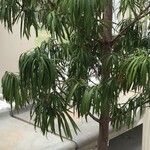
Podocarpus henkelii
Henkel's podo · Henkel's yellowwood · Fern-pine · Falcate Yellowwood · Falcate yellow wood
Description
Source: leafsnapPodocarpus henkelii, commonly known as Henkel's Yellowwood, is a slow-growing evergreen tree native to South Africa. Belonging to the Podocarpaceae family, it can reach heights of up to 20 meters, with a trunk diameter of up to 1 meter. The tree features a conical shape and dense foliage comprised of dark green, needle-like leaves arranged in spirals along the branches. Henkel's Yellowwood produces small male and female cones on separate trees. The male cones are yellowish-brown and appear in clusters at the tips of branches, while the female cones are greenish-yellow and appear solitary. This plant prefers well-drained soil with moderate moisture levels but can tolerate drought conditions once established. It thrives in full sun or partial shade but requires protection from strong winds. Henkel's Yellowwood is commonly used as an ornamental plant due to its attractive foliage, conical shape, and slow growth rate. It also holds cultural significance for some indigenous communities, who use its wood for carving traditional items such as walking sticks and musical instruments. Overall, Podocarpus henkelii is an impressive evergreen tree that adds beauty and cultural value wherever it grows.
Care Guide
💧 Water Every 7 days
The falcate yellow wood, native to subtropical regions, flourishes in moderate humidity and needs watering every 1-2 weeks. While it maintains a balanced moisture level, it is not drought-resistant. As an evergreen outdoor plant, it retains water in its foliage to withstand different temperatures year-round.
☀️ Light Full sun
Falcate yellow wood occurs in open habitats, such as sunny meadows and forest margins, where light is plentiful. It does best in Full Sun but can also tolerate Partial Sun, adapting well to a range of sunlight conditions.
🌡️ Temperature 20–37.8°C
Falcate yellow wood is fairly adaptable to temperature, tolerating high heat and wide temperature fluctuations. In hot weather, make sure to keep up watering and provide suitable shade to prevent sunburn. Conversely, it is relatively sensitive to low temperatures; while it can endure some cold, very low temperatures may cause frost damage.
💨 Humidity
🪴 Soil 6-7
🌱 Fertilizer
Falcate yellow wood has particular nutrient needs and does not require heavy fertilization. Spring is the best time to fertilize for optimal growth. Providing nutrients enhances its health, strengthens its resistance to pests and diseases, and helps sustain its long lifespan.
🪴 Pot & Repot 2-3 years
When repotting Falcate yellow wood, select a pot 1-2 inches (2.5–5.1 cm) larger that provides ample drainage. Use a well-draining potting mix. Repot in spring or fall, ensuring the root ball sits slightly below the rim of the pot. Water thoroughly after repotting and place it in a warm spot with indirect sunlight.
✂️ Pruning
To promote healthy growth and improve fruit yield, prune the falcate yellow wood in the summer for new growth or in the fall for spring benefits. If you want the plant to have a shrub-like form, trim about one-third of the new vertical growth each year to encourage fullness. For trees, remove the lower branches to enhance the display of the bark. If you are growing a hedge, perform light pruning as needed.
🌿 Propagating
🐛 Diseases & pets
☠️ Toxicity
Characteristics
- Plant Type
- Tree
- Life Cycle
- Perennial
- Genus
- Podocarpus
- Family
- Podocarpaceae
- Hardiness Zone
- 9-11
- Mature Height
- 14.94 m
- Mature Spread
- 6.1 m
- Leaf Color
- Dark Green
- Leaf Type
- Evergreen
- Bloom Time
- Mid spring, Late spring
- Planting Time
- Spring, Autumn
- Harvest Time
- Late summer, Early fall, Mid fall
- Native Area
- Malawi, South Africa, Madagascar, Tanzania, Zimbabwe