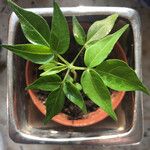
Polanisia dodecandra
Clammyweed · Red-whisker clammyweed · Redwhisker clammyweed · Common Clammyweed · Red-whiskered Clammyweed
Description
Source: leafsnapPolanisia dodecandra is a species of flowering plant in the Cleomaceae family, known by the common name redwhisker clammyweed or clammyweed, and there are three subspecies of Polanisia. Usually annual, occasionally perennial, Polanisia is native to North America, and is found throughout much of Canada and the United States. It favors full sun, mesic to dry conditions, and barren, sandy or gravelly soils, even highly disturbed areas where there is little other ground vegetation. It looks similar to a close relative, the spider flower (Cleome). The scientific name of the genus derives from the fact that the plant has numerous, long stamens of unequal lengths (from Greek polys, "many", and anisos, "unequal"). The name of the species, dodecandra means "having 12 stamens". The common name clammyweed refers to the sticky, or clammy, residue left on hands after handling the plant. Polanisia grows from 30 to 91 cm (1 to 3 ft) tall and the vegetation and sap have a noticeable odor described as smelling unpleasant, sulphur-like, "strong and rank". The leaves, about 5.1 cm (2 in) long, are made up of three 2.5 centimetres (1 in) palmate leaflets. The stems are covered in glandular hairs, and numerous flowers are borne in terminal racemes (May–October). Each flower has four white or cream petals about 2.5 cm (1 in) long, and reddish purple stamens extend well beyond the petals (hence the "red whisker" clammyweed nomenclature). The seedpods are long, slender capsules 2.5–5.1 cm (1–2 in) long. They contain multiple small reddish brown seeds approx 2 mm (0.079 in). Polanisia seedpods project upward (whereas Cleome pods project out or down). There are several subspecies of 'Polanisia dodecandra, including: Polanisia dodecandra subsp. dodecandra – redwhisker clammyweed P. dodecandra subsp. riograndensis – Rio Grande clammyweed (only found in Texas) P. dodecandra subsp. trachysperma – sandyseed clammyweed.
🌳 Redwhisker Clammyweed has demonstrated promise for bioremediation, the use of living organisms to clean up contaminated sites, because it can establish in a variety of soil types, including those affected by pollution. It also offers an attractive source of nectar for important pollinators like bees and butterflies, thus playing a vital role in the ecosystem by supporting biodiversity.
Care Guide
💧 Water
Redwhisker Clammyweed is well-suited to dry conditions due to its excellent drought tolerance. It requires weekly watering, but be careful not to overwater and saturate the soil. This plant thrives in full sunlight and benefits from deep watering followed by periods of dryness, mimicking the rainfall patterns of its native environment. The availability of water plays a crucial role in its growth cycle and the intensity of its flowering.
How should I water my Redwhisker Clammyweed?
To water Redwhisker Clammyweed, you have several options. You can use a garden hose with a spray nozzle, a watering can, or just about any other common watering tool. This plant is not too picky about how it receives water, as it can survive on rainwater, tap water, or filtered water. However, it's generally best to avoid watering this plant from overhead. This can cause damage to the leaves and flowers, and may even lead to disease. Instead, a drip irrigation system is often the best method for watering Redwhisker Clammyweed. This system applies water evenly and directly to the soil, preventing damage to the plant. If you have a container-grown Redwhisker Clammyweed, you can still use a similar watering approach but with different tools. Instead of a hose or watering can, you can use a cup, watering can, or even your tap to apply water directly to the soil.
What should I do if I give my Redwhisker Clammyweed too much or too little water?
To remedy underwatering Redwhisker Clammyweed, simply water it more regularly when you notice it lacks moisture. However, overwatering can be a serious issue, potentially leading to diseases and the plant's decline. To prevent this, choose a growing location with plenty of sunlight to dry the soil and good drainage to prevent waterlogged soils. If you overwater a potted Redwhisker Clammyweed, consider changing it to a new pot with better drainage. When repotting, use loose soils and ensure the new pot drains efficiently.
How frequently do I need to water my Redwhisker Clammyweed?
To keep your Redwhisker Clammyweed healthy, it's important to water it regularly. In the spring, watering it once a week should be sufficient. As the weather gets warmer, you may need to water it two to three times a week. However, be careful not to overwater it, as this can harm the plant. Regardless of how often you water, make sure the soil remains moist but not too wet. If your Redwhisker Clammyweed is in a pot, it will require more frequent watering. Potted plants tend to dry out faster than those in the ground, so plan to water them a few times a week, rather than just once.
How much water does my Redwhisker Clammyweed require?
There are a few ways to determine how much water your Redwhisker Clammyweed needs. One method is to feel the soil for moisture and water until the top six inches are moist. Alternatively, you can use a set measurement of around two gallons per week, adjusting for temperature and soil dryness. However, be careful not to overwater if your plant needs less. If growing in a container, water until all the dry soil layers are moist or until you see water trickling out of the drainage holes.
How can I know if I'm giving enough water to my Redwhisker Clammyweed?
Avoiding overwatering your Redwhisker Clammyweed can be a bit challenging. On one hand, these plants need regular watering to reach their deep roots. However, they are highly prone to root rot and browning if overwatered. Underwatering is less of a concern as these plants can survive without additional watering for some time. However, if you neglect to water them for too long, they will start to wilt and exhibit dry leaves.
☀️ Light Full sun
Redwhisker Clammyweed does well with a substantial amount of sunlight daily. In its natural environment, it favors spots with intense, direct sun. Insufficient light can cause stunted growth. By contrast, giving it more light than it needs does not seem to harm it.
What are the sunlight requirements for Redwhisker Clammyweed?
Redwhisker Clammyweed requires more than 6 hours of sunlight daily to thrive well. It favors locations where the sun's rays are strong and unfiltered, characteristic of its natural habitat. Observing the movement of sunlight through your garden and choosing locations that achieve a good balance of light and shade can help ensure the plant's growth and happiness. Exceeding this sunlight requirement does not seem to adversely affect the plant, making it adaptable to very sunny spots.
How can artificial lighting be used for indoor plants?
For indoor Redwhisker Clammyweed plants or other plants requiring significant sunlight, artificial lighting offers a great solution to promote optimal growth, especially in spaces with insufficient natural sunlight or during less sunny seasons like winter. LED lights are particularly beneficial, as they can be customized to provide specific wavelengths needed by plants. Full sun plants need 30-50W/sq ft of artificial light, partial sun plants 20-30W/sq ft, and full shade plants 10-20W/sq ft. The artificial light source should be placed 12-36 inches above the plants to mimic natural sunlight, and plants generally need 8-12 hours of light per day to mimic natural daylight hours. This setup helps in promoting faster and healthier growth.
What are common symptoms of light deficiency in Redwhisker Clammyweed?
When Redwhisker Clammyweed is grown indoors or in conditions of inadequate sunlight, it may show several symptoms indicating light deficiency. These include new leaves growing smaller than older ones, elongated spaces between leaves or stems leading to a leggy or sparse appearance, early dropping of older leaves to conserve resources, slowed or halted growth, development of pale or irregularly colored new leaves due to a lack of chlorophyll, and symptoms of chlorosis where leaves lose their green color and turn yellow. Additionally, symptoms of excessive sunlight exposure, such as sunscald, leaf curling, wilting, and leaf scorching, can also occur, indicating the need for a balanced light environment.
What solutions can address Redwhisker Clammyweed's light deficiency symptoms?
To address light deficiency symptoms in Redwhisker Clammyweed, a gradual adjustment towards optimal sunlight exposure is essential. For indoor plants, slowly moving them to sunnier spots or utilizing a south-facing window can help. Artificial lighting, such as desk lamps or professional grow lights, should be considered for at least 8 hours daily to supplement light. Outdoors, gradually transitioning plants to sunnier locations can prevent sunburn. Reducing obstacles like tree branches that block sunlight, or transplanting smaller plants to sunnier spots, can significantly improve light exposure. Notably, while adjusting light conditions will promote healthy new growth, parts of the plant previously affected may not recover.
🌡️ Temperature 5–35°C
Redwhisker Clammyweed is native to temperate environments and commonly grows at temperatures of 68 to 95 °F (20 to 35 ℃). It prefers warmer, steady conditions. Seasonal adjustments may be necessary to maintain optimal growth.
What is the native environment for Redwhisker Clammyweed?
Redwhisker Clammyweed, or Polanisia dodecandra, is native to temperate environments. It thrives in temperatures ranging from 68 to 95 °F (20 to 35 °C), preferring warmer conditions with consistent temperatures. Due to its strong cold resistance, special frost protection measures are generally not necessary. However, in preparation for winter, especially if temperatures are expected to drop below its growth limit, it's important to adequately protect the plant. Covering with soil or straw and watering abundantly before the first freeze to ensure the soil remains moist can help the plant survive colder months.
How does Redwhisker Clammyweed react to low temperatures?
Redwhisker Clammyweed is notably cold-tolerant and performs best when temperatures are kept above its minimum suitable growth temperature. During winter, it's crucial to maintain temperatures above its tolerable growing minimum. Falling below this can lead to a lack of noticeable changes in the winter, but might result in decreased sprouting or a complete lack of sprouting in the spring. If this happens, it's recommended to remove any parts of the plant that have failed to sprout in the spring.
What should be done if Redwhisker Clammyweed experiences high temperatures?
During the summer, it's important to keep Redwhisker Clammyweed below its maximum suitable growth temperature. Exceeding its tolerable growing maximum can cause the leaves to lighten in color, become prone to curling, and in severe cases, may lead to the whole plant wilting and becoming dry. To combat this, sunburned and dried parts of the plant should be trimmed away. Moving the plant to a shaded area or using a shade cloth during the midday and afternoon sun will help. Additionally, watering the plant in the morning and evening helps keep the soil moist, aiding in its recovery and ongoing health.
💨 Humidity
🪴 Soil 6-7
🌱 Fertilizer
Once most of Redwhisker Clammyweed’s blooms have reached full size, resume fertilizing. When the flowers are at their peak, start fertilizing again every three to four weeks, weather permitting. Then, once Redwhisker Clammyweed begins producing fewer new blooms, discontinue fertilizing; there is no need to fertilize when the plant can no longer produce additional blooms.
🪴 Pot & Repot
✂️ Pruning
Redwhisker Clammyweed benefits from pruning in the early to late spring. To promote better air circulation and a healthier plant, concentrate on removing dead or diseased stems and trimming overgrown branches. Regular pruning helps prevent mildew and encourages blooming. Be sure to use clean, sharp tools to support the plant's healing process.
🌿 Propagating
🐛 Diseases & pets
☠️ Toxicity
Characteristics
- Plant Type
- Herb
- Life Cycle
- Annual
- Genus
- Polanisia
- Family
- Cleomaceae
- Hardiness Zone
- 4-10
- Mature Height
- 30 cm to 61 cm
- Mature Spread
- 91 cm
- Leaf Color
- Green
- Leaf Type
- Deciduous
- Flower Color
- White, Pink
- Flower Size
- 2.54 cm
- Bloom Time
- Early summer, Mid summer
- Planting Time
- Spring, Summer, Autumn
- Harvest Time
- Mid summer