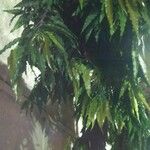
Polyalthia longifolia
Cemetery-tree · Mast-tree
Description
Source: leafsnapPolyalthia longifolia, commonly known as the Indian mast tree or false Ashoka, is a tall evergreen tree native to India and Southeast Asia. It can reach heights of up to 30 meters and features a straight trunk with smooth grey bark. The leaves are long and narrow, measuring up to 30 cm in length, with a glossy dark green color on the upper surface and a lighter green underside. The plant produces small yellow-green flowers that, while not particularly showy, have a pleasant fragrance. The fruit is an oblong capsule containing numerous small seeds. Polyalthia longifolia is often used as an ornamental tree in parks and gardens due to its attractive foliage and elegant form. Additionally, it has medicinal properties; various parts of the plant have been traditionally used to treat ailments such as fever, diarrhea, dysentery, asthma, and rheumatism, among others. The tree prefers well-drained soil with moderate moisture levels but can tolerate some drought conditions once established. It grows best in full sun or partial shade. Overall, Polyalthia longifolia is an attractive evergreen tree that offers both aesthetic value and medicinal benefits, making it popular among gardeners throughout its native range of India and Southeast Asia.
Care Guide
💧 Water Every 7 days
Originating from tropical India, the false ashoka plant thrives in high humidity and can tolerate brief dry spells. Water the plant every 2-3 weeks, making sure to let the soil partially dry out between waterings. Although it is often grown outdoors, the false ashoka can benefit from mulching, which helps retain moisture and supports its growth by ensuring a consistent water supply.
☀️ Light Partial sun
The false ashoka plant flourishes optimally when it is abundantly exposed to sunlight. Lack of adequate light can hinder its growth and cause health problems, while it can manage well in conditions of extreme light without any detrimental impacts. Its adaptability to plentiful sunlight can be traced back to its native habitat, where it was routinely subjected to direct sun exposure.
How much sunlight does False ashoka require?
False ashoka thrives best when generously provided with sunlight, needing above 6 hours of sunlight daily to prosper. Its origins in environments with full exposure to the sun enhance its tolerance for ample sunlight, though it can tolerate a range of light conditions. Insufficient light can hinder its growth and cause health issues, yet it can withstand excessive light without adverse effects. It's crucial to observe the play of sunlight in your garden to find the optimal balance of light and shade, ensuring the plant's well-being.
What types of artificial lighting are recommended for indoor False ashoka plants?
When natural sunlight is not enough, especially during winter or in less sunny spaces, indoor False ashoka plants benefit from artificial lighting to maintain optimal growth. LED lights are recommended due to their ability to be customized to the specific light wavelengths needed by plants. For full sun plants, including False ashoka, it is suggested to provide 30-50W per square foot of artificial light. The artificial light source should be placed 12-36 inches above the plant to imitate natural sunlight as closely as possible, and the plants should be exposed to this light for 8-12 hours per day.
What are the symptoms of insufficient lighting in False ashoka plants?
Insufficient lighting can cause a range of symptoms in False ashoka plants, indicating a need for more light. These symptoms include smaller new leaves, leggy or sparse growth, faster leaf drop, slower or halted growth, lighter-colored new leaves or irregular color patterns indicating a lack of chlorophyll, chlorosis or yellowing of the leaves, sunscald which damages plant tissues, leaf curling as a defense mechanism against extreme sunlight, wilting due to excessive transpiration, and leaf scorching characterized by brown, dry, and crispy leaf edges.
How can I improve light conditions for my False ashoka?
Improving light conditions for False ashoka involves gradually moving the plant to sunnier locations to ensure at least 6 hours of direct sunlight daily. For indoor plants that are large or difficult to move, supplementing with artificial light such as desk, ceiling lamps, or professional plant grow lights for at least 8 hours a day can be beneficial. Outdoor plants should also be moved to better sunlight spots gradually to prevent sunburn. Reducing obstructions like pruning trees can help increase sunlight exposure. If necessary, smaller plants can be transplanted during their dormant period to locations with ample sunlight and good drainage. Remember, it's important to avoid sudden changes in light intensity to protect the plant.
🌡️ Temperature 20–35°C
The false ashoka tree is native to a hot climate, favoring temperatures ranging from 20 to 35 ℃ (68 to 95 °F). Its growth might be hindered in cooler temperatures. During colder seasons, it might be imperative to modify its environment to a hotter setting.
What is the ideal temperature range for False ashoka?
False ashoka thrives in warm climates and prefers temperatures between 68 to 95 °F (20 to 35 °C). It is extremely heat-loving and cooler temperatures can impair its growth. During colder seasons, it's crucial to maintain the environment warm enough, ideally keeping the temperature above 20°C. Exposing the plant to temperatures near 5°C or below can be harmful. In autumn, if grown outdoors, it is advisable to bring the False ashoka indoors, placing it near a bright window but away from direct heat sources to ensure it remains within its preferred temperature range.
How does low temperature affect False ashoka, and what are the solutions?
False ashoka is sensitive to low temperatures and performs best when the temperature remains above 20°C. Exposure to temperatures below 5°C is detrimental, and under 1°C, the leaves may start to lighten in color. After frost damage, this discoloration progresses to a brown or black hue, accompanied by wilting and drooping. To counteract frost damage, trim off the affected parts and move the plant to a warmer indoor location, preferably near a south-facing window to ensure it gets enough sunlight. It's also important to keep the plant away from direct heat sources like heaters or air conditioning vents to avoid air dryness.
What should be done if False ashoka is exposed to high temperatures?
During summer, it's crucial to ensure that False ashoka is not subjected to temperatures above 95°F (35°C). Exposure to temperatures exceeding 105°F (41°C) can lead to lighter leaf coloration and increase the risk of sunburn. In such cases, sunburned or dried parts of the plant should be trimmed away. Moving the plant to a shaded area, especially away from the harsh midday and afternoon sun, can protect it from further damage. Additionally, watering the plant in the morning and evening will help keep the soil adequately moist, minimizing heat stress.
💨 Humidity normal (40-60%)
This plant will thrive in moderate humidity, which is probably the level in your home. However, misting it a few times a week can be very beneficial. Make sure the room has good ventilation.
🪴 Soil 5-6
🌱 Fertilizer
The optimal period to feed a False ashoka is at the start of spring, when it's coming out of its dormant state. This enhances overall growth and flower generation. Fertilizing improves the quality of leaves, stems, and branches, encouraging the growth of big, bright, and durable blossoms. It facilitates nutrient transportation from roots to flowers and heightens the plant's condition and resilience against diseases.
🪴 Pot & Repot
✂️ Pruning
Pruning false ashoka trees improves their upright growth and glossy foliage. The key techniques for pruning include removing dead branches, thinning out crowded areas, and shaping the tree for aesthetic appeal. The best time for pruning is from early to late winter when the tree is dormant. This promotes healthier growth and helps maintain the tree's attractive presence in the garden.
🌿 Propagating
🐛 Diseases & pets
☠️ Toxicity
Characteristics
- Plant Type
- Tree
- Life Cycle
- Perennial
- Genus
- Polyalthia
- Family
- Annonaceae
- Hardiness Zone
- 10
- Mature Height
- 9.14 m
- Mature Spread
- 2.44 m to 3.05 m
- Leaf Color
- Green, Black
- Leaf Type
- Evergreen
- Flower Color
- Yellow
- Flower Size
- 2.54 cm to 3.56 cm
- Bloom Time
- Late spring, Early summer, Mid summer
- Planting Time
- Spring, Autumn
- Harvest Time
- Mid summer