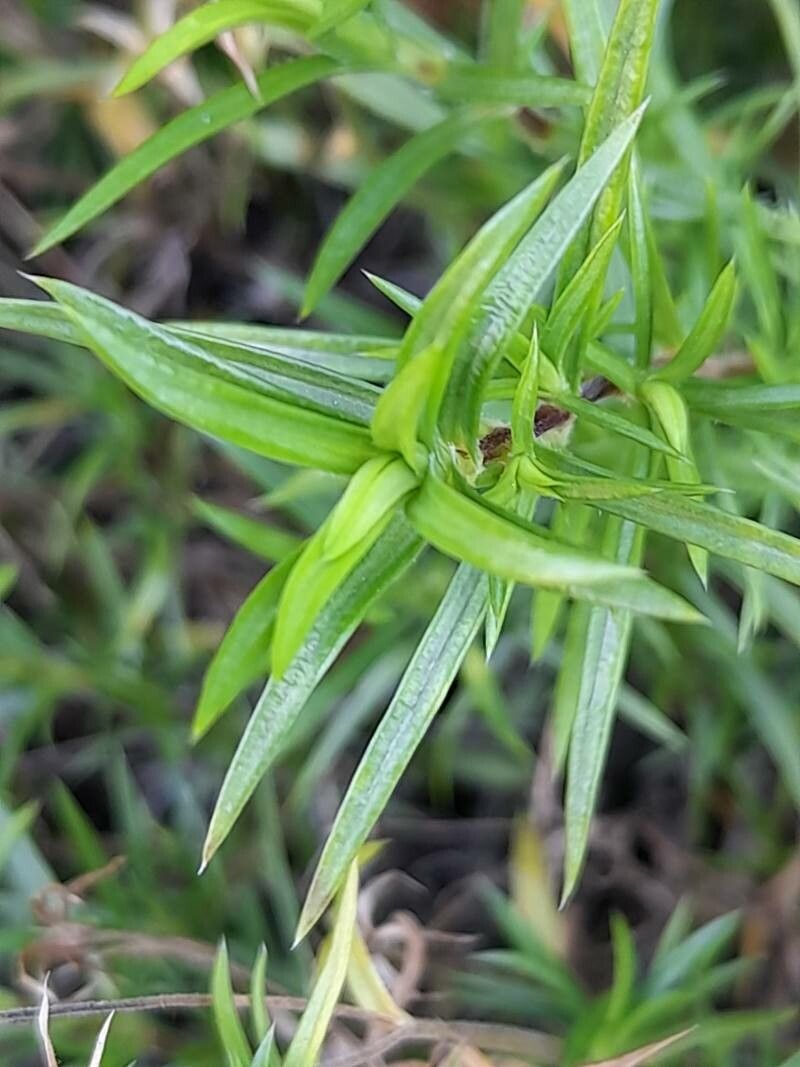
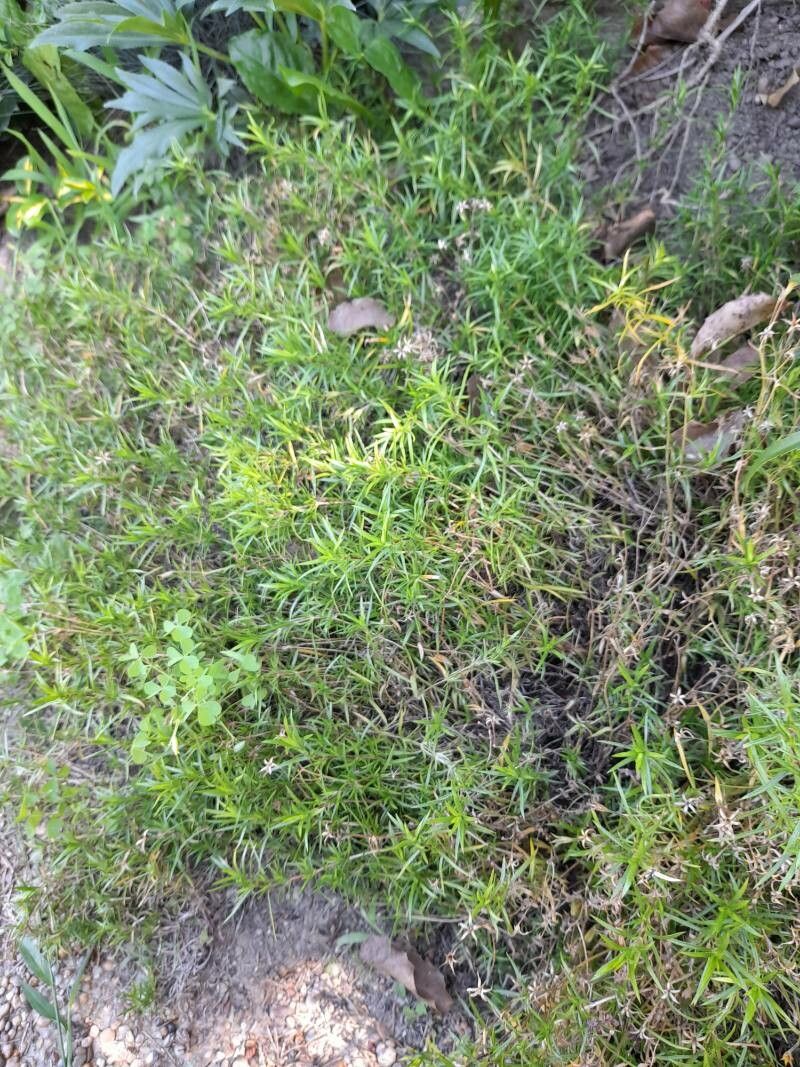
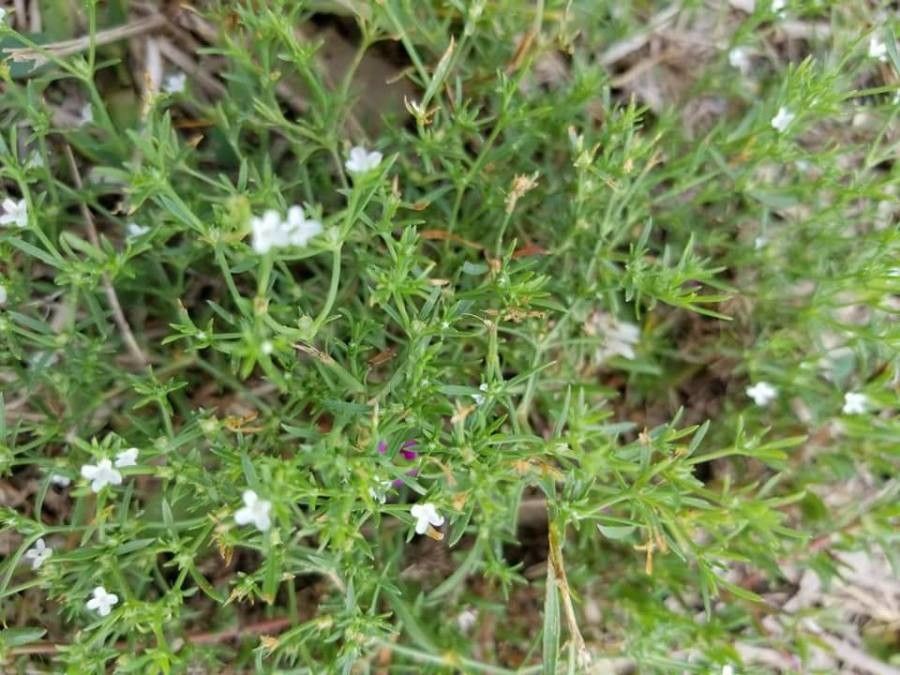
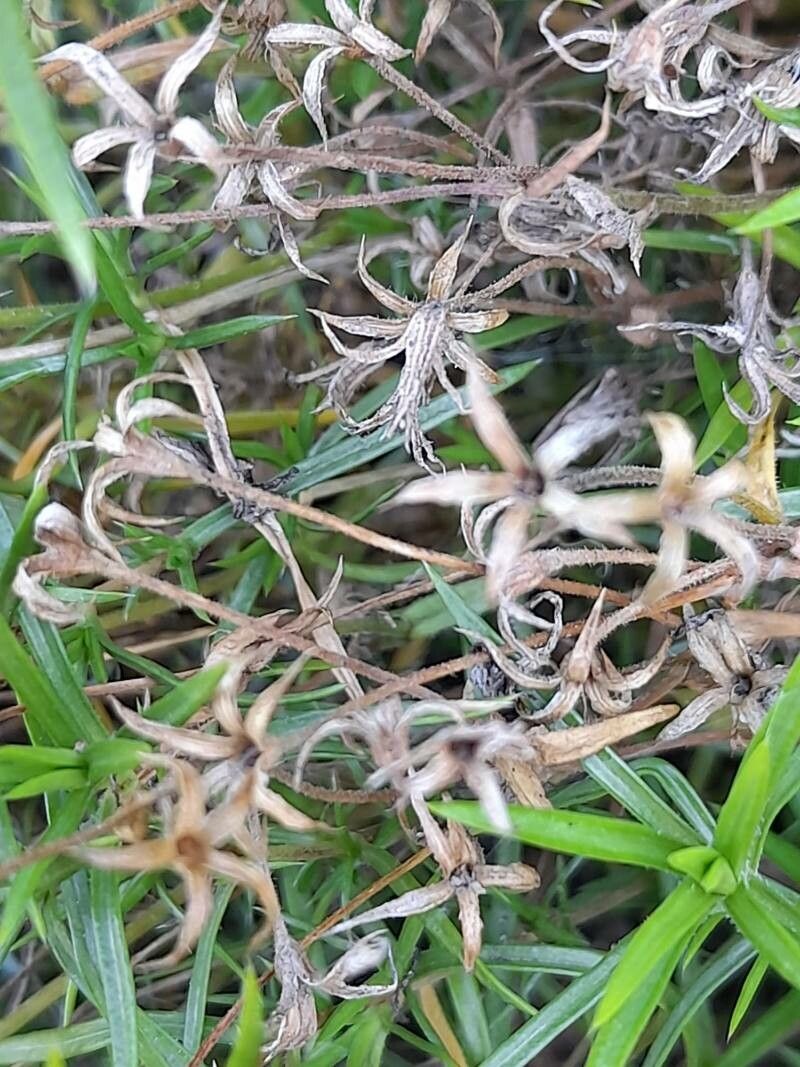
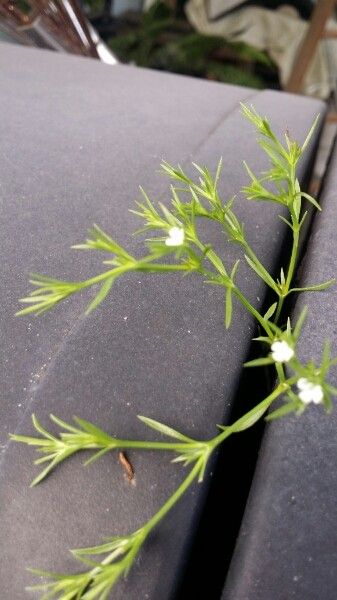
Polypremum is a flowering plant genus in the family Tetrachondraceae. The genus contains the single species Polypremum procumbens, commonly known as juniperleaf or rustweed. Polypremum has also been placed in the various families Buddlejaceae, Loganiaceae, Rubiaceae, and most recently in its own Polypremaceae.P. procumbens is a perennial or annual forb/herb, and grows low with sometimes multiple ascending stems producing small white flowers that bloom in summer and fall. Leaves are opposite, 1–2.5 cm, narrow, and pointed at the end. The foliage turns a brownish red in autumn.P. procumbens is native to eastern USA excluding New England, south to Central America and the West Indies, with occurrences in South America. It has been introduced in the Pacific basin and Australia, often occurring along roads and airstrips. In its southeastern USA range it is common in coastal plain and piedmont regions, growing in disturbed areas, and rare in the mountains.
Juniperleaf has good resistance to disease and generally is not prone to illnesses. However, it can be susceptible to pests and diseases present in its environment. Such infections are typically mild. For care, this plant requires moderate maintenance. It needs regular pruning to maintain a good appearance and healthy growth. Fertilizing can also help encourage flowering. Juniperleaf is suitable for anyone with an outdoor area, like a garden or patio, and does not demand extensive care experience. It may need more attention if grown indoors.
How to keep Polypremum Procumbens.
Light
Juniperleaf does best when it gets abundant light during the day, though it can tolerate short periods of reduced sun. Its native habitats are generally places with strong sunlight. Too little light can inhibit growth, while too much can scorch the leaves.
Water
Juniperleaf is well-suited for arid environments, needing minimal care and only requiring watering once a week. Its drought tolerance makes it perfect for xeriscaping and rock gardens, thriving in temperate regions that experience seasonal dry spells.
Temperature
Juniperleaf is well adapted to its native growing conditions and prefers a temperature range of 68 to 95 °F (20 to 35 ℃). To help it thrive, you may need to adjust temperatures if your local environment is not similar.
Fertilizer
One fertilizer application in spring is generally enough for Juniperleaf, though repeated feedings can boost growth. Apply fertilizer about once every month to month-and-a-half. Feeding improves the leaves’ appearance and function, helping preserve uniform color and a healthy texture. It also promotes root development and nutrient uptake, supporting the plant’s long-term health.
Botanical profile.
- Plant Type
- Herb
- Life Cycle
- Perennial, Annual
- Genus
- Polypremum
- Family
- Tetrachondraceae
- Hardiness Zone
- 3
- Mature Height
- 30 cm
- Mature Spread
- 30 cm to 34 cm
- Leaf Color
- Green
- Leaf Type
- Evergreen
- Flower Color
- White
- Flower Size
- 2.54 cm
- Bloom Time
- Early summer, Mid summer
- Planting Time
- Spring, Summer
- Harvest Time
- Mid summer
- Native Area
- Colombia, Bahamas, Cuba, Honduras, Mexico, Guatemala, Venezuela, El Salvador, Nicaragua, Costa Rica, Jamaica
Other names.
Reader questions.
How should I water my Juniperleaf plant?
When watering the Juniperleaf, it's best to use filtered, room temperature water. Tap water may contain harmful particles, so filtered water is preferred. The Juniperleaf prefers warmer water as it comes from a warm environment, and cold water can be a shock to its system. Additionally, avoid overhead watering to prevent issues with the foliage. Instead, focus on saturating the soil with filtered, room temperature water. This helps moisten the roots and allows them to spread and absorb nutrients from the soil.
What are the sunlight requirements for Juniperleaf?
Juniperleaf requires a considerable amount of sunlight throughout the day to thrive, ideally thriving in full sun conditions, which is defined as receiving more than 6 hours of sunlight daily. It can also tolerate partial sun, meaning it can grow in conditions where it receives about 3-6 hours of sunlight. It’s important to observe the movement of sunlight through your garden to find spots that offer a balance of light and shade, ensuring the plants' growth and health.
What is the ideal growing environment for Juniperleaf?
Juniperleaf, botanically known as Polypremum procumbens, thrives in its native environment and prefers a temperature range of 68 to 95 °F (20 to 35 °C). If you live in an area with different environmental conditions, you might need to adjust the temperature to meet these preferences. Remarkably, Juniperleaf is highly cold-tolerant and does not require additional frost protection measures during winter. However, to aid in its winter survival, it's advised to water the plant generously before the first freeze in autumn. This ensures the soil stays moist and helps prevent drought and water scarcity for the plant during winter and early spring.
What should I do if I give my Juniperleaf plant too much or too little water?
Overwatering and underwatering are both harmful to your Juniperleaf, but overwatering is more common. Too much water can cause the stems and leaves to wilt and turn yellow. It can also lead to diseases such as root rot, mold, and mildew, which can kill the plant. Underwatering is less likely, as the Juniperleaf has good drought tolerance. However, when it happens, the leaves may become brittle and brown. It is important to notice the signs of overwatering early when caring for your Juniperleaf. Some diseases like root rot cannot be fixed if you wait too long. If you see early signs of overwatering, reduce watering immediately. Check the soil drainage and replace it with a well-draining potting mix if needed. If your Juniperleaf shows signs of not enough water, simply increase watering until the signs are gone.
How should I use artificial lighting for indoor Juniperleaf plants?
For indoor Juniperleaf plants, when natural sunlight is insufficient, especially during winter or in spaces that don't receive enough sunlight, artificial lighting is a crucial alternative. LED lights are recommended for their ability to provide specific wavelengths needed by the plants. Full sun plants require 30-50W per square foot, partial sun plants need 20-30W per square foot, and full shade plants should have 10-20W per square foot of artificial light. The artificial light source should be placed 12-36 inches above the plant to mimic natural sunlight conditions, and most plants benefit from 8-12 hours of light per day.
How does Juniperleaf tolerate low temperatures and what should be done in the spring?
Juniperleaf demonstrates extreme cold tolerance, capable of withstanding temperatures down to -35°C without noticeable harm during the winter. However, if temperatures fall below this level, the plant may exhibit decreased sprouting or fail to sprout at all come springtime. To address this, it's recommended to remove any parts of the plant that have failed to sprout in the spring, supporting its recovery and future growth.
How often do I need to give water to my Juniperleaf?
If your Juniperleaf is potted, the most accurate way to determine if it needs water is by inserting your finger into the soil. Once you find that the top two to three inches of soil are dry, it's time to water it. The same method can be used for Juniperleaf plants grown outdoors in the ground. When you notice the top few inches of soil drying out, it's time to provide water. Typically, during spring and early fall, watering once a week using this method is sufficient. However, in very hot weather, you may need to water twice a week or even more frequently. It's worth noting that mature, well-established Juniperleaf plants can handle drought conditions well.
What symptoms indicate Juniperleaf is not receiving enough light?
Symptoms of inadequate lighting in Juniperleaf include small new leaves, leggy or sparse growth, faster leaf drop, slowed or halted growth, pale new leaves, and symptoms of too much light such as chlorosis, sunscald, leaf curling, wilting, and leaf scorching. These indicate the plant is struggling with the light conditions, either getting too much or too little, affecting its health and growth.
What measures should be taken if Juniperleaf is exposed to high temperatures?
Juniperleaf struggles in high temperatures, particularly when the mercury exceeds 35°C. Under such conditions, its growth halts, and the plant becomes prone to rot. To mitigate the adverse effects of high temperatures, it's advisable to trim away any sunburned or dried-up parts of the plant. Relocating the plant to a shaded area, especially from the midday and afternoon sun, or using a shade cloth can provide much-needed relief. Additionally, watering the plant in the morning and evening helps keep the soil moist and supports the plant's wellbeing in extreme heat.
How much water does my Juniperleaf plant require?
To properly water your Juniperleaf, you should not hold back on the amount of water you use. Make sure the top two to three inches of soil are dry before watering. It's best to give the plant a good, deep watering so that the soil becomes completely saturated. Make sure to add enough water to cause excess water to drain out from the bottom of the pot. If you don't see any excess water draining, it means you haven't watered enough. However, make sure you don't let the water accumulate in the soil as this can be harmful to the plant. On the other hand, if water doesn't drain properly from the pot, it could indicate that the soil doesn't drain well, which is bad for the plant's health. If your Juniperleaf is outdoors, about 1 inch of rainfall per week will be enough.
What are the solutions for Juniperleaf receiving inadequate sunlight?
To address insufficient sunlight for Juniperleaf, gradually move the plants to sunnier spots, ensuring they receive at least 6 hours of sunlight daily. If indoors and moving the plant isn't feasible, consider using artificial light, keeping it on for at least 8 hours a day. For outdoor plants, avoid sudden changes in sunlight exposure to prevent sunburn. If obstructions block natural light, consider pruning or transplanting the plant to a location with more sunlight, especially during its dormant period. Note that while parts of the plant damaged by inadequate light may not recover, new growth following increased light exposure should be healthy.
How should I water my Juniperleaf at different times that it is growing?
The water needs of the Juniperleaf can vary depending on its growth stages. In the early years or when you just moved it to a new location, more water than usual is required. During this period, the Juniperleaf focuses on growing new roots, which need more moisture to support future growth. As the plant matures, it will require less water. Additionally, during the blooming period, extra water may be necessary as flower development utilizes a significant amount of moisture.