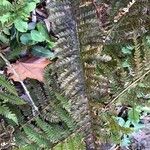
Polystichum aculeatum
Hard shield-fern · Prickly shield fern · Prickly fern · Pricky Fern
Description
Source: leafsnapPolystichum aculeatum, the hard shield-fern, is an evergreen fern native to Europe. It is most abundant in upland regions of the British Isles and western France, where it benefits from the combination of mild winters and moist summers, but also occurs more locally across most of Europe except northern Scandinavia, northern Russia; in the Mediterranean region it is confined to high altitudes. It grows on steep slopes in woodlands. it is sometimes considered an indicator of the presence of ancient woodlands. The glossy dark green fronds are 30–90 cm long, usually drooping downslope, with typically 3-8 fronds on a mature plant. The fronds are stiff and hard-textured, bipinnate (single-pinnate on small, young plants), with the pinnae opposite on the stalk. Each pinna is 3–11 cm long, with a large upward-pointing pinnule at the base, and the other pinnules decreasing in size toward the pinna tip; the pinnules have bristly tips. Individual fronds live for 1.5-2.5 years and remain attached to the rhizome after withering. The round sori occupy two rows on either side of the midrib of each pinnule and are covered by a centrally-attached, umbrella-like indusium with fringed edges. They produce light yellow spores. The Latin specific epithet aculeatum means “bristly”.Polystichum aculeatum is grown as an ornamental plant in gardens, and has gained the Royal Horticultural Society’s Award of Garden Merit.
Care Guide
💧 Water
The hard shield fern flourishes in the moist undergrowth of temperate forests and requires soil that stays consistently damp. To keep its foliage lush, water it twice a week. If you're growing it indoors, higher humidity levels will promote its health. For container gardening, choose a well-draining potting mix that also retains moisture, catering to the fern's natural preferences.
What do I do if I give my Hard shield fern too much or too little water?
The Hard shield fern can be overwatered if you leave it in standing water or use a planter without drainage holes. This can cause the roots to be unable to absorb nutrients and moisture and can lead to fungal or bacterial diseases. Signs of overwatering include wilted and yellow leaves, drooping or soft stems. However, it's important to check for other causes of these symptoms since overwatering is hard to do with this plant. On the other hand, the Hard shield fern can also be underwatered if not monitored closely. In dry conditions, the appearance of the plant can rapidly change from lush and green to brown and crispy. In extreme cases, the plant may seem completely dried out, but if some roots are still healthy, there is a chance to save it. To do this, remove all dry and dead stems, water thoroughly, and place the plant back in its usual location. Although it may take several months, with proper care, the fern can recover and grow new fronds.
How do I water my Hard shield fern the right way?
To keep your Hard shield fern happy and healthy, it's important to provide consistently moist soil that resembles its natural environment. This may require watering every one or two days, as this plant should not be allowed to dry out. Once you notice even a slight dryness on the top layer of soil, it's time to water again. Make sure to thoroughly soak the soil until water drains out from the bottom of the pot. Afterward, remember to remove any excess water to prevent the pot from sitting in a puddle. Following this method will effectively prevent the soil from becoming too dry.
What do I need to think about when watering my Hard shield fern?
The frequency of watering your Hard shield fern depends on the humidity level in the air. Higher humidity means watering less often because evaporation is slower. Avoid placing the fern near heating or cooling vents as this can cause it to dry out quickly; instead, choose a location protected from drafts. They thrive in dappled and indirect sunlight and prefer temperatures between 55-80 degrees F (13-27 degrees C). Avoid placing them in a warm and sunny spot on a windowsill as this can dehydrate them quickly. Rainwater or distilled water is ideal for this plant, but tap water works fine in most places. Tap water may contain minerals and chemicals that can lead to brown leaf tips, especially since Hard shield fern has delicate leaves. Small pots can cause problems because they hold less potting medium and dry out faster. It's best to give this plant more space in the pot compared to other houseplants. Consider using a self-watering planter for your Hard shield fern. These pots have a wicking system that continuously soaks up water from a central reservoir, ensuring consistent moisture in the soil. This not only saves you from frequent watering but also provides a constant water supply for the roots, which is beneficial compared to the cycle of dry and wet soil.
☀️ Light Full shade
The hard shield fern grows best in moderate sunlight, showing healthy development. It is also capable of surviving in low light, which underscores its adaptability. Native to forested habitats, it is accustomed to dappled light and can languish or display poor growth when exposed to excessive light.
What are the sunlight requirements for Hard Shield Fern?
Hard Shield Fern thrives in partial sun to full shade conditions, preferring about 3-6 hours of sunlight for partial sun and less than 3 hours of sunlight for full shade. It's crucial to observe how sunlight moves through your garden to select optimal spots that offer a balanced light and shade environment for the plants, ensuring their growth and well-being.
Can Hard Shield Fern grow under artificial lighting?
Yes, Hard Shield Fern can grow under artificial lighting, especially when natural sunlight is insufficient, such as during winter or in spaces with less sunlight. Artificial lights, including LED lights, can be tailored to provide specific wavelengths needed by the plants. For full sun plants, 30-50W/sq ft of artificial light is recommended, partial sun plants need 20-30W/sq ft, and full shade plants should have 10-20W/sq ft. The light source should be placed 12-36 inches above the plant for about 8-12 hours per day to mimic natural sunlight conditions.
What are the symptoms of light deficiency in Hard Shield Fern?
Symptoms of light deficiency in Hard Shield Fern include smaller new leaves, leggy or sparse growth, faster leaf drop, slower or no new growth, and lighter-colored new leaves. These symptoms indicate inadequate light exposure, essential for the plant's growth and health. Conversely, excessive sunlight can cause chlorosis, sunscald, leaf curling, wilting, and leaf scorching, demonstrating the plant's need for a balanced light environment.
How can I address insufficient sunlight for my Hard Shield Fern?
To address insufficient sunlight, gradually move Hard Shield Fern to sunnier spots each week to enable adaptation to new light conditions, aiming for 3-6 hours of direct sunlight daily. If the plant is large or not easily movable, use artificial light like desk or ceiling lamps for at least 8 hours daily or invest in professional plant grow lights. For outdoor plants, avoid sudden light intensity changes to prevent sunburn. Reducing tree branch obstructions or transplanting smaller plants during their dormant period are also effective strategies for enhancing sunlight exposure.
🌡️ Temperature 5–32.2°C
Hard shield fern is native to environments with temperatures from 41 to 89.6 °F (5 to 32 ℃). Although it does best within that range, during hotter seasons it may need cooler, shaded placements.
What is the indigenous environment of the Hard Shield Fern?
The Hard Shield Fern is indigenous to environments where temperatures range from 41 to 89.6 °F (5 to 32 °C). It thrives best within this temperature range, favoring cooler, shaded areas during the hotter seasons to maintain its health.
Does the Hard Shield Fern require frost protection measures during winter?
The Hard Shield Fern has strong cold resistance and usually does not require special frost protection measures during winter. However, in extreme conditions where winter temperatures are expected to drop below -30°C, it is important to provide cold protection by covering the plant with soil or straw. Additionally, abundantly watering the plant before the first freeze in autumn, ensuring the soil is moist entering a frozen state, helps prevent drought and water scarcity for the plant during winter and early spring.
How does low temperature affect Hard Shield Fern and what are the solutions?
Hard Shield Fern is cold-tolerant and thrives best when the temperature is above 5°C. During winter, it should be kept above -25°C. When the temperature falls below -30°C, there may not be noticeable changes during the winter; however, there may be a decrease in sprouting or even no sprouting during springtime. As a solution, in spring, any parts that have failed to sprout should be removed to help the fern recover.
How does high temperature affect Hard Shield Fern and what are the solutions?
During summer, Hard Shield Fern should be kept below 32°C. Exceeding 35°C can cause the leaves to become lighter in color, prone to curling, and more susceptible to sunburn. To counteract this, sunburned and dried-up parts should be trimmed away. Moving the plant to a location providing shade during the midday and afternoon sun, or using a shade cloth, can protect it. It's also important to water the plant in the morning and evening to keep the soil moist.
💨 Humidity
🪴 Soil 5-7
🌱 Fertilizer
Why should I add fertilizer to my Hard shield fern?
The reason why it is important to fertilize Hard shield fern is straightforward. By providing your plant with extra nutrients, you help promote healthy new growth. Additionally, these additional nutrients also contribute to the well-being of older growth and can boost your plant's resilience against diseases and pests.
When should I fertilize my Hard shield fern?
The feeding schedule of the Hard shield fern depends on its location. It is not a very demanding plant but still needs some extra nutrients. Outdoor plants should be fertilized once in the spring, while indoor plants require monthly feeding from spring to summer.
When should I not fertilize my Hard shield fern?
To ensure optimal growth of the Hard shield fern, it is important to follow these guidelines for fertilization. Firstly, avoid fertilizing after early autumn as excessive growth before winter can be detrimental. Secondly, refrain from fertilizing during hot and dry periods as the effectiveness of fertilizer in dry soil is limited, and this can lead to increased growth that will require additional water which may not be available. Instead, it is advisable to apply fertilizer earlier in the season when temperatures are cooler. Lastly, be cautious of inadvertently providing the ferns with a double dose of fertilizer, as they can absorb any nearby applied fertilizer, making it best to exercise care when fertilizing nearby plants or lawns.
What kind of fertilizer does my Hard shield fern need?
When choosing a fertilizer for Hard shield fern, you have a few options depending on whether the plant is growing indoors or in the garden. For outdoor plants, using mulch or compost will help them thrive. For indoor plants, an ideal fertilizer would have an N-P-K ratio of 3-1-2. However, in some cases, a general-purpose fertilizer with an even blend of nutrients can also work well. Regardless, when using a balanced fertilizer, the ratio number representing the volume of each nutrient should be at 3 or lower.
How should I put fertilizer on my Hard shield fern?
To fertilize Hard shield fern, the method will vary depending on its location. For outdoor garden plants, it is beneficial to add a layer of mulch or compost to the soil, making sure to place it around the base of the plant. On the other hand, for indoor plants, it is best to use a diluted liquid fertilizer before watering. This should be done monthly during the spring and summer seasons.
🪴 Pot & Repot
✂️ Pruning
The hard shield fern has evergreen fronds and can tolerate low light conditions. To promote healthy growth, prune it in early spring by removing any dead fronds. Be careful not to trim too much, as this can stress the plant; always use clean tools to minimize the risk of infection. Regular pruning helps maintain the plant's vigor and prevents it from becoming overcrowded.
🌿 Propagating
🐛 Diseases & pets
☠️ Toxicity
Characteristics
- Plant Type
- Fern
- Life Cycle
- Perennial
- Genus
- Polystichum
- Family
- Polypodiaceae
- Hardiness Zone
- 4-8
- Mature Height
- 61 cm
- Mature Spread
- 49 cm
- Leaf Color
- Green
- Leaf Type
- Evergreen
- Planting Time
- Spring, Summer, Autumn
- Native Area
- Turkey, Sweden, Austria, Slovakia, Montenegro, Slovenia, Morocco, Croatia, Belarus, Russia, Germany, Estonia, Romania, Latvia, Belgium, Netherlands, France, Tajikistan, Czech Republic, Bulgaria, Armenia, Poland, Greece, Ukraine, Lebanon, Serbia, Lithuania, Norway, China, Kyrgyzstan, Italy, Spain, Switzerland, Denmark, Iran, Albania, Ireland, United Kingdom, Hungary, Algeria, Azerbaijan