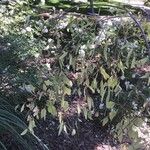
Populus euphratica
Euphrates poplar · Indian poplar · Charab poplar
Description
Source: leafsnapPopulus euphratica, commonly known as the Euphrates poplar, is a deciduous tree species belonging to the Salicaceae family. Native to the arid regions of Central Asia and Western China, this tree has remarkable adaptations to survive harsh environmental conditions such as drought, salinity, and extreme temperatures. The Euphrates poplar can reach heights of up to 30 meters, with trunk diameters extending up to 2 meters. It features a broad crown with thick branches that provide substantial shade during hot summers. The leaves are triangular and have serrated edges; they are green on the top side and pale underneath. Ecologically, the Euphrates poplar plays a crucial role by providing habitat for various wildlife, including birds, insects, and mammals. Its roots help stabilize riverbanks, preventing soil erosion, while its leaves offer food for herbivores. Beyond its ecological importance, Populus euphratica holds cultural significance for local communities, who utilize its wood for fuel and building materials. The tree's bark contains medicinal properties that traditional healers use to treat various ailments, such as fever and diarrhea. However, human activities such as dam construction and overgrazing have significantly reduced its population in recent years, making it an endangered species. Conservation efforts from governments and organizations are essential to protect and preserve this valuable tree.
🎭 Cash, Flying
Care Guide
💧 Water Every 7 days
The Euphrates poplar is well-suited for arid regions and can thrive with minimal water. Its deep root system allows it to be watered only once every three weeks. As a hardy outdoor species, it efficiently conserves water, making it an excellent choice for xeriscaping in harsh climates.
☀️ Light Full sun
The Euphrates poplar does best when it receives plenty of sunlight, which encourages optimal growth. The quality of light greatly affects its health and development at every growth stage. Coming from areas with abundant sunshine, this species is not negatively affected even by very strong light, while a lack of light can stunt its growth.
What are the sunlight requirements for Euphrates poplar?
Euphrates poplar requires full sun conditions to thrive, which means it needs more than 6 hours of direct sunlight daily. It can also tolerate partial sun, with about 3-6 hours of sunlight. It's important to observe your garden's sunlight patterns to choose spots that provide the right balance of light and shade, ensuring your Euphrates poplar's health and happiness.
How does sunlight affect the growth of Euphrates poplar?
The growth and health of Euphrates poplar are significantly influenced by sunlight. Originating in environments with abundant sunlight, it thrives in conditions that offer ample sunshine, which fosters optimal growth. Insufficient light may stunt the plant's growth, indicating the crucial role of light quality in its development through various growth stages. In indoor settings or less sunny spaces, artificial lighting, such as LED lights with specific wavelengths, can be used to provide the necessary light intensity and duration to promote healthier growth.
What symptoms indicate insufficient sunlight in Euphrates poplar?
When Euphrates poplar does not receive enough sunlight, it may exhibit symptoms such as smaller new leaves, leggy or sparse growth, faster leaf drop, slower or no new growth, and lighter-colored new leaves or chlorosis. Chlorosis, sunscald, leaf curling, wilting, and leaf scorching are also signs, with chlorosis resulting from excessive sunlight leading to a breakdown of chlorophyll, affecting photosynthesis. These symptoms highlight the plant's need for adequate sunlight and its reaction to varying light conditions.
How can you provide adequate sunlight to Euphrates poplar?
To ensure Euphrates poplar receives enough sunlight, gradually move the plant to a sunnier location, ensuring it gets at least 6 hours of direct sunlight daily. Utilize south-facing windows for indoor plants and keep curtains open to maximize light exposure. For additional support, especially for large or immovable plants, consider artificial lights, keeping them on for about 8-12 hours daily. Outdoors, gradually acclimate your plants to avoid sunburn. Pruning obstructive branches, or transplanting smaller plants to sunnier spots, can also increase sunlight exposure. Note that some damage from insufficient light may be irreversible, but new growth should be healthy with improved light conditions.
🌡️ Temperature 0–25°C
Euphrates poplar originates from temperate areas with temperatures between 32 and 77 °F (0 to 25 ℃). It prefers that range but can adapt as seasons shift.
What is the native temperature range for Euphrates poplar?
The Euphrates poplar, or Populus euphratica, is native to temperate regions and thrives in a temperature range of 32 to 77 °F (0 to 25 °C). This tree is well-adapted to these temperatures but is capable of adjusting to varying conditions across different seasons.
How do you protect Euphrates poplar in winter?
Euphrates poplar is exceptionally cold-tolerant and doesn't require specific frost protection measures during the winter. However, it's advised to water the plant generously before the first freeze of autumn. This practice helps ensure the soil stays moist when it freezes over, mitigating the risks of drought and water scarcity for the plant during the winter and early spring months.
What should you do if the winter temperature drops below -40°C for Euphrates poplar?
Although the Euphrates poplar is highly cold-tolerant, winter temperatures dropping below -40°C may not show immediate effects, but come spring, branches may turn brittle and dry, failing to produce new shoots. To address this, prune away any dead branches that have not produced new leaves in the spring.
How does Euphrates poplar react to temperatures above 25°C?
The Euphrates poplar struggles with high temperatures above 25°C, potentially leading to significant leaf drop. In extreme cases, the plant might even wither and die. To combat this, trim away sunburned and dried-up parts. Consider moving the plant to a shaded area or using a shade cloth to protect it from the harsh midday and afternoon sun. Ensure the plant is watered in the morning and evening to keep the soil consistently moist.
💨 Humidity
🪴 Soil 6-7
🌱 Fertilizer
Fertilize your Euphrates poplar in early spring to encourage healthy growth. Regular fertilization boosts overall health, producing vigorous growth, greater tolerance of harsh conditions, and enhanced resistance to diseases and pests. Keep to a set fertilization schedule for your Euphrates poplar to maintain foliage that is vibrant, deeply colored, and lush in appearance.
🪴 Pot & Repot
✂️ Pruning
Prune Euphrates poplars in early spring, concentrating on removing dead or diseased branches. Additionally, thin out the branches to improve air circulation. Make clean cuts to prevent disease and support healthy growth, which will also enhance the tree's structure and encourage the development of new shoots. For more detailed pruning techniques, refer to the Royal Horticultural Society's guidelines.
🌿 Propagating
🐛 Diseases & pets
☠️ Toxicity
Characteristics
- Plant Type
- Tree
- Life Cycle
- Perennial
- Genus
- Populus
- Family
- Salicaceae
- Hardiness Zone
- 2-5
- Mature Height
- 14.94 m
- Mature Spread
- 10.06 m to 14.94 m
- Leaf Color
- Green, Dark Green
- Leaf Type
- Deciduous
- Flower Color
- Red, Brown
- Flower Size
- 2.54 cm to 5.08 cm
- Bloom Time
- Early spring, Mid spring
- Planting Time
- Spring
- Harvest Time
- Late spring, Early summer
- Native Area
- Tajikistan, Turkey, India, Egypt, Pakistan, Morocco, China, Uzbekistan, Afghanistan, Iraq, Syria, Kyrgyzstan, Kazakhstan, Mongolia, Iran, Azerbaijan, Algeria, Turkmenistan