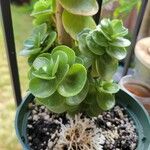
Portulaca molokiniensis
'ihi · Ihi
Description
Source: leafsnapPortulaca molokiniensis, known also as 'ihi, is a succulent plant endemic to Hawaii. This plant is federally listed as an endangered species. It has small yellow flowers and when grown from seed may produce a caudex. This plant is easy to propagate. This rare species of Portulaca is restricted to a few coastal sites on Molokini Island (Maui), Puʻukoaʻe Islet and Kamōhio Bay, Kahoʻolawe. It is known to grow in volcanic tuff, detritus at base of sea cliff and on steep rocky slopes from about 30 to about 375 feet. Portulaca molokiniensis is a rare endemic to the Hawaiian islands where it known to grow in loose volcanic scree on steep slopes and in sand near the seaside on the arid islets of Molokini and Pu'ukoa'e and at Kanhio Bay on Kaho'olawe off the west coast of Maui. Though many think of the Hawaiian islands as lush and moist, the collection sites on these islands are on the leeward, rainshadow side and are extremely dry. Though this plant was first collected by Charles N. Forbes on Molokini in February 1913, it was identified as Portulaca lutea, a plant more widely distributed throughout the Pacific islands. It was collected once again as Portulaca lutea in the 1920s and then not documented again until collections made in the late 1970s and early 1980s where the distinctiveness of the plant was noted and it was officially described as a new species by Hawaii forester Bob Hobdy in 1987.
🌳 Although uncommon, ihi is frequently sought for ornamental cultivation, likely because of its distinctive, attractive growth habit and structure. Horticulturists appreciate ihi for its rosette shape and fleshy leaves, which enhance the appearance of drought-resistant landscapes. Growing it draws attention to conservation needs and to sustainable horticultural practices that could act as a model for propagating other rare species. It has not been widely recognized for uses beyond ornamentation.
Care Guide
💧 Water Every 2-3 weeks
Ihi, a plant native to Hawaii's arid climate, is highly drought-tolerant and can thrive with minimal watering every 2-3 weeks. It prefers dry, well-draining soil, making it ideal for rock gardens or xeriscapes. This helps prevent excessive moisture from accumulating around its roots.
☀️ Light Full sun
Ihi thrives when exposed to plentiful light, which is essential for its healthy development. Its natural habitat receives ample sunshine, reflecting its adaptation to those conditions. Receiving less light can cause it to grow more slowly, while providing more light than it needs offers no benefit.
What are the sunlight requirements for Ihi (Portulaca molokiniensis)?
Ihi requires full sun, which means it should be placed in locations that receive above 6 hours of sunlight daily. Alternatively, it can thrive in partial sun with about 3-6 hours of sunlight. Observing the movement of sunlight through your garden is crucial to finding the perfect spots that provide a balance of light and shade, ensuring the plants' well-being.
Why is light essential for Ihi's growth, and what solutions are available for insufficient natural light?
Light is essential for Ihi's growth because it mirrors its natural habitat, which is bathed in plenty of sunlight. Insufficient light results in slow growth, but exceeding the required light is not beneficial either. For indoor plants lacking natural sunlight, especially during winter or in less sunny spaces, artificial lighting serves as an excellent alternative. Artificial lighting such as LED lights can be customized to provide specific wavelengths needed by plants, promoting healthier, faster growth. For full sun plants, 30-50W/sq ft of artificial light is recommended, for partial sun plants, 20-30W/sq ft, and for full shade plants, 10-20W/sq ft. The light source should be placed 12-36 inches above the plant for 8-12 hours per day to mimic natural light conditions.
What symptoms indicate inadequate lighting for Ihi, and what are its consequences?
Symptoms of inadequate lighting for Ihi include smaller leaves, leggy or sparse growth, faster leaf drop, slower or no new growth, and lighter-colored or yellowing leaves (chlorosis). Excessive sunlight can lead to sunscald, leaf curling, wilting, and leaf scorching. These symptoms suggest that the plant is either not getting enough light or is receiving too much, affecting its ability to photosynthesize and maintain overall health. Adjusting the plant's exposure to light, whether by moving it to a sunnier spot or employing artificial lighting, can address these issues.
What solutions can be applied to remedy light-related growth issues in Ihi?
To address light-related growth issues in Ihi, gradually moving the plant to a location with at least 6 hours of direct sunlight daily is advised. If moving the plant isn't feasible, using a desk, ceiling lamp, or professional grow lights for at least 8 hours a day can provide additional light. For outdoor plants, avoid sudden changes in light intensity to prevent sunburn. Minimizing obstructions to sunlight, such as by pruning trees, and transplanting to better-lit areas during the plant's dormant period, can also help. It's important to note that parts of the plant already affected may not recover, but new growth should be healthy after improving light exposure.
🌡️ Temperature 20–37.8°C
Native to less tropical regions, ihi flourishes at 68 to 100 ℉ (20 to 38 ℃). Because temperatures shift through the year, moderate adjustments can help sustain optimal growth conditions. Consider providing supplemental heat during colder seasons.
What is the ideal temperature range for growing Ihi?
The ideal temperature range for growing Ihi (Portulaca molokiniensis) is between 68 to 100°F (20 to 38°C). This heat-loving plant prefers less tropical environments and requires moderate adjustments in care as temperatures fluctuate throughout the year to maintain ideal growth conditions. It's important to provide supplemental heat during the colder seasons to ensure the plant continues to thrive.
What should I do with my Ihi plant when the temperature drops below freezing?
When the outdoor temperature drops below 0°C, it is crucial to move your Ihi plant indoors to protect it from the cold. Choose a location near a south-facing window to maximize sunlight exposure, which is vital for the plant's health during colder months. If natural light is insufficient, consider using supplemental lighting to keep your Ihi plant healthy. Additionally, reduce or stop watering if the temperature falls below 20°C to prevent root rot, especially for Ihi plants grown outdoors. In extreme cases, covering the plant with plastic film or fabric for insulation, or even setting up a temporary greenhouse, can provide additional protection against low temperatures.
What are the symptoms of Ihi being exposed to temperatures too low or too high?
Ihi plants show distinct symptoms when exposed to temperatures outside their ideal range. Low temperatures below 20°C can slow the plant's growth, and exposure to temperatures below 0°C may lead to the plant becoming weak, wilting, and being prone to root rot. In extreme cases, exposure to temperatures below -5°C can cause significant damage without immediate symptoms, leading to gradual withering after a week. High temperatures above 43°C can also harm the plant, resulting in ceased growth,water loss, wilting, and increased susceptibility to sunburn.
How should I care for my Ihi plant if it has been damaged by frost or high temperatures?
If your Ihi plant has been damaged by frost, trim off the frostbitten areas and check for root rot. If root rot is present, cut off the rotted roots, and consider propagating the plant through cuttings. Move the plant to a warm, indoor environment near a south-facing window for ample sunlight, using supplemental lighting if necessary. In case of damage from high temperatures, remove sunburned and rotten parts and shield the plant from direct afternoon sunlight until it recovers. If root rot has occurred, cease watering until new roots develop to help the plant recover.
💨 Humidity
🪴 Soil 6-7
🌱 Fertilizer
For Ihi, light applications of fertilizer once or twice a year during the growing season are adequate. Do not fertilize in winter or summer when it is dormant. Use less fertilizer on repotted plants and wait a couple of months after repotting before feeding. Fertilizing promotes healthy growth and encourages blooms.
🪴 Pot & Repot Every 2 years
Ihi thrives best in a snug pot, which helps promote its bushy growth. It's recommended to repot every two years in the spring, using a container that is slightly larger and offers good drainage. After you have repotted the plant, place it in bright light and refrain from watering for a week. This waiting period helps the roots recover, ensuring the plant remains healthy.
✂️ Pruning
To maintain its ornamental value, the Ihi plant requires timely pruning throughout the growing season. This involves removing any crossed or dense branches. In late fall, pruning away old leaves can improve ventilation. During repotting, it is crucial to trim any rotten or weak roots.
🌿 Propagating
🐛 Diseases & pets
☠️ Toxicity
This plant is considered toxic to animals and should be kept out of their reach. It is recommended that you keep this succulent away from the reach of young children too.
Characteristics
- Plant Type
- Herb
- Life Cycle
- Perennial
- Genus
- Portulaca
- Family
- Portulacaceae
- Hardiness Zone
- 9-11
- Mature Height
- 25 cm
- Mature Spread
- 15 cm
- Leaf Color
- Green
- Leaf Type
- Evergreen
- Flower Color
- Yellow
- Flower Size
- 2.03 cm to 3.05 cm
- Bloom Time
- Late spring, Early summer, Mid summer
- Planting Time
- Spring, Summer, Autumn
- Harvest Time
- Mid summer, Late summer
- Native Area
- Hawaii